Author: Makkleod

  • European Defense Stocks 2026: The Rotation Inside the Drop

    European Defense Stocks 2026: The Rotation Inside the Drop

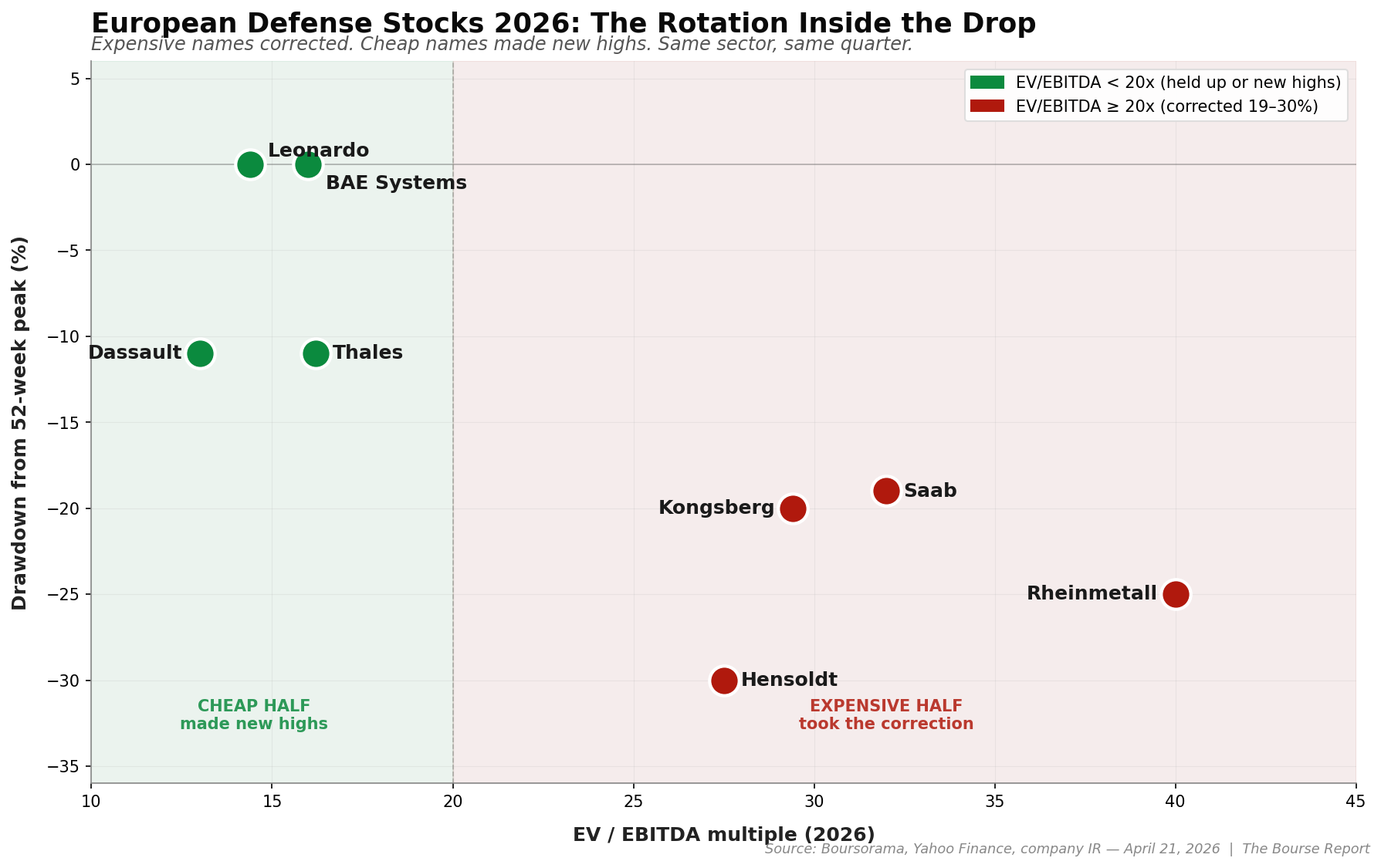
    European defense stocks 2026 broke apart into two very different groups inside the same basket. Rheinmetall traded at €2,008 on March 3. Today it trades at €1,495, a 25% fall from peak in seven weeks. Saab is down 19% from its January high. Hensoldt is 30% off its peak. Dassault and Thales are both 11% below their own recent highs.

    Over the same window, BAE Systems hit a new 52-week high and is up 31.6% year to date. Leonardo is up 30.4% and is trading near its 52-week high too. Same sector, same tailwinds, same quarter. The spread between the worst and the best performer inside the European defense basket is now close to 60 percentage points.

    The story in the press is that European defense stocks “corrected” in March. That framing is lazy. What happened is a surgical rotation. The market sold the expensive names with the biggest 2024-25 rallies, and kept buying the cheaper names with direct exposure to the parts of defense spending that are now accelerating: sensors, electronics, missiles, counter-drone systems. That dispersion, not the headline direction, is the only thing worth trading in this sector right now.

    My thesis in one sentence: the European defense trade is no longer a beta call, it is a dispersion call, and the map below tells you where the money is already moving.

    The one variable that matters: valuation dispersion

    Across European defense stocks in 2026, the cheapest name in the basket trades at 14.4x EV/EBITDA. The most expensive trades at roughly 40x. Same sector, same order book story, nearly 3x differential. That is the single number that explains the entire 2026 tape.

    Here is what the multiples look like, dated April 21, 2026:

    NameTickerFwd P/EEV/EBITDABacklog / RevYTD 2026From 52-wk peak
    LeonardoLDO.MI~27x TTM14.4x2.4x+30.4%near high
    ThalesHO.PA24.8x16.2x1.6x~flat-11%
    BAE SystemsBA.L23.5x~16x TTM3.0x+31.6%at high
    HensoldtHAG.DE42-48x25-30x3.6x+9.6%-30%
    KongsbergKOG.OL~41x29.4xn/v~-6%-20%
    SaabSAAB-B.ST46.4x30-34x2.6x~flat-19%
    RheinmetallRHM.DE36-38x~40x6.4x+20%-25%
    Dassault Av.AM.PA20.6xn/v6.3x~flat-11%

    Two things jump out of that table, and only two.

    First, the three cheapest names on EV/EBITDA (Leonardo 14.4x, Thales 16.2x, and BAE on forward P/E 23.5x) are the three names that either held up or made new highs in 2026. The three most expensive names on EV/EBITDA (Saab 30-34x, Hensoldt 25-30x, Rheinmetall ~40x) are the three names that took the biggest hits from their peaks. That is not a coincidence, and it is not a “risk-off” pattern. It is the market re-pricing how much of the structural rearmament story was already in the multiple.

    Second, the backlog-to-revenue ratios are not the differentiator. Rheinmetall (6.4x) and Dassault (6.3x) both have enormous order books, and they performed differently. Leonardo (2.4x) has a lower ratio but converted better in 2025 and rallied. The dispersion is not about visibility, it is about what investors are willing to pay for the same visibility.

    The pullback was surgical, not sector-wide

    If this were a generic sector correction, everything would have fallen together. It did not. The MSCI Europe Aerospace and Defence index fell 9.2% in March, its worst month in five years, and that number is accurate at the index level. But inside the index, the pain concentrated in three specific names, and BAE plus Leonardo ran the other way.

    Look at the peak dates. Rheinmetall topped out March 3. Saab topped out January 19. Hensoldt topped out February. In every case, the peak was set before the Iran war ceasefire on April 8 and before the Ukraine deal headlines on April 10. So the correction cannot be blamed on those events. Those events accelerated a move that had already started inside the expensive half of the basket.

    The Reuters and Invezz analysis pin the pullback on three overlapping drivers: profit-taking after a parabolic 2024-25, stretched forward multiples (sector peaked at ~29x forward P/E), and a shift in narrative around what “future defense spending” actually buys. The third driver is the one I think matters most, and it is the one that explains why the dispersion came out this way instead of the reverse.

    Demand is shifting inside defense, not adding on top

    The structural rearmament story is still in place. Every NATO member except Spain signed onto the 5% of GDP target by 2035 at the Hague summit in 2025 (3.5% core defense, 1.5% security-related). Germany’s 2026 defense budget sits at €117.2 billion with a path to €162 billion by 2029. France is at €68.5 billion in 2026 and targeting 3.5% of GDP beyond. Those numbers are not in question.

    What changed is where the money goes inside that envelope. The Ukraine war and the Iran war together delivered a lesson that European procurement chiefs now state openly: modern combat is fought with thousands of cheap drones and layered sensor networks, not dozens of expensive legacy platforms. Ukraine burns ~9,000 drones per day. Iran produces ~400 Shahed drones per day. The price per unit on those weapons runs from hundreds to a few thousand euros. That is not a narrative, it is a unit economics fact.

    Europe is responding with a specific redistribution. France committed €8.5 billion to multiplying drone and missile stocks by 400% before 2030. Germany committed €10 billion specifically to military drones. The EU launched the European Drone Defence Initiative with over €1 billion of R&D, targeted at a 360-degree counter-drone shield by 2027. Bank of America’s European defense team publicly rotated its top picks toward missile, drone, and counter-drone technology in Q1.

    Match that to the company mix. Thales makes defense electronics, radars, missile systems, and cyber. Leonardo owns MBDA through its stake in the missile joint venture, plus helicopters and electronics. Hensoldt makes radar and sensors. Saab makes Gripen fighters (platform) and A26 submarines (platform) but also missiles and electronics. Kongsberg makes strike missiles and naval systems. Rheinmetall is primarily tanks, artillery, ammunition, and vehicles. BAE is a diversified prime with heavy US exposure and strong submarine and air programs.

    The names with the highest share of sensors, electronics, missiles, and counter-drone in the mix are the ones that held up. The names most levered to tanks, artillery, and legacy platforms are the ones that corrected. The dispersion is doing exactly what the demand redistribution would predict.

    Execution risk is the under-priced problem

    The tell that the market has started to doubt the expensive names is not the share price, it is what the companies themselves are guiding.

    Rheinmetall’s full-year 2025 results printed sales of €9.9 billion, up 29%, and a record €63.8 billion order backlog, up 36%. Headline results were strong. Then management guided 2026 sales to €14-14.5 billion against analyst consensus of €15 billion. That is a 3-7% miss on the number that was supposed to justify a 40x EV/EBITDA multiple. The stock went from €2,008 to €1,495 in six weeks. That is what a miss looks like when the valuation assumes perfection.

    Hensoldt shows the same pattern in more extreme form. Q1 2026 order intake grew 62% to €4.7 billion and backlog crossed €8.8 billion, 3.6x annual revenue. Impressive. Revenue growth in the same quarter was 9.6%. Order-to-revenue conversion is running at roughly one-sixth of the order intake growth rate. At 42-48x forward P/E, the stock needs that gap to close fast. The 30% drawdown from peak says the market is not waiting.

    Saab raised its medium-term organic growth target from 18% to 22% after 2025 results. Even so, independent analysts at Seeking Alpha downgraded the stock citing a 60%+ history of missing forecasts at the company, and a 40-50x P/E multiple. When the bear case is structural (company has missed guidance repeatedly in the past) rather than cyclical, the multiple is the weak point.

    Leonardo delivered full-year 2025 revenue of €18.6 billion (+9.8%), earnings of €1.22 billion (+14%), and guided for €25 billion of new orders in 2026 against a prior €23.8 billion run-rate. Clean execution, confirmed guidance, and it trades at 14.4x EV/EBITDA. The market is rewarding it with a 30% year-to-date rally and price near 52-week highs.

    Execution gap, not geopolitics, is the variable that cracked the premium names. And execution gap is what the dispersion is re-pricing in real time.

    What could go wrong

    Three scenarios would invalidate the dispersion thesis. I list them in order of probability.

    Iran ceasefire breaks and triggers a sector-wide rally. The ceasefire expires April 22. President Trump has called extension “highly unlikely” and Iran seized a US-flagged vessel on April 19-20. The Strait of Hormuz is partially re-blockaded already. If the ceasefire fails and a shooting phase resumes, defense stocks rally together, and the dispersion compresses. The cheap names gain less than the expensive ones in a beta rip, because they started closer to fair value. In that scenario, Rheinmetall, Saab, and Hensoldt could outperform Leonardo and BAE for a few weeks. My thesis would under-perform. I would not change positioning in the first week of that rally, because a breakdown is likely to be short-lived or partial, but I would tighten stops.

    Ukraine-Russia reaches a real deal. Ukraine’s top negotiator signalled progress on April 10 and the sector dropped on that single headline. A real deal would cut the Eastern European procurement curve more than an Iran escalation would add. This is a larger risk than Iran because Ukraine is a bigger share of the European order book thesis. If a deal materializes in the next 2-4 weeks, I would expect the entire basket to repair lower, with the cheaper names (Leonardo, Thales, BAE) taking smaller losses because the re-rating room is already gone. In that scenario the dispersion thesis actually holds.

    German budget execution slips. The €117.2 billion 2026 defense budget is legal authority, not delivered revenue. If German procurement gets stuck in the Bundeswehr’s historical execution bottleneck, Rheinmetall’s guidance becomes structurally at risk, and a second guidance miss in Q2 or H1 could take the multiple from 40x to 25x. That is a 30-35% downside from here even without any geopolitical event. This is the quiet risk inside the expensive names.

    The one scenario I rule out is a sudden re-rating of the cheap names higher. Leonardo at 14.4x EV/EBITDA is already doing the work on its price. BAE at 23.5x forward P/E is fairly priced. The upside from here is earnings growth, not multiple expansion.

    My view

    I would not buy Rheinmetall here. The 25% drawdown is not the buying opportunity it looks like. It is the market taking down a multiple that was priced for zero execution risk, against a company that just missed its own 2026 guidance. I would revisit below €1,300, or after one clean quarter that proves the €14-14.5 billion guide is deliverable.

    I would not chase BAE. +31.6% year to date at a 52-week high, with a forward P/E of 23.5x, is not cheap and not expensive. If you do not already own it, wait for a 10% pullback on any headline, and buy in pieces. It is the single best-run name in the basket and its record Β£83.6 billion backlog covers almost three years of revenue. For readers outside France, this is the quality core of a defense allocation.

    The dispersion trade I do find interesting is long Leonardo and Thales, underweight Rheinmetall and Saab, inside a defense-sector allocation. Leonardo at 14.4x EV/EBITDA is the cheapest pure-play in the basket with the fastest-closing execution gap. Thales at 16.2x with +27% Q1 orders growth and a book-to-bill above 1.0 is the purest play on the electronics, missiles, and sensors pivot. Both are PEA-eligible for French readers.

    For a single-name thesis piece, the cleanest call right now is: wait on Rheinmetall, own Leonardo or Thales in a taxable account, and let the dispersion do the work. I would add to positions in both on any 5-8% pullback from here, and I would not touch Rheinmetall until Q2 2026 reports in late July.

    What would change my mind: a clean Rheinmetall Q2 beat that re-anchors the €14-14.5 billion guide, a German supplementary budget that adds to 2026 outlays, or a sustained Iran war escalation that pushes oil above $120 and re-rates the entire basket. Absent those catalysts, the dispersion plays out.

    A note for French readers on PEA eligibility

    For readers holding a PEA (Plan d’Γ‰pargne en Actions), one name in this basket is off-limits. BAE Systems is listed in London and post-Brexit UK stocks are no longer PEA-eligible. If you want BAE exposure, it has to sit in a CTO (compte-titres ordinaire) and you accept the flat tax on gains and dividends.

    Everything else discussed in this piece is PEA-eligible. Rheinmetall (Germany), Thales (France), Leonardo (Italy), Dassault Aviation (France), Hensoldt (Germany), Saab (Sweden), and Kongsberg (Norway, EEA with a tax treaty) all qualify under the EU/EEA rule. If you want defense exposure inside the PEA wrapper, the cheaper end of the dispersion (Leonardo, Thales, Dassault) also happens to map onto PEA-eligible names. That is a useful coincidence, not a recommendation.

    See my full PEA guide (in French) for the eligibility framework and fiscal treatment.

    Disclaimer

    This article is educational content and does not constitute financial advice, investment advice, or a solicitation to buy or sell any security. All figures are sourced from public company filings and financial press as of April 21, 2026, and prices may have moved since publication. Defense stocks carry specific geopolitical and execution risks that may be material for your personal situation. You are responsible for your own investment decisions. If you are unsure, consult a regulated financial advisor.

    Keep Reading

  • BNP Paribas at €91: Why I Hold Before the April 30 Print, and the Sanctions Tail Risk

    BNP Paribas at €91: Why I Hold Before the April 30 Print, and the Sanctions Tail Risk

    BNP Paribas closed at €91.37 on Euronext Paris in the second week of April 2026. Two months earlier, on February 27, it touched €97.35. The next morning, joint US and Israeli strikes on Iran opened an active war. What had been a geopolitical headline became the daily operating reality for any European bank with exposure to the Middle East. The stock has since settled about six percent below that high. The sell-off started the day of the strikes, not because of anything specific to BNP.

    On April 30 at 06:00 CET, BNP reports its first-quarter results. The BNP Paribas Q1 2026 print is the next hard data point for what is my largest position in a European bank, built over several years. I want to walk through three things here: what the April 30 report needs to show for the investment case to hold, where I would add or lighten my position from today’s price, and the one risk I think deserves more attention than it is getting. That risk is the collision between the 2026 expansion of US sanctions law and BNP’s own 2014 guilty plea over sanctions violations involving Sudan, Cuba, and Iran.

    What the BNP Paribas Q1 2026 report needs to show

    The only number that matters in this report is how much revenue BNP’s investment banking arm, called Corporate and Institutional Banking (CIB), generates relative to the ambitious targets management committed to reaching by 2028.

    The story behind those targets is straightforward. In September 2025, BNP’s leadership announced they were aiming for a 13% return on the bank’s equity by 2028. In plain terms, that means BNP wants to earn about €13 for every €100 of its own capital, up from roughly 10.8% in 2024. They reconfirmed that goal in February 2026 when they published their full-year results. Around the same time, the European Central Bank (the regulator that supervises large eurozone banks) approved a €1.15 billion share buyback programme. That buyback only works if the profitability targets stay on track.

    CIB is the division that has to deliver. In the first quarter of 2025, CIB brought in €5.28 billion in revenue, a record for the division. Trading and market-making activities (what BNP calls “Global Markets”) grew more than 17% year-on-year. The equity and prime services desk, which handles stock trading and lending for hedge funds, grew 42%.

    Those are the benchmarks the BNP Paribas Q1 2026 report will be measured against. If CIB revenue comes in below €5 billion with flat or declining trading activity, the 2028 target starts to look unrealistic, and the stock deserves to trade lower. If CIB matches or exceeds €5.3 billion, especially if trading revenue holds up through the war-driven volatility since late February, then the path to 2028 remains credible and the buyback is money well spent.

    The cash return to shareholders is already locked in

    BNP paid €5.16 per share in dividends for 2025, a 7.7% increase over 2024. The first half (€2.59) was paid in September 2025. The second half (€2.57) arrives on May 20, 2026. At €91.37 per share, that works out to a 5.6% yield: for every €100 invested in BNP stock today, you collect €5.60 in annual dividends.

    Add the €1.15 billion buyback, which represents roughly another 1% of the company’s market value, and total cash returned to shareholders for 2025 reaches about 6.6% at today’s price. That is a concrete number, already approved, not a projection.

    BNP’s stated policy is to distribute 60% of its profits each year: 50% as dividends, 10% as buybacks. Even a weak first quarter would not threaten next year’s dividend, because the bank’s capital cushion (its CET1 ratio, a regulatory measure of financial strength) sat comfortably above its target at the end of 2025. Management has the balance sheet to keep paying. The open question is whether profit growth accelerates that return or just sustains it.

    The next paragraph applies specifically to French-resident investors. If you are not based in France, skip to the next section.

    For investors holding BNP inside a PEA (the French tax-advantaged equity savings plan), the maths tilt further in favour of the position. Dividends received inside the PEA avoid the 12.8% income tax that applies in a standard brokerage account. Social contributions of 17.2% apply only when you withdraw, and only under certain conditions. The practical difference: the same €5.16 dividend yields 5.6% gross inside the PEA versus roughly 4.0% after tax in a standard account. Over years of compounding, that gap is not trivial. Full breakdown in the PEA guide.

    The stock is priced for things to go wrong

    At €91.37, BNP trades at approximately 0.76 times the net value of its tangible assets (think of it as paying 76 cents for every euro of hard equity the bank owns). That is below the long-run average for large European banks, below where the Italian bank Intesa Sanpaolo trades today, and well below what BNP’s own profitability would justify if the 2028 target lands.

    Here is the simplest way to think about what the stock could be worth if management delivers. At a 13% return on equity, BNP generates roughly €13 of profit per €100 of book value. If the market re-prices the stock from 0.76 times book to just 0.9 times (still conservative by historical European standards), the share price moves from €91.37 to around €108. That is an 18% capital gain, before collecting three years of 5-6% annual dividends and 1-2% annual buyback yield. The total return over the period lands in the mid-30% range without assuming anything aggressive.

    This is not a lonely view. The Boursorama consensus page tracks 19 analysts covering BNP. Their average 12-month price target sits around €101, with a high of €110 and a low of €87. Fourteen are rated as buyers, four as holds, one as a sell. The professional research community already sees roughly 10% upside over the next year. My position is not contrarian on the direction of the stock. Where I differ from the consensus is on the weight I give to the sanctions risk.

    The flip side holds too. At 0.76 times book, the market has already marked the stock down for the profitability target to miss by a meaningful margin. If management delivers even 11.5% returns instead of 13%, the stock at today’s price is close to fair value. The current price assumes mediocre execution. That asymmetry, where a miss is largely priced in but delivery is not, is the reason I did not trim when the stock hit €97 in February.

    What I worry about

    I own this stock. I also hold an honest view of what could sink it. Three things concern me, ranked by severity.

    BNP’s 2014 sanctions settlement is no longer a closed chapter. In January 2026, the law firm Holland & Knight flagged that the US Office of Foreign Assets Control (OFAC, the agency that enforces economic sanctions) doubled its statute of limitations from five years to ten. That change is now in effect. BNP’s 2014 guilty plea and the $8.9 billion settlement with the US Department of Justice covered transactions from 2004 through 2012 involving Sudan, Cuba, and Iran, including $650 million of Iran-linked payments routed through Dubai. The settlement resolved the historical exposure. It did not grant permanent immunity.

    Under the old five-year rule, almost nothing from the settlement era could be reopened. Under the new ten-year rule, any contact with sanctioned parties after the settlement, even indirect, even through a chain of intermediary banks, is legally reachable for the first time.

    Since February 28, 2026, OFAC has expanded its sanctions list in multiple rounds, targeting entities and tankers tied to Iranian oil flows. The European Union added its own Iran-related designations in March. American Banker reported in 2026 that OFAC is explicitly prioritising enforcement against financial intermediaries and “gatekeepers.” No regulator has publicly opened a new file on BNP. That is not the point. Three things have moved in the same direction at the same time: the legal window for past violations is now twice as wide, the political pressure around Iran is the most intense in a decade, and BNP sits at the intersection of the one historical case regulators still cite and the enforcement category OFAC has said it will focus on. I have not seen these factors reflected in the analyst models I have read on BNP Paribas Q1 2026.

    This is the part that concerns me most. The Iran conflict is not a single shock that the market absorbs and moves past. It is a slow accumulation. Each new round of OFAC sanctions widens the list of counterparties every European bank has to screen against. Each vessel or shell company flagged in a transaction chain creates a fresh compliance question to trace and report.

    Each month the war continues raises the probability that a regulatory investigation lands somewhere in European banking, not necessarily on BNP, but somewhere in the sector, and that alone would be enough to reprice the entire group. Unlike the 2014 case, where the problem was historical and closed when the fine dropped, an active war generates new exposure windows in real time, while the rules are being rewritten underneath the banks. The longer the war lasts, the wider this risk becomes. Time does not heal it. Time compounds it.

    A faster ECB rate-cutting cycle compresses lending profits. BNP’s 2026 guidance assumes interest rates come down gently. If the European Central Bank cuts rates more aggressively in the second half of 2026, BNP’s retail operations in France and Belgium earn less on the spread between what they pay depositors and what they charge borrowers. The effect would shave half a percentage point to a full percentage point off the profitability trajectory and push the 2028 target out by a year. The stock would not collapse, but the recovery story would slow.

    A European recession hits the property loan book. BNP has significant exposure to commercial real estate, particularly in Germany and France. If the European economy lands harder than current consensus (which assumes 0.8 to 1.1% GDP growth in 2026), loan losses rise and the buyback gets smaller. This is not a 2026 concern yet, but a 2027 watch item.

    Where I stand

    I hold. Above €97, I lighten. Below €80, I add. Between the two, I do nothing.

    €97 is the price the stock hit the day before the Iran strikes. It assumed a calm geopolitical backdrop and a fresh profitability target with the wind behind it. If BNP returns to €97 without meaningful clarity on the sanctions risk described above, the risk-reward balance starts to tilt against holding a full position, and I would sell 10 to 15% to rotate into a name with fewer open-ended regulatory questions.

    €80 is the other boundary. At that price, BNP would trade at roughly 0.67 times its tangible book value and yield 6.4% in dividends alone. The 2028 profitability target would have to collapse to below 11% to justify that valuation. I do not think the numbers support that, and I would add at or below €80.

    Between €80 and €97, the base case is intact and I let the dividends and buyback do their work. The April 30 print is the next decision point. If CIB revenue comes in at or above €5.3 billion and trading holds up, the 2028 path is sound. If CIB comes in below €5 billion with weak trading, I hold, but I pause automatic reinvestment of the May 20 dividend until I see a second quarter of data.

    Why not Santander, Intesa, or SociΓ©tΓ© GΓ©nΓ©rale? I considered the peers before concentrating on BNP. Santander has a stronger growth story through its Latin American operations, but its geographic mix disqualifies it from the PEA, the French tax-advantaged wrapper that matters most for after-tax returns. Intesa Sanpaolo runs a cleaner retail franchise in Italy and posted a record €9.3 billion in net profit in 2025, with its own Q1 2026 report due on May 5. But Intesa has already repriced to about 1.4 times book value, and the valuation gap I still see in BNP no longer exists there. SociΓ©tΓ© GΓ©nΓ©rale is cheaper at about 0.7 times book, but that discount reflects a smaller investment banking franchise. I stayed in BNP because nothing else in European banking offers the same combination of PEA eligibility, scale, explicit capital return policy, and a credible profitability target backed by a record-setting investment bank.

    Keep Reading

    Disclaimer

    This article is personal commentary for educational purposes. It is not investment advice, not an offer to buy or sell securities, and not a recommendation tailored to your situation. European bank stocks carry specific risks: sensitivity to interest rates, changing capital requirements, credit losses, and geopolitical disruption. The ongoing Iran conflict, including the February 28, 2026 US-Israeli strikes and the intensified US sanctions enforcement posture in 2026, changes the risk profile of any bank with historical exposure to Middle East counterparties, BNP Paribas included. Past settlements do not protect against future investigations under the new ten-year statute of limitations now in force. I am a retail investor writing about my own position. Before acting on anything here, verify every number at the primary source, consider your own tax residence and risk tolerance, and speak to a regulated financial adviser if you are unsure.

    Position disclosure

    I have held BNP Paribas in my PEA for several years and accumulated the position over multiple entries. It is my largest single European bank holding. I have not added since the February 28, 2026 strikes on Iran and I have not sold any shares in 2026. I have no long or short position in Santander, Intesa Sanpaolo, SociΓ©tΓ© GΓ©nΓ©rale, ING, Unicredit, or any other European bank mentioned in this article. I will reinvest the May 20, 2026 dividend into the same position unless Q1 2026 materially misses the CIB run-rate discussed above.

  • TotalEnergies at €79: You Are Betting on Brent, Nothing Else

    TotalEnergies at €79: You Are Betting on Brent, Nothing Else

    The One Variable That Matters

    TotalEnergies trades at €79.42. Five weeks ago, before the US and Israel launched Operation Epic Fury against Iran on February 28, it traded around €57-60. The stock has gained 37% year-to-date. Brent crude moved from roughly $70 to $109 over the same period, after Iran closed the Strait of Hormuz and shut down about 20% of global seaborne oil trade.

    Remove the earnings models, the segment breakdowns, the peer multiples. The question is: where does Brent go from here? And that depends on a geopolitical outcome that no financial model can predict.

    The Oil Brent Explains 100% of the Added Value

    The company’s cash flow sensitivity runs at roughly $3 billion per $10/bbl move in Brent. At $109, that is $10-12 billion in additional annual cash flow compared to FY2025’s average of roughly $75/bbl. Even accounting for the 15% of production shut down in Iraq, Qatar, and offshore UAE since mid-March, the net cash flow effect is overwhelmingly positive. Management has confirmed that an $8/bbl Brent increase offsets all lost Middle East cash flow.

    The stock price reflects this arithmetic. Before the war, TotalEnergies was priced for Brent in the $70-80 range and traded at €57-60. At €79, the market is pricing Brent somewhere in the $90-100 range on a sustained basis. The analyst consensus target of €74.97 is stale; most of those targets were set before February 28.

    So the question is binary. If you believe the war keeps Brent above $100 for six months or more, TotalEnergies has room to reach €90-95. If you believe a ceasefire reopens Hormuz and sends Brent back to $70-80, the stock corrects to €55-65. That is a 15-25% drop from current levels.

    Four Scenarios, One Variable

    The usual consensus of the potential scenarios is:

    Scenario 1: Prolonged war, no escalation (Brent $110-130). The conflict grinds on for six months or more. Hormuz remains partially closed. Oil supply stays constrained. TotalEnergies benefits from elevated prices on 85% of its production while its trading desk continues to profit from dislocated Middle East cargoes (already $1B+ in trading gains from 70+ distressed shipments). Fair value: €90-95, representing 13-20% upside.

    Scenario 2: Ceasefire within three months (Brent $80-90). Diplomatic resolution reopens Hormuz. Oil prices retreat but stay above pre-war levels because of supply chain damage and restocking. The stock gives back most of its war premium. Fair value: €65-75, representing 6-18% downside.

    Scenario 3: Rapid resolution, Hormuz fully reopens (Brent $70-80). A quick end to hostilities. Oil markets normalize. TotalEnergies returns to its pre-war valuation range, though LNG supply tightness may persist. Fair value: €55-65, representing 18-31% downside.

    Scenario 4: Escalation, $150+ oil (Brent $130-150+). The conflict widens. Physical damage to Gulf infrastructure increases. Oil spikes above $130. TotalEnergies benefits from price, but faces growing risk of asset destruction in Iraq and UAE, plus near-certain windfall taxation from the EU. At $130+ oil, the macro picture deteriorates fast: the ECB has already paused rate cuts, inflation forecasts are rising, and demand destruction in Europe and Asia becomes a real constraint. The 1970s analog is worth remembering: oil companies boomed in the first phase of the crisis and suffered in the recession that followed. Fair value: €95-110+, representing 20-39% upside, but with much higher variance and significant tail risk from both asset losses and a global economic slowdown.

    Why TotalEnergies Is Different from the Competition

    TotalEnergies separates from Shell, BP, and Equinor on several structural points.

    The integrated trading operation is a war-time moat. While Shell and BP also have trading desks, TotalEnergies has used the Hormuz disruption more aggressively than any peer. The company bought 70+ distressed Middle East oil cargoes from UAE and Oman at a discount in March alone (double the February pace), reselling into a $109+ Brent market. This generated over $1 billion in trading profit. Pure upstream players like Equinor cannot replicate this.

    The LNG portfolio gains from the disruption. Qatar’s North Field operations are shut down, removing significant LNG supply from global markets. European TTF gas prices have doubled to €50-70/MWh from pre-war levels of €30-35. TotalEnergies’ non-Qatar LNG volumes (Australia, Nigeria, US) are now selling into a supply-squeezed market. The company is the world’s third-largest LNG trader at 43.9 Mt of annual sales. This is a structural advantage that BP (smaller LNG book) and Shell (less diversified sourcing) match only partially.

    85% of production sits outside the war zone. TotalEnergies’ Middle East assets (Iraq, Qatar, UAE offshore) account for about 15% of total production and only 10% of upstream cash flow due to higher host-country taxation. The remaining 85% in Brazil, West Africa, the North Sea, and the Americas produces at full capacity into $109 Brent. Equinor, with its concentrated Norwegian exposure, benefits from high oil prices but lacks the diversification and the trading upside. BP’s balance sheet is weaker (no A+ credit rating) and its upstream portfolio less productive.

    The balance sheet can absorb a bad outcome. A+ credit rating (S&P), 1.2x debt/EBITDA, dividend breakeven at $25/bbl Brent, and over $25 billion in liquidity. A sudden drop to $70 Brent would hit the stock price, but the company can finance its operations, its capex, and its dividend at that level without touching its credit lines. The dividend at €3.40/share (4.3% yield) remains covered under every scenario except a prolonged period below $40 oil, which no one is forecasting.

    What Could Go Wrong Beyond Brent

    Two structural risks deserve mention even in a Brent-focused thesis.

    Qatar North Field delay is a real problem. The North Field East expansion was TotalEnergies’ centerpiece LNG growth story (6.25% NFE stake plus 9.375% in North Field South, roughly 3.5 Mtpa combined equity volumes at full capacity, first LNG expected late 2026). QatarEnergy has suggested infrastructure damage could take up to five years to repair. If accurate, TotalEnergies’ 70%+ LNG cash flow growth target by 2030 is in serious trouble. This is structural damage that persists regardless of where oil goes.

    Windfall tax risk is elevated. The EU imposed a windfall tax on energy companies in 2022 when oil spiked after Ukraine. With Brent at $109, the political pressure for a repeat is high. France, where TotalEnergies is headquartered, is particularly exposed to this. A 20-30% windfall surcharge could reduce 2026 earnings by $2-4 billion. This risk grows with every month that oil stays above $100.

    My View: Do Not Buy at €79

    TotalEnergies is the best European oil major. That is not the same as saying it is a buy.

    At €79, the stock has already absorbed the good news. The 37% YTD rally tracks the Brent move almost perfectly. The trading desk profits, the LNG windfall, the balance sheet strength: the market sees all of it. The current price implies Brent stays in the $90-100 range for the foreseeable future. If you buy here, you are not buying TotalEnergies the company. You are buying a continuation of the Iran war.

    Look at the four scenarios through the lens of expected value, not just direction. The prolonged war case (Brent $110-130) adds 13-20%. Both de-escalation paths subtract 6-31%. The escalation path offers 20-39% on paper but comes with windfall tax risk ($2-4B earnings hit) and physical asset destruction in Iraq, Qatar, and UAE. Only one of the four scenarios delivers clean upside from €79. That is a bad bet at any price, and it is a terrible bet at an all-time high.

    The asymmetry gets worse when you consider timing. Geopolitical outcomes are binary and sudden. A ceasefire announcement, a Hormuz reopening, a diplomatic back-channel: any of these could materialize over a weekend and send the stock to €65 by Monday. The upside scenarios, by contrast, require months of sustained conflict to play out. You are paying for time you may not get.

    My position: stay out at €79. Wait for €65-70.

    A pullback to that range (from profit-taking, partial de-escalation, or a ceasefire scare) changes the math entirely. At €65-70, you get a 4.5-5% dividend yield, a margin of safety against war resolution, and exposure to a company that remains best-in-class regardless of where oil settles. The integrated model, the LNG portfolio, the 12.6% ROCE, the A+ balance sheet: none of that disappears at a lower price. You just get it cheaper.

    For existing shareholders, holding is defensible. The dividend is rock-solid at $25/bbl breakeven, the trading operation is printing money, and the business quality speaks for itself. Selling into strength is also defensible if you want to lock in a 37% gain and re-enter lower.

    The bottom line: TotalEnergies is the right company in this sector. For more equity analysis, see our ASML stock review. €79 is the wrong price. The stock is a war premium sitting on top of a great business, and war premiums disappear faster than they build.


    Disclaimer

    This is an opinion piece, not investment advice. All analysis reflects the author’s personal views as of April 5, 2026, based on publicly available information. The situation in the Middle East is evolving rapidly and facts may have changed between writing and reading.

    The author is not a licensed financial advisor, broker, or analyst. This report does not constitute a recommendation to buy, sell, or hold any security. TotalEnergies SE (EPA: TTE) is discussed for informational and educational purposes only.

    All forward-looking statements, including Brent price scenarios, fair value estimates, and cash flow projections, are speculative and based on the author’s interpretation of company disclosures and market conditions. They carry substantial uncertainty. Geopolitical outcomes are inherently unpredictable. Past stock performance and financial results are not indicative of future returns.

    Key data sources: TotalEnergies FY2025 annual report, company investor presentations, publicly available broker research, market data as of April 5, 2026. Some figures are approximations derived from these sources.

    Disclosure: The author holds a position in TotalEnergies SE at the time of writing, having sold roughly half of his position near current prices in recent days. That sale is consistent with the view expressed in this report: the company is excellent, but the risk/reward at €79 favors taking profits rather than adding exposure. The author receives no compensation from TotalEnergies. Readers should factor this position and recent activity into their assessment of the opinions above, conduct their own due diligence, and consult a qualified financial advisor before making any investment decision. All investments carry risk, including the possible loss of principal.

    Keep Reading

  • What Is an ETF? A European Investor’s Guide for 2026

    What is an ETF? An ETF (exchange-traded fund) is a basket of investments that trades on the stock exchange like a single stock. You buy one share and own a slice of dozens, hundreds, or thousands of companies. If you invest from Europe, though, there is more to know than most beginner guides cover: UCITS rules, accumulating versus distributing structures, synthetic replication, and how to decode those long, confusing fund names.

    Key Takeaways

    • An ETF is a fund that tracks an index (like the S&P 500 or MSCI World) and trades on a stock exchange. You buy and sell it through your broker, the same way you would a stock.
    • European investors must buy UCITS ETFs: funds that comply with EU investor protection rules. You cannot buy US-domiciled ETFs (like SPY or VOO) due to the PRIIPs regulation.
    • The choice between accumulating and distributing ETFs matters for taxes. Accumulating ETFs reinvest dividends automatically; distributing ETFs pay them out as cash. In most European countries, accumulating is more tax-efficient.
    • ETFs cost a fraction of what active funds charge. A typical UCITS index ETF charges 0.07%–0.25% per year. The average actively managed European fund charges 1.5%–2.0%. Over 30 years, that difference compounds into tens of thousands of euros.
    • You can start buying ETFs from a European brokerage account with as little as €1 (fractional shares) or around €50–100 for a full share of most broad index ETFs.

    How an ETF Works

    Think of an ETF as a container. Inside the container sit the actual investments: stocks, bonds, commodities, or a mix. The container itself is listed on a stock exchange with its own ticker symbol and price. You can buy or sell it anytime the exchange is open.

    Most ETFs are index funds. They do not try to pick winners. Instead, they copy a specific index, a predefined list of companies weighted by market capitalisation. The MSCI World index, for example, contains around 1,300 companies from 23 developed countries. An ETF tracking the MSCI World holds shares in all of those companies in the same proportions. When the index changes its composition, the ETF adjusts automatically.

    This is different from an actively managed fund, where a fund manager decides what to buy and sell. The manager charges higher fees for this service. The track record is poor: the S&P SPIVA Europe scorecard shows that over 15 years, more than 70% of active European equity funds fail to beat their benchmark index. ETFs remove the fund manager and the fees that come with them.

    The creation and redemption mechanism

    Large institutional players called Authorised Participants (APs) can create new ETF shares by delivering baskets of the underlying stocks to the fund provider, or redeem ETF shares in exchange for those stocks. This arbitrage mechanism keeps the ETF’s market price aligned with the value of its holdings (the net asset value, or NAV). When the ETF price drifts above NAV, APs create new shares and push the price down. When it drops below, they redeem shares and push it up. The practical effect: you pay close to fair value for an ETF at any given moment.

    Why European Investors Must Buy UCITS ETFs

    If you are based in the EU or EEA, you need to know one acronym: UCITS. It stands for Undertakings for Collective Investment in Transferable Securities, which is as opaque as it sounds. In practice, UCITS is the EU’s regulatory framework for investment funds sold to retail investors. It sets rules on diversification, transparency, and investor protection.

    A UCITS ETF must:

    • Publish a Key Information Document (KID) in the local language of each country where it is sold
    • Limit single-stock exposure to no more than 10% of the fund, and all positions above 5% combined cannot exceed 40%
    • Hold fund assets separately from the provider’s own assets (so if iShares or Vanguard went bankrupt, your money in the ETF would be ring-fenced)
    • Report regularly on holdings, costs, and performance

    The EU’s PRIIPs regulation requires that any “packaged” investment product sold to retail investors comes with a KID. US-domiciled ETFs (like SPY, VOO, or QQQ) do not produce KIDs. European brokers are legally required to block you from buying them.

    Every major US index has a UCITS equivalent. The S&P 500 has the iShares Core S&P 500 UCITS ETF (CSPX) and the Vanguard S&P 500 UCITS ETF (VUAA). The NASDAQ-100 has the iShares NASDAQ 100 UCITS ETF (CNDX). For global exposure, there is the Vanguard FTSE All-World UCITS ETF (VWCE). These funds are domiciled in Ireland or Luxembourg, comply with all EU rules, and trade on European exchanges like Xetra, Euronext, and Borsa Italiana.

    Our guide on how to buy US stocks in Europe covers this distinction further, including why individual US stocks are not affected by PRIIPs.

    Accumulating vs Distributing ETFs

    This is the most European-specific decision you will make as an ETF investor. Most global guides skip it because it barely matters in the US.

    When companies inside an ETF pay dividends, the fund collects them. What happens next depends on the ETF structure:

    • Distributing ETFs (sometimes marked “Dist” or “D”) pay those dividends out to you as cash, typically quarterly or semi-annually. You see the money arrive in your brokerage account.
    • Accumulating ETFs (marked “Acc” or “C”) reinvest the dividends back into the fund automatically. No cash hits your account. Instead, the ETF’s share price grows slightly faster because the dividends are compounding inside the fund.

    The reason this matters is taxation.

    In most European countries, dividends paid out to you are taxed as income in the year you receive them. If you hold a distributing ETF that pays €500 in dividends and your country taxes dividends at 26% (Italy), 30% (Belgium, France via the PFU), or 26.375% (Germany including SolidaritΓ€tszuschlag), you owe that tax immediately. Even if you plan to reinvest the dividends yourself, you pay tax first, then reinvest what is left.

    An accumulating ETF avoids this drag in most countries. The dividends never reach you. They stay inside the fund. You only face tax when you eventually sell your shares, and that is typically taxed as a capital gain, which may carry a lower rate or qualify for exemptions depending on your country and how long you held.

    There are exceptions. Germany applies a Vorabpauschale (advance lump sum) to accumulating funds, creating a small annual tax even without distributions. Belgium as of January 2026 taxes capital gains on financial assets at 10% above a €10,000 annual exemption. But the general principle holds: accumulating ETFs offer tax deferral, which means more of your money compounds for longer.

    Our view: If you are investing for the long term (10+ years) and do not need dividend income now, choose accumulating. If you want regular cash flow, perhaps in retirement, distributing makes sense. Check your country’s specific tax treatment before deciding.

    Physical vs Synthetic Replication

    An ETF can hold the investments it tracks in two ways.

    Physical replication (also called “direct” replication): The ETF buys and holds the actual stocks or bonds in the index. A physically replicated S&P 500 ETF owns shares of Apple, Microsoft, Amazon, and every other company in the index. Most large ETFs use this method. A variant called optimised sampling holds a representative subset of the index (useful when the full index has thousands of tiny positions).

    Synthetic replication: The ETF does not hold the underlying stocks directly. Instead, it enters into a swap agreement with a counterparty bank. The bank promises to deliver the index return, and the ETF holds a basket of collateral. This introduces counterparty risk: if the swap counterparty defaults, the ETF relies on its collateral. UCITS rules limit uncollaterlised swap exposure to 10% of NAV.

    When does synthetic make sense? For hard-to-access markets, for certain commodity exposures, or when it can reduce tracking error and withholding tax drag. Some synthetic ETFs on US indices achieve better after-tax returns than physical ones because the swap structure avoids the 15% US dividend withholding tax that even Irish-domiciled physical ETFs pay at the fund level.

    For most European beginners: physical replication is the default choice. It is simpler, more transparent, and the counterparty risk question does not apply. Look at synthetic only if you understand why it might deliver a better net return for your specific situation.

    How to Read an ETF Name

    ETF names look like alphabet soup. They follow a pattern, though. Take a real example:

    iShares Core MSCI World UCITS ETF USD (Acc)

    • iShares β€” the provider (BlackRock’s ETF brand)
    • Core β€” the product line (iShares uses “Core” for its cheapest, broadest funds)
    • MSCI World β€” the index the ETF tracks
    • UCITS β€” confirms compliance with EU regulation
    • ETF β€” it is an exchange-traded fund
    • USD β€” the fund currency (the currency in which the fund’s NAV is calculated, not necessarily the currency you buy it in)
    • (Acc) β€” accumulating structure (dividends reinvested)

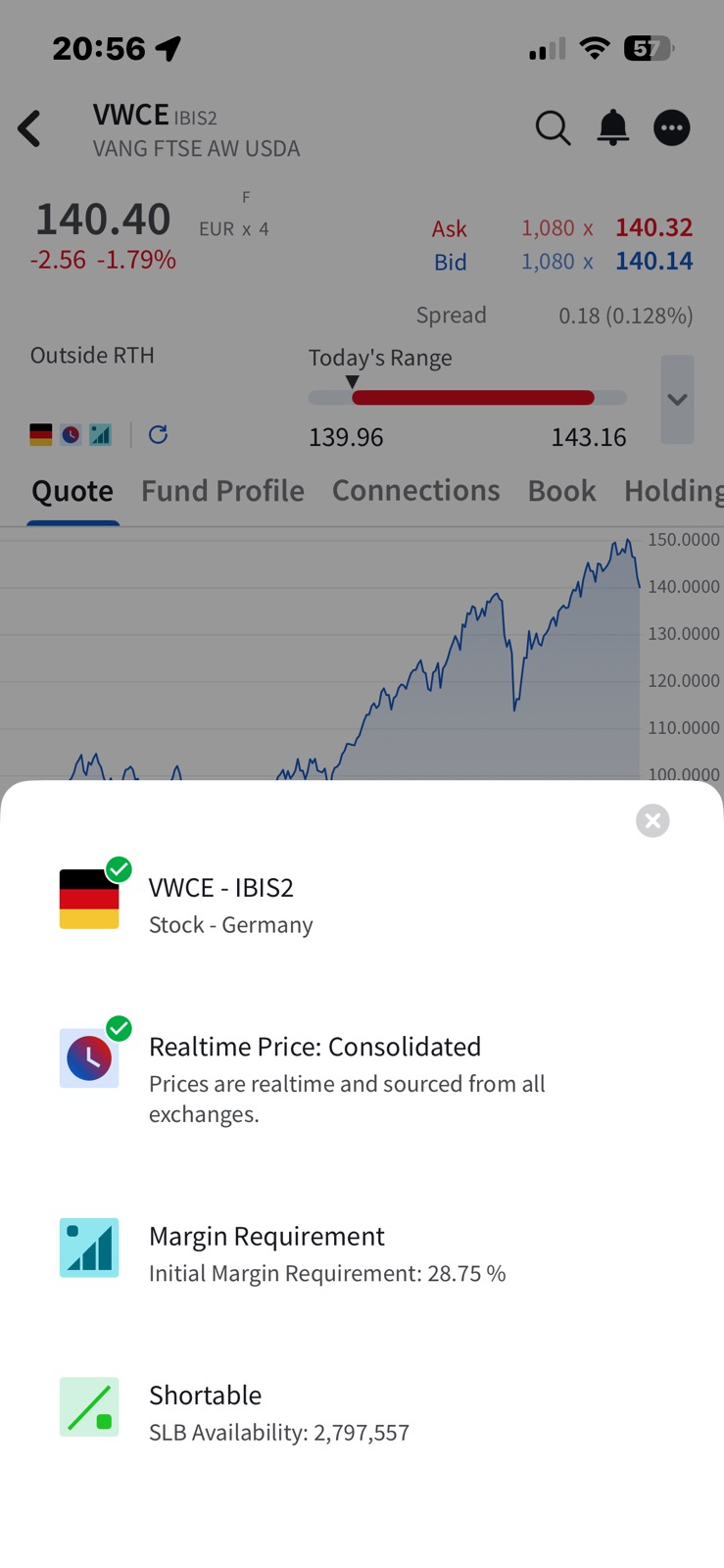
    What is an ETF: IBKR mobile app showing VWCE ETF quote on Xetra with ticker, price, and bid-ask spread

    VWCE on IBKR’s mobile app. The header reads “VWCE IBIS2” β€” that tells you the ticker (VWCE) and the exchange (IBIS2, which is Xetra). Below: price, bid-ask spread, and key stats.

    The same ETF might trade on multiple exchanges under different tickers: IWDA on Euronext Amsterdam (in USD), SWDA on London Stock Exchange (in USD), EUNL on Xetra (in EUR). These are all the same fund. You are choosing which exchange and currency to trade in. The underlying holdings are identical.

    Every UCITS ETF also has an ISIN (International Securities Identification Number) that uniquely identifies it regardless of exchange or ticker. For the fund above, the ISIN is IE00B4L5Y983. When you are comparing ETFs, the ISIN removes all ambiguity.

    What an ETF Costs

    ETF costs come in layers. Knowing them prevents surprises.

    TER (Total Expense Ratio)

    The TER is the annual fee the fund charges, expressed as a percentage of your investment. It is deducted automatically from the fund’s value. You never see a bill. A broad MSCI World UCITS ETF typically charges 0.10%–0.20% per year. An S&P 500 UCITS ETF can be as low as 0.03%–0.07%. Compare this to the average European actively managed equity fund at 1.5%–2.0%.

    To put this in euros: on a €10,000 investment, a 0.12% TER costs you €12 per year. A 1.5% active fund fee costs €150. Over 30 years with compounding, that gap grows to tens of thousands of euros on a six-figure portfolio.

    Tracking difference

    The TER does not tell the full cost story. Tracking difference measures the actual gap between the ETF’s return and the index’s return over a given period. An ETF with a 0.20% TER might have a tracking difference of only 0.10% (because it earns revenue from securities lending) or 0.30% (because of transaction costs and withholding taxes). Tracking difference is the more honest cost measure, and you can find it on fund factsheets or on justETF or trackingdifferences.com.

    Trading costs

    These are broker fees, not fund fees. Every time you buy or sell an ETF, you pay a commission to your broker (anywhere from €0 to €3 depending on the broker and platform) plus a bid-ask spread (the small gap between the buy and sell price). For large, liquid ETFs like VWCE or CSPX, the spread is small, often 0.01%–0.05%. For niche or small ETFs, the spread can be wider.

    We compared broker costs in detail in our best brokers for European investors guide.

    Types of ETFs

    Not every ETF is a broad stock market index fund. The main categories break down as follows.

    Equity index ETFs (the core)

    The most popular for European investors track MSCI World (developed markets), FTSE All-World (developed + emerging), S&P 500 (US large cap), and MSCI Emerging Markets. If you are building a simple long-term portfolio, one or two of these form the backbone.

    Bond ETFs

    Bond ETFs hold government bonds, corporate bonds, or a mix. They add stability and income to a portfolio. European investors often look for euro-hedged versions to avoid currency risk, or euro-denominated government bond ETFs.

    Thematic and sector ETFs

    Sector and thematic ETFs target specific areas (technology, healthcare, clean energy) or investment themes (artificial intelligence, cybersecurity, ageing population). They concentrate your bets, and costs tend to be higher: 0.30%–0.65% TER is common. Useful as satellite positions, not as your core.

    Dividend ETFs

    Dividend ETFs track indices of high-dividend-paying companies. Popular in Europe for income-focused investors, but watch for the tax implications discussed in the accumulating vs distributing section above.

    Multi-asset ETFs

    Some ETFs combine stocks and bonds in a single fund, like the Vanguard LifeStrategy UCITS ETFs (available in 20/40/60/80% equity versions). These are one-fund portfolios that rebalance automatically.

    ETF vs Mutual Fund vs Stock: When to Use Each

    For most European investors building long-term wealth, ETFs are the default tool. Individual stocks are for people who want to actively research specific companies (we write stock reviews for those who do). Active mutual funds have lost ground to ETFs for years, and the data explains why.

    How to Buy Your First ETF in Europe

    Four steps, nothing complicated.

    1. Open a brokerage account

    You need a broker that gives you access to European exchanges (Xetra, Euronext, Borsa Italiana, etc.) where UCITS ETFs trade. The main options for European investors are Interactive Brokers, Degiro, Trade Republic, and Scalable Capital. We compared them all in our best brokers guide.

    2. Decide on your ETF

    For a first ETF, keep it simple. A single global equity index ETF gives you exposure to the entire developed world. The two most popular choices among European investors:

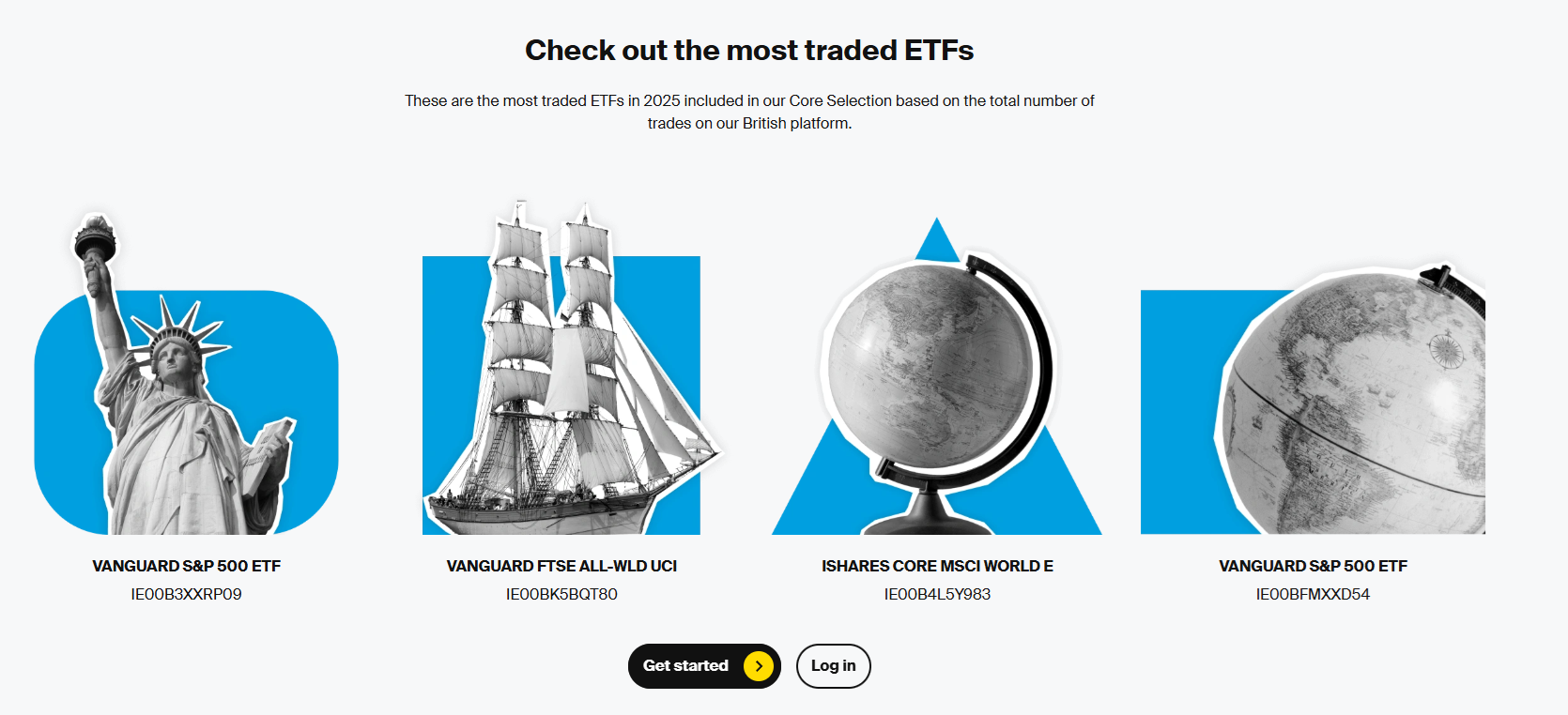
    • iShares Core MSCI World UCITS ETF (Acc) β€” ISIN: IE00B4L5Y983, TER: 0.20%, tracks ~1,300 companies in 23 developed countries
    • Vanguard FTSE All-World UCITS ETF (Acc) β€” ISIN: IE00BK5BQT80, TER: 0.19%, tracks ~4,200 companies in developed + emerging markets

    Both are accumulating, physically replicated, and domiciled in Ireland. Either one works as a core holding for a long-term portfolio.

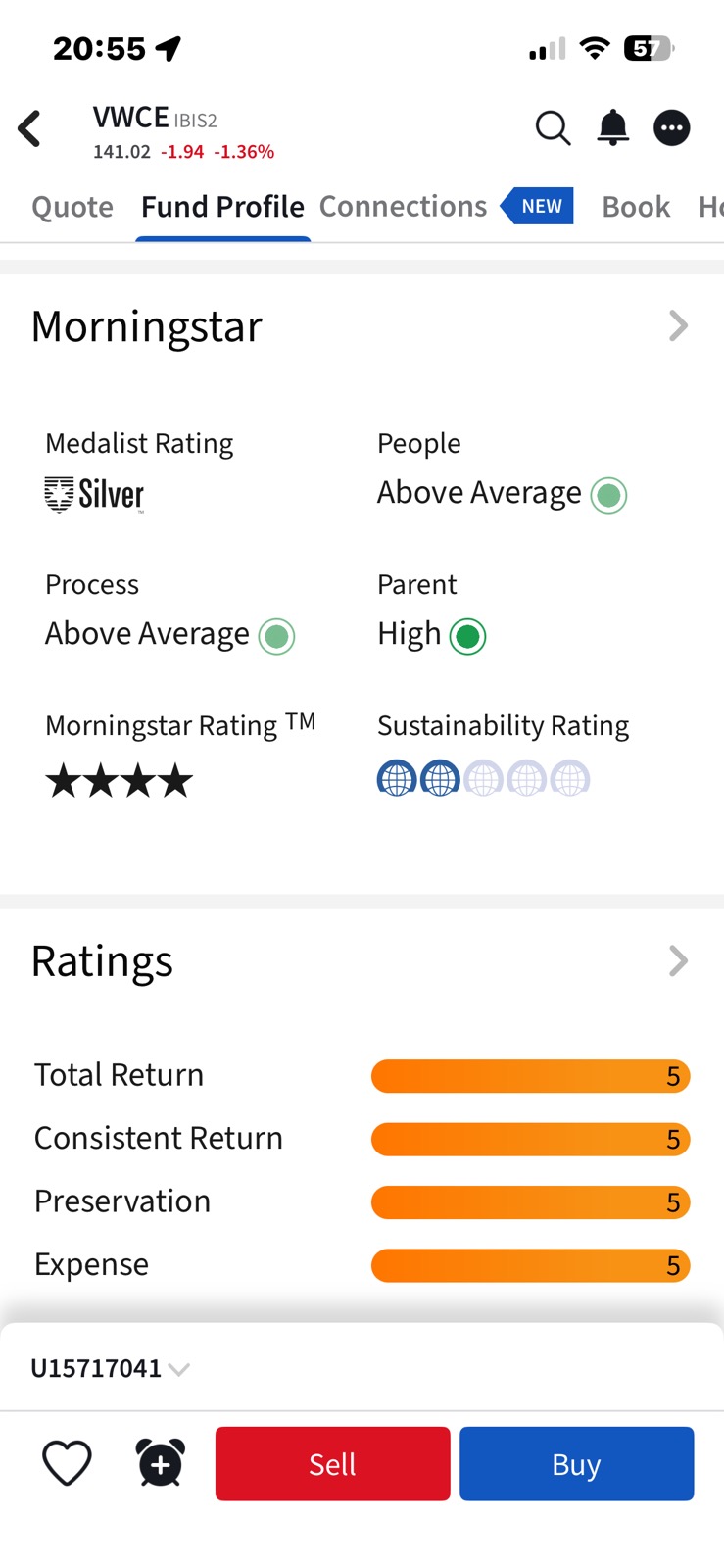
    IBKR mobile app Fund Profile tab for VWCE showing Morningstar Silver rating and 4-star rating

    The Fund Profile tab for VWCE inside IBKR. Morningstar rates it Silver with 4 stars. You can check ratings like these before buying to compare funds.

    3. Place your order

    Search for the ETF by ISIN or ticker in your broker’s platform. Select the exchange you want to trade on (Xetra is the most liquid for many UCITS ETFs traded in EUR). Place a limit order at or near the current price. The trade settles in T+2 (two business days).

    Example: buying VWCE on Interactive Brokers. In the IBKR Client Portal or mobile app, type “VWCE” or the ISIN (IE00BK5BQT80) in the search bar. IBKR will show you multiple listings β€” pick the one on Xetra (IBIS2) if you want to trade in EUR. Click Trade, select Buy, enter the number of shares (or use the order value field for a euro amount). Set the order type to Limit, enter a price at or slightly above the current ask, and submit. IBKR charges 0.05% of the trade value on Xetra, with a minimum of €1.25 and a maximum of €29 β€” so a €5,000 ETF purchase costs you €2.50 in commission. The shares appear in your portfolio within seconds, and settlement completes in two business days. For a detailed walkthrough, see our IBKR review.

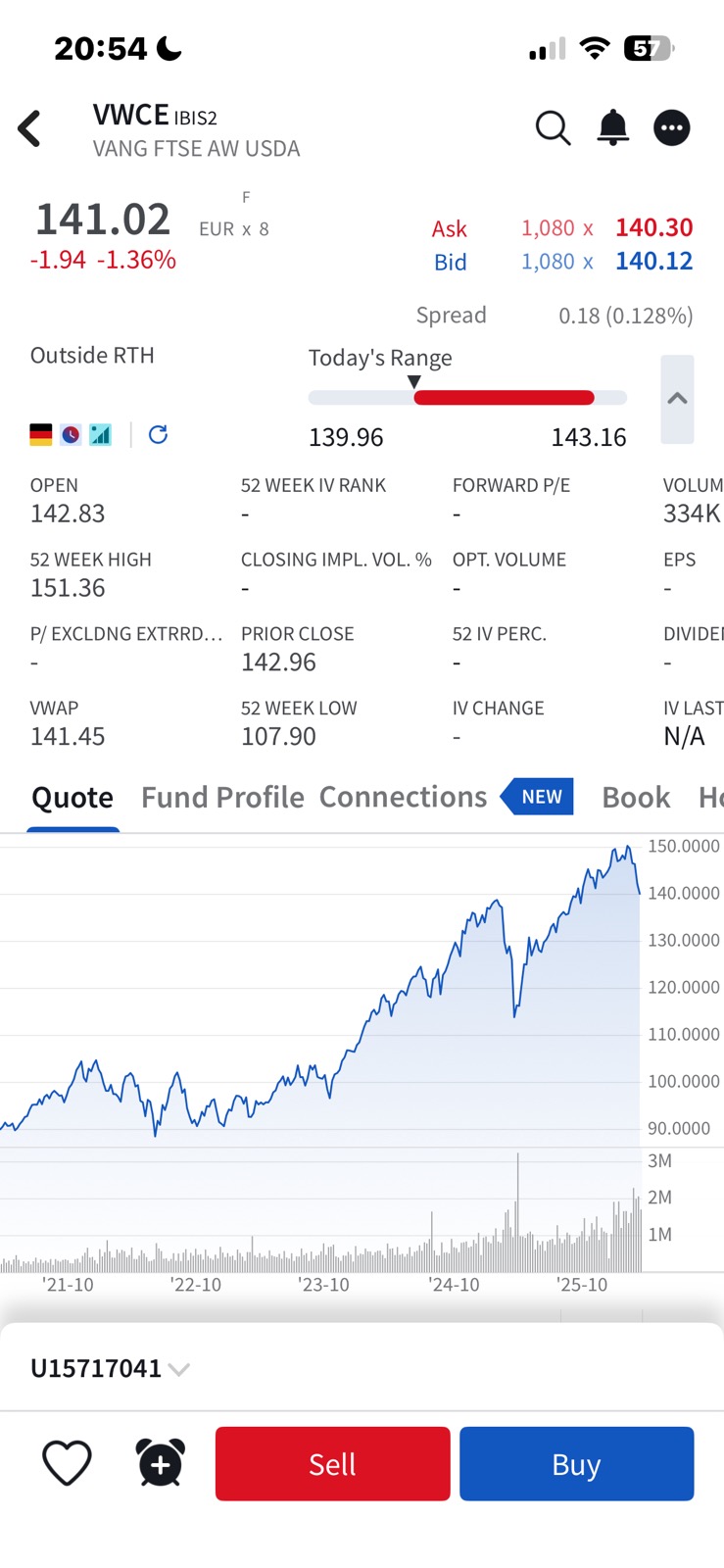
    IBKR mobile app showing VWCE ETF quote with live price chart on Xetra

    VWCE on IBKR, showing the live quote and price chart. The spread of 0.18 (0.128%) tells you this is a liquid ETF with tight trading costs.

    4. Automate if possible

    Several European brokers offer savings plans (SparplΓ€ne in German) that automatically buy a fixed euro amount of your chosen ETF every month. Trade Republic and Scalable Capital offer these for free on many ETFs. Degiro offers a selection of commission-free ETFs. Automation removes emotion and builds the habit of consistent investing.

    Common Mistakes European ETF Investors Make

    Overcomplicating the portfolio

    You do not need 10 ETFs. A single global equity ETF covers over 1,300 companies across all sectors and geographies. Adding a second ETF for bonds or emerging markets is reasonable. Beyond that, every extra fund adds rebalancing work with diminishing diversification benefit. Many European investors hold one or two ETFs for their entire portfolio.

    Chasing past performance

    The thematic ETF that returned 40% last year might lose 30% next year. Broad indices are boring by design, and boring compounds well.

    Ignoring the tax implications of distributing ETFs

    Choosing a distributing ETF in a country with high dividend taxation means you lose a chunk of every dividend payment to tax, even if you reinvest. Check whether accumulating makes more sense in your tax jurisdiction before buying.

    Buying the wrong share class

    The same ETF can have an accumulating and a distributing version, an EUR-hedged and an unhedged version, and trade on multiple exchanges. Always verify the ISIN before you buy. The name alone is not enough. Two different ISINs can have very similar names but different structures.

    Trading too often

    ETFs trade like stocks, which makes it tempting to buy and sell based on market movements. Resist. Transaction costs, bid-ask spreads, and the tax events triggered by selling all eat into your returns. The optimal strategy for most people is to buy regularly and not sell for decades.

    Frequently Asked Questions

    Is an ETF safer than a stock?

    An ETF is more diversified than a single stock, which reduces the risk of one company destroying your portfolio. But ETFs still carry market risk. If the entire stock market drops 30%, your MSCI World ETF drops roughly 30% too. Diversification protects against company-specific risk, not market risk.

    Can I lose all my money in an ETF?

    For a broad index ETF to go to zero, every company in the index would have to go bankrupt simultaneously. This has never happened. Individual stocks can go to zero. Broad ETFs cannot, practically speaking. That said, they can and do lose significant value during market downturns: a 40%–50% drawdown is within the historical range for equity indices.

    What is the minimum amount to invest in an ETF?

    The price of one share. For the Vanguard FTSE All-World UCITS ETF, that is roughly €110–130. Some brokers like Trade Republic and Interactive Brokers offer fractional shares, allowing you to invest as little as €1. Monthly savings plans on many European brokers start from €1–25.

    Should I buy an ETF in EUR or USD?

    The trading currency does not affect your returns. Whether you buy IWDA in USD on Euronext Amsterdam or EUNL in EUR on Xetra, the underlying holdings are identical. Your real currency exposure is to the currencies of the companies in the index (mostly USD for an MSCI World ETF). The only difference is whether your broker needs to convert your EUR to USD before the trade, which may incur an FX fee. Buying in EUR on Xetra avoids that step.

    How are ETFs taxed in Europe?

    There is no single EU-wide tax treatment. Each country has its own rules for capital gains, dividends, and sometimes special provisions for ETFs (like Germany’s Vorabpauschale or France’s PEA wrapper). The general principle: you owe tax in your country of residence when you sell (capital gains) and possibly when you receive distributions. Consult your local tax authority or a tax advisor for specifics.

    What happens to my ETF if the provider (iShares, Vanguard) goes bankrupt?

    UCITS rules require that fund assets are held by an independent custodian (a large bank like State Street or BNP Paribas), separate from the fund provider. If iShares or Vanguard went under, the ETF’s holdings would still exist at the custodian. The fund would be liquidated or transferred to a new provider, and you would receive the value of your shares. Your investment is not lost.

    Disclaimer: This article is for informational purposes only and does not constitute investment, tax, or legal advice. ETFs carry market risk, including the potential loss of principal. Tax treatment depends on your individual circumstances and country of residence. Always consult a qualified advisor before making investment decisions.

    Some links in this article are affiliate links. If you open an account through these links, The Bourse Report may receive a commission, at no extra cost to you. See our full affiliate disclosure.

    Keep Reading

  • How to Buy US Stocks in Europe: A Practical Guide for 2026

    Yes, you can buy US stocks from Europe. You do it through a broker that gives you access to NYSE and NASDAQ, you fill out a tax form called the W-8BEN, and you pay attention to currency conversion costs. That is the short version. This guide covers everything else you need to know to buy US stocks Europe in 2026, including the brokers that actually work, what they cost, and the tax rules most guides gloss over.

    Key Takeaways: Buy US Stocks Europe

    • European investors can buy individual US stocks freely. The PRIIPs regulation only blocks US-domiciled ETFs and funds, not individual shares.
    • Three brokers dominate US stock access for Europeans: Interactive Brokers, Degiro, and Trade Republic. They differ significantly on currency conversion costs.
    • You need a W-8BEN form to reduce US dividend withholding tax from 30% to 15% (for most EU countries). Your broker usually handles this during account setup.
    • The US does not tax capital gains for non-resident investors. You only owe capital gains tax in your home country.
    • Currency conversion is the hidden cost. On a €10,000 purchase, the difference between brokers ranges from €2 to €75.

    Individual Stocks vs US ETFs: the PRIIPs Distinction

    Before anything else, a clarification that trips up many European investors. The EU’s PRIIPs regulation (Packaged Retail and Insurance-based Investment Products), in force since January 2018, requires that any “packaged” investment product sold to EU retail investors comes with a Key Information Document (KID). US-domiciled ETFs and mutual funds do not produce KIDs. So European brokers are legally required to block you from buying them.

    Individual US stocks are not packaged products. They are not affected by PRIIPs. You can buy Apple, Microsoft, Nvidia, or any other company listed on NYSE or NASDAQ from a European brokerage account with no regulatory restrictions.

    If you want broad US market exposure through an ETF, you need a UCITS-compliant version domiciled in Europe. Providers like iShares, Vanguard, and Xtrackers all offer UCITS equivalents of popular US ETFs. For example, the iShares Core S&P 500 UCITS ETF (ticker: CSPX on London Stock Exchange, SXR8 on Xetra) tracks the same index as the US-domiciled SPY or VOO.

    This guide focuses on how to buy US stocks Europe β€” individual shares, directly.

    Which Broker to Use (and What It Actually Costs)

    Three brokers cover the vast majority of European investors buying US stocks (we compared them all in our best brokers for European investors guide). Each has a different fee model, and the real cost difference is not in trading commissions. It is in currency conversion.

    When you buy a US stock, you are buying in US dollars. Your account holds euros. Someone has to convert the currency, and that conversion has a cost. Here is how the three main options compare:

    BrokerUS Stock CommissionFX Conversion CostFX MethodTotal Cost on €10,000 Purchase
    Interactive Brokers$0.005/share, min $1 (Pro Fixed plan; Tiered starts at $0.0035/share, min $0.35)0.002% (min $2) manual; 0.03% autoManual or automatic~€4 (manual FX + commission)
    Degiro€1 per transaction0.25% (embedded in spread)Automatic only~€26 (commission + FX)
    Trade Republic€1 per transactionNot published precisely; estimated at 0.5-0.7% based on user reportsAutomatic only~€51-71 (estimated commission + FX)

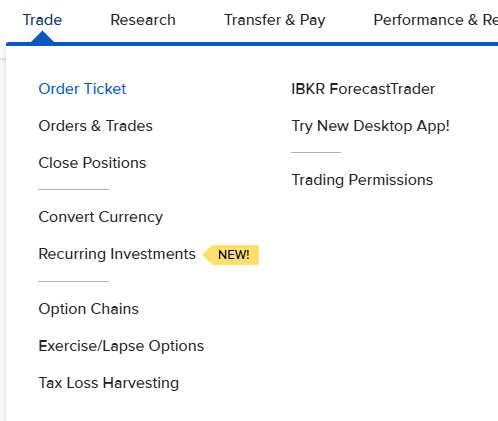
    I use IBKR for my own US stock purchases. The currency conversion process is straightforward: two clicks to access the conversion tool from the main menu, you select your source currency (EUR), enter the amount, select USD as the target, and the screen immediately shows you the number of dollars you will receive. The whole thing takes under a minute. It is not hidden behind menus or buried in settings. Once you have done it once, you will not think twice about it.

    The table tells most of the story. On a single €10,000 trade, the FX cost difference between IBKR and Trade Republic can be €50 or more. Over a year of regular investing, this compounds.

    IBKR gives you the option to convert currency manually before placing a trade. You go to the currency conversion tool, convert EUR to USD at a 0.002% fee (that is 0.2 basis points, or roughly $2 on a $10,000 conversion), then use the settled USD to buy your stock. It takes an extra step, but the savings are substantial.

    Degiro and Trade Republic handle FX automatically. You place the order in euros, they convert at the time of execution, and the spread is baked into the price you see. Simpler process, higher cost.

    A note on euro-denominated US stocks

    Some US companies have shares listed on European exchanges. Apple, for instance, trades on Xetra under the ticker APC. You buy it in euros, no currency conversion needed. But there are trade-offs: liquidity is lower, bid-ask spreads are wider, and the share price still moves with EUR/USD because the underlying business earns dollars. You avoid the explicit FX fee but take on an implicit one through wider spreads. For large-cap stocks with active European listings, this can work. For smaller US companies, the European listing may have very thin volume.

    Buy US Stocks Europe: Step by Step with IBKR

    Here is the actual process to buy US stocks Europe step by step, using Interactive Brokers as the example because it offers the most control.

    1. Open and fund your account

    Account opening takes 1-3 business days. You will need proof of identity (passport or national ID) and proof of address. IBKR’s EU entity is Interactive Brokers Ireland Limited, regulated by the Central Bank of Ireland. During the application, IBKR asks you to complete the W-8BEN form electronically. Do this. It reduces your US dividend withholding tax from 30% to 15%. More on this below.

    Fund your account via bank transfer in EUR. SEPA transfers are free and typically arrive within one business day.

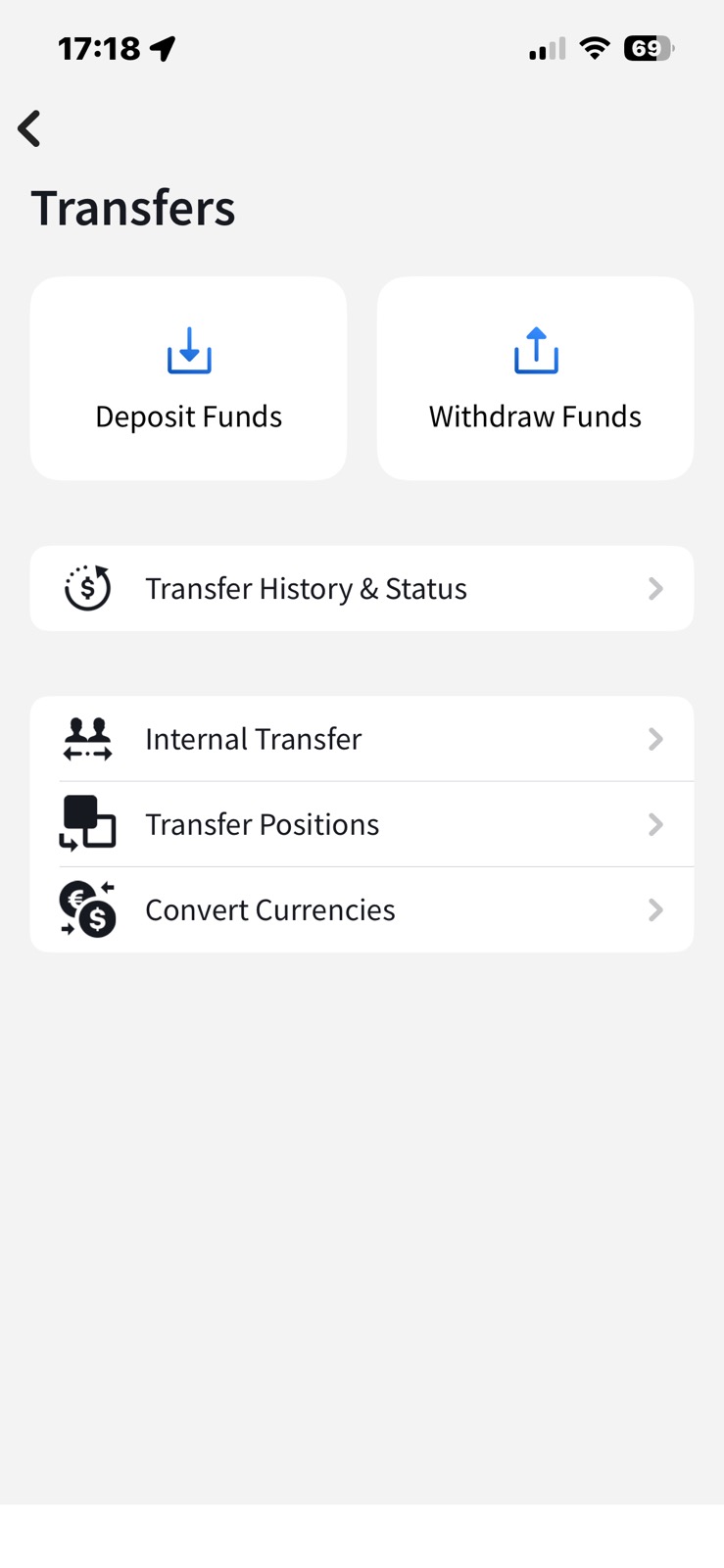
    How to buy US stocks Europe: IBKR mobile app Transfers page showing bank transfer options
    The Transfers page in the IBKR mobile app. SEPA bank transfers arrive within one business day.
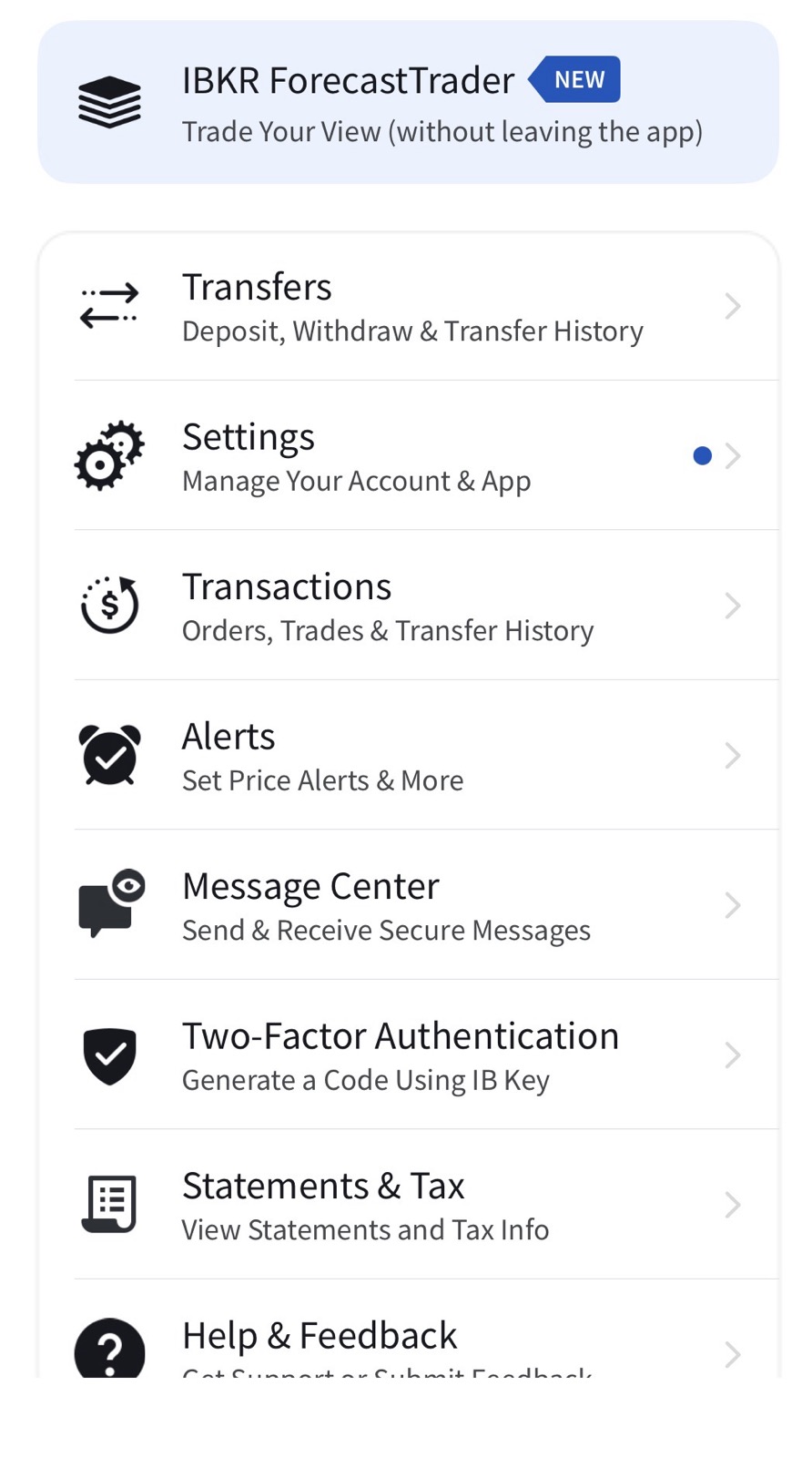
    IBKR mobile app main menu showing trading, transfers, and account management options
    IBKR’s mobile app gives you access to trading, transfers, and account management from the main menu.

    2. Convert EUR to USD

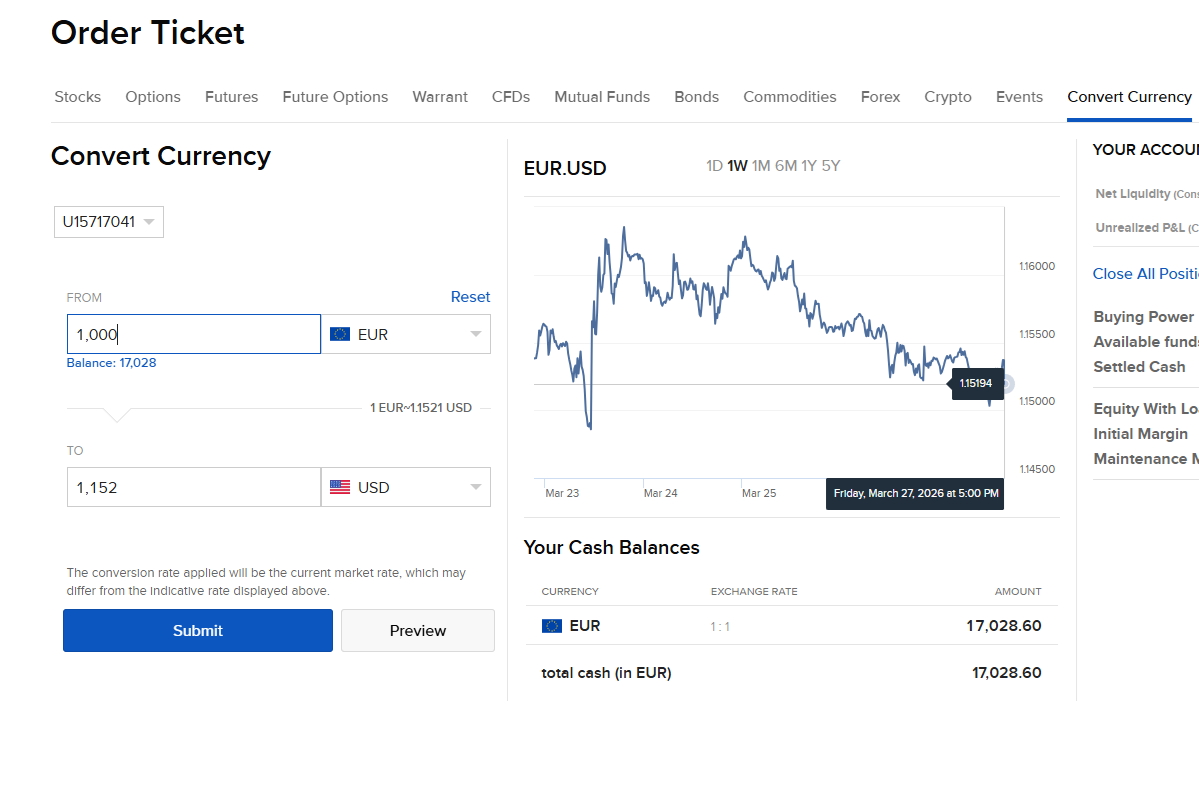
    In the IBKR Client Portal, go to Transfer & Pay, then Convert Currency. Enter the amount of EUR you want to convert. IBKR shows you the live interbank rate plus the 0.002% fee. For a €10,000 conversion, the fee is approximately $2.

    The converted USD settles in two business days (T+2). You can trade immediately on margin if you have a margin account, or wait for settlement if you have a cash account.

    IBKR Client Portal currency conversion screen showing EUR to USD conversion with live rate and fee
    The IBKR currency conversion tool: select your source currency, enter the amount, and you see the converted amount instantly.
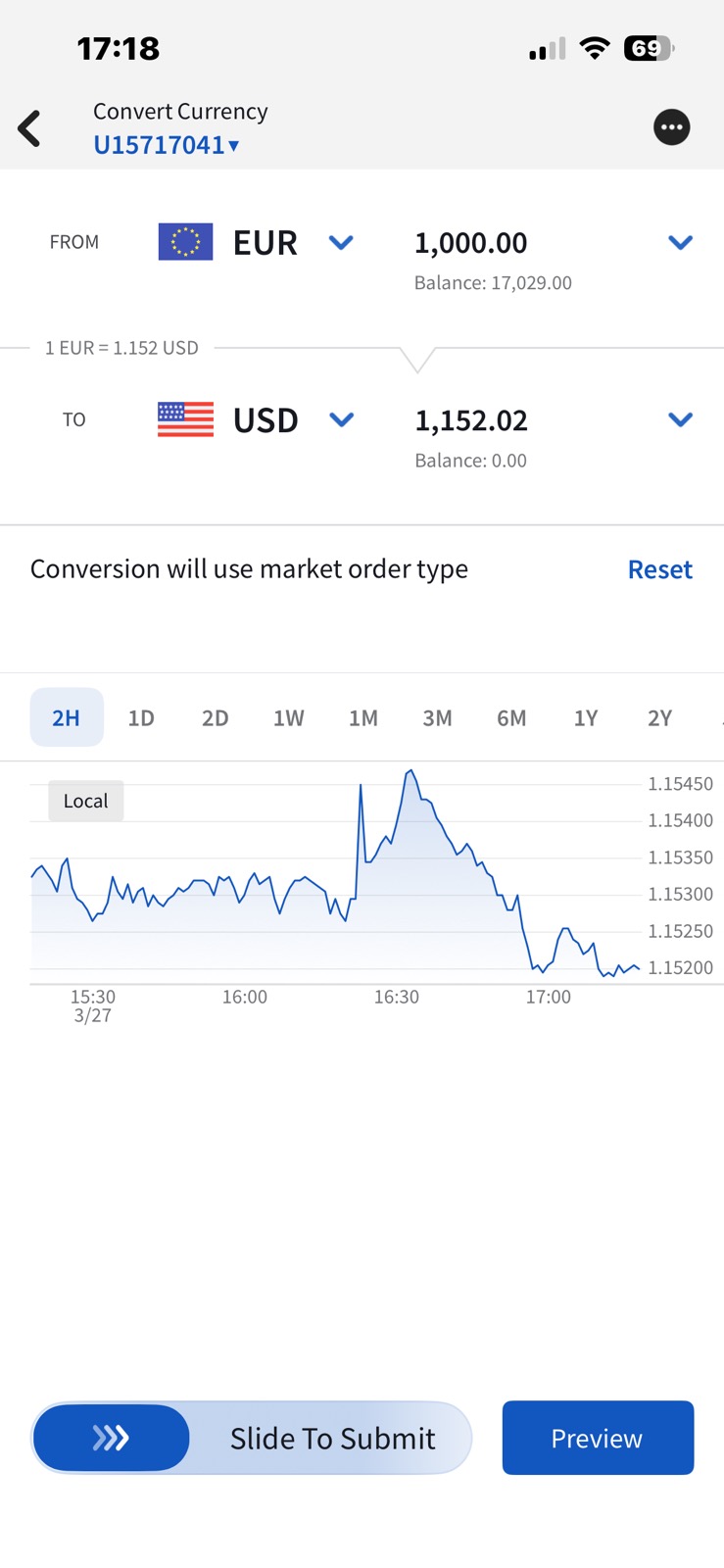
    IBKR mobile app currency conversion screen showing EUR to USD exchange
    The same conversion tool on IBKR’s mobile app. Two taps to access, and the process takes under a minute.

    3. Place your order

    Search for the stock by ticker or name. Make sure you select the US exchange (NYSE or NASDAQ), not a European listing. Choose your order type. Limit orders are generally better than market orders for US stocks during European trading hours, because you are trading during pre-market or early session when spreads can be wider.

    US markets are open from 15:30 to 22:00 CET (9:30 AM to 4:00 PM Eastern). IBKR also offers extended-hours trading from 10:00 to 02:00 CET, though liquidity is lower outside regular hours.

    IBKR Client Portal trade menu showing stock search and order entry options
    The trade screen in IBKR’s Client Portal. Search by ticker, select the US exchange, and choose your order type.

    4. Settlement

    US stocks settle on T+1 (one business day after the trade). This changed from T+2 in May 2024. Your shares appear in your portfolio immediately but are not technically yours until settlement completes.

    The W-8BEN Form and US Dividend Tax

    If you own US stocks that pay dividends, the US government withholds tax on those payments before they reach your account. The standard rate is 30%. The W-8BEN form (Certificate of Foreign Status of Beneficial Owner for United States Tax Withholding and Reporting) allows you to claim a reduced rate under your country’s tax treaty with the US.

    For most EU countries, the treaty rate is 15%. Here are the rates for the largest European markets:

    CountryTreaty Rate on DividendsNotes
    France15%Credit claimable against French income tax (PFU or barème)
    Germany15%Credited against Kapitalertragsteuer (26.375% total with Soli)
    Netherlands15%Credited against Box 3 or Box 2 tax depending on situation
    Ireland15%Credited against Irish income tax on dividends
    Spain15%Credited against Spanish income tax
    Italy15%Credited against 26% Italian capital income tax
    Belgium15%Credited against 30% Belgian withholding tax on dividends
    Sweden15%Credited against Swedish capital income tax (30%)
    Switzerland15%Reclaimable via DA-1 form in Swiss tax return

    Without the W-8BEN, you pay 30%. With it, you pay 15%. On a $1,000 annual dividend, that is $150 in your pocket instead of $300 going to the IRS. Most brokers ask you to complete the form during account opening. If yours did not, check your account settings. The form is valid until the last day of the third calendar year after you sign it (sign in 2026, valid through 31 December 2029), then needs renewal.

    One important point: the US does not tax capital gains for non-resident investors. If you buy Apple at $200 and sell at $250, the $50 profit is not taxed by the US. You owe capital gains tax only in your home country, under your local rules. This catches people off guard in the opposite direction: they worry about being taxed twice on gains, but there is no US tax on the gain at all.

    The Costs That Catch People Off Guard

    Trading commissions and currency conversion are the obvious costs. There are three others that deserve attention.

    Dividend withholding drag

    Even with the W-8BEN reducing withholding to 15%, you still lose 15% of every dividend payment upfront. Most EU countries let you claim this as a credit against your domestic tax bill, so it is not a net loss if your local tax rate on dividends exceeds 15%. But if your country’s rate is exactly 15%, you break even. If it is lower (rare for dividends), you may not recover the full amount. Check your specific situation.

    Currency risk

    When you hold US stocks as a euro-based investor, you are exposed to EUR/USD fluctuations. If the dollar weakens 10% against the euro, your US stock portfolio loses 10% in euro terms, even if the stock prices are flat. This works both ways: a strengthening dollar boosts your returns. Over long periods (10+ years), currency movements tend to partially wash out, but over shorter periods they can materially affect your returns. Some investors accept this as part of global diversification. Others prefer to concentrate on European stocks for their individual holdings and use UCITS ETFs (which can be hedged) for US exposure.

    Estate tax risk for large portfolios

    The US imposes estate tax on US-situated assets held by non-residents, including US stocks. The exemption threshold for non-residents is only $60,000 (compared to $15 million for US citizens in 2026). Above that threshold, rates start at 18% and go up to 40%. Some US tax treaties provide higher thresholds or credits. France, for example, has a treaty that effectively eliminates double estate taxation for most cases. Germany has a similar provision.

    But not all EU countries have comprehensive estate tax treaties with the US. If you hold a large US stock portfolio (above $60,000), look into whether your country’s treaty covers this. For most retail investors with diversified portfolios, this is unlikely to be a problem. For concentrated positions in US stocks, it is worth researching.

    Buy US Stocks Europe: Direct Shares or UCITS ETFs?

    This is the real decision for most European investors. You can get US market exposure two ways, and each has advantages.

    Direct US StocksUCITS ETFs (US market trackers)
    What you getOwnership of individual companiesBasket of hundreds or thousands of US companies
    PRIIPsNo restrictionMust be UCITS-domiciled (Ireland, Luxembourg)
    Dividend tax15% US withholding (with W-8BEN), then home country tax15% US withholding at fund level (Irish-domiciled), then home country tax on distribution or accumulation
    Currency conversionYou handle it (or broker auto-converts)Buy in EUR on Xetra, no conversion needed
    Estate tax riskYes, if portfolio exceeds $60,000No (UCITS fund is Irish/Luxembourg-domiciled)
    DiversificationConcentrated (you pick stocks)Broad (hundreds of holdings)
    Best forInvestors with conviction in specific companiesInvestors wanting broad US exposure with minimal hassle

    Irish-domiciled UCITS ETFs benefit from Ireland’s US tax treaty, which means the fund itself pays only 15% withholding on US dividends. This is the same rate you would pay directly with a W-8BEN. But the UCITS route avoids the US estate tax issue entirely, and if you buy an accumulating fund on Xetra, you never touch USD at all.

    If you want to buy US stocks Europe, the practical answer for most people is this: use UCITS ETFs for broad US market exposure, and buy individual US stocks only when you have a specific thesis about a company you want to own directly. (For an example of what that looks like, see our ASML stock review.)

    Frequently Asked Questions About How to Buy US Stocks Europe

    Can Europeans buy US stocks?

    Yes. Individual US stocks (Apple, Microsoft, Tesla, etc.) are fully accessible to European retail investors through brokers like Interactive Brokers and Degiro. The PRIIPs regulation only restricts US-domiciled ETFs and funds, not individual stocks.

    Can I buy US ETFs in Europe?

    Not US-domiciled ones like SPY, VOO, or QQQ. The PRIIPs regulation blocks European retail investors from buying them because they lack a Key Information Document (KID). Instead, buy the UCITS equivalent: CSPX or SXR8 for S&P 500, EQQQ for NASDAQ-100. Same index, different legal wrapper.

    Do I pay tax twice on US stock dividends?

    Not if you claim the credit. The US withholds 15% (with W-8BEN). Your home country then taxes the dividend income under its own rules but typically gives you a credit for the US tax already paid. The result is you pay the higher of the two rates, not both stacked. Check your specific country’s rules.

    What happens if I do not file a W-8BEN?

    The US withholds 30% of every dividend payment instead of 15%. On $1,000 in annual dividends, that costs you an extra $150. Most brokers prompt you to complete this form during account setup. If you missed it, update it in your account tax settings.

    Is it cheaper to buy Apple on Xetra in euros or on NASDAQ in dollars?

    It depends on your broker’s FX fee. On IBKR, buying on NASDAQ after a manual currency conversion costs about 0.002% in FX fees. On Degiro, the auto-FX charge of 0.25% applies if you buy on NASDAQ, but there is no FX charge on Xetra. However, the Xetra listing typically has wider bid-ask spreads. For large orders (above €5,000), buying on NASDAQ via IBKR is usually cheaper overall. For smaller orders on Degiro, Xetra may be the better choice to avoid FX costs.

    Disclaimer: This article is for informational purposes only and does not constitute investment, tax, or legal advice. Tax rules vary by country and individual circumstances. Consult a qualified tax adviser in your country of residence before making investment decisions. Information is accurate as of the date of publication but may change.

    Some links in this article are affiliate links. If you open an account through these links, The Bourse Report may receive a commission at no extra cost to you. This does not affect our editorial independence or the opinions expressed. See our full affiliate disclosure.

    Keep Reading

  • ASML (ASML) Stock Review 2026: The Monopoly That Powers Every Advanced Chip

    ASML (ASML) Stock Review 2026: The Monopoly That Powers Every Advanced Chip

    ASML stock review 2026: ASML holds a position that is unique in global technology. It is the only company on Earth that can build the machines needed to manufacture the most advanced semiconductors. Every cutting-edge chip inside your phone, your laptop, or the servers running AI models passed through an ASML machine. That kind of monopoly is rare, and it doesn’t come cheap. At a current price around €1,200 on Euronext Amsterdam, the stock trades at a premium that demands scrutiny. I dug into the numbers, the technology, and the risks.

    Key Takeaways

    • ASML is the sole manufacturer of EUV lithography systems, the machines required for chips below 7nm. No competitor exists.
    • FY2025 revenue hit a record €32.7 billion with net income of €9.6 billion.
    • Backlog stands at €38.8 billion as of Q4 2025, with 2026 guidance of €34 to €39 billion in revenue.
    • SK Hynix placed a record $8 billion order on 24 March 2026, the largest single order in ASML’s history.
    • The stock trades at roughly 49x trailing earnings, a premium, though below its late-2024 peak multiples.
    • Key risks: China export restrictions, customer concentration, semiconductor cyclicality, and geopolitical exposure.
    • Disclosure: I hold a long position in ASML, initiated March 2026.

    Company at a Glance

    Detail ASML
    Sector Semiconductor equipment
    Headquarters Veldhoven, Netherlands
    Primary exchange Euronext Amsterdam (ASML)
    Secondary listing NASDAQ (ASML)
    ISIN NL0010273215
    Employees ~44,000 (2025)
    FY2025 revenue €32.7 billion
    Market capitalisation ~€470 billion (March 2026)
    Index membership AEX, EURO STOXX 50, STOXX Europe 600
    CEO Christophe Fouquet (since April 2024)

    What Does ASML Do?

    ASML makes lithography machines. That sounds dry until you understand what it means. Every semiconductor ever manufactured required a lithography step: projecting a circuit pattern onto a silicon wafer using light. For decades, the industry used deep ultraviolet (DUV) light at 193nm wavelength. That worked until physics said it couldn’t go smaller. To print the transistors needed for modern chips (billions of them, each smaller than a virus) the industry needed a completely different light source.

    That light source is extreme ultraviolet (EUV), with a wavelength of just 13.5nm. Getting there took ASML and its partners over 30 years. The Veritasium documentary The Machine That Saved Moore’s Law captures the absurdity of the engineering involved: you fire a high-powered laser at tiny droplets of molten tin, 50,000 times per second, each droplet hit twice: once to flatten it, once to vaporise it into a plasma that emits EUV light. That light is then bounced off a series of mirrors so perfectly smooth that if you scaled one up to the size of Germany, the largest bump would be a millimetre tall.

    Each EUV machine weighs about 180 tonnes, requires three Boeing 747s to ship, and costs upwards of €350 million. ASML recognised revenue on 48 EUV systems in 2025. Nobody else can build these machines. Intel tried to develop its own EUV capability decades ago and abandoned the effort. Nikon, once a competitor in DUV, never made the leap. ASML’s monopoly on EUV isn’t a moat. It’s an ocean.

    But ASML isn’t only EUV. The company also dominates DUV lithography (used for less advanced but still critical chip nodes), and it sells metrology and inspection systems through its Computational Lithography division. In FY2025, EUV accounted for 48% of systems revenue (€11.6 billion, up 39% year-on-year) with DUV and other products making up the rest. The installed base of lithography systems worldwide also generates recurring service and upgrade revenue. Installed base management contributed €8.2 billion in FY2025, about 25% of total sales.

    Financial Performance

    ASML’s financials over the past five years tell a story of accelerating demand for advanced chipmaking equipment, punctuated by the usual semiconductor-cycle swings.

    Metric FY2021 FY2022 FY2023 FY2024 FY2025
    Revenue (€B) 18.6 21.2 27.6 28.3 32.7
    Net income (€B) 5.9 5.6 7.8 7.6 9.6
    Net margin 31.7% 26.4% 28.3% 26.9% 29.4%
    Gross margin 52.7% 50.5% 51.3% 51.3% 52.8%
    EPS (€, basic) 14.36 14.14 19.91 19.25 24.73
    Bookings (€B) 26.2 30.7 20.0 18.9 28.0
    ASML High-NA EUV lithography system, the next generation of semiconductor manufacturing technology
    ASML’s High-NA EUV technology. Source: ASML

    A few things stand out. Revenue nearly doubled from 2021 to 2025, driven by surging demand for EUV machines. But bookings tell the more interesting story: they peaked at €30.7 billion in 2022, then fell to €20.0 billion in 2023 and €18.9 billion in 2024 as customers digested post-pandemic inventory. In October 2024, ASML accidentally leaked Q3 results showing weaker-than-expected orders. The stock dropped 16% in a single session. And then the cycle turned. Q4 2025 alone brought in €13.2 billion in new bookings, nearly double analyst expectations, and full-year 2025 bookings hit €28.0 billion. Semiconductor cycles haven’t been repealed, but AI demand is providing a powerful upswing.

    Margins are striking. ASML consistently earns gross margins above 50% and net margins near 30%. For a hardware company shipping physical machines, those are software-like numbers. That’s monopoly pricing at work: when your customers have no alternative supplier, you set the terms.

    The backlog at the end of Q4 2025 stood at €38.8 billion, providing strong visibility for the next 12 to 18 months. Management guided FY2026 revenue at €34 to €39 billion, implying continued growth at the midpoint.

    Valuation

    ASML’s valuation is the question that keeps potential investors up at night. Let’s look at the numbers without flinching.

    Metric ASML Applied Materials KLA Corp Lam Research
    P/E (trailing) ~49x ~38x ~40x ~48x
    P/E (forward) ~34x ~26x ~32x ~28x
    EV/EBITDA (fwd) ~35x ~20x ~32x ~24x

    The entire semiconductor equipment sector trades at elevated multiples right now, inflated by AI capex expectations. ASML is the most expensive of the group, but the gap is smaller than you might expect. Lam Research trades at nearly the same trailing P/E (~48x), and KLA isn’t far behind (~40x). Applied Materials is the relative bargain at ~38x trailing.

    So the question isn’t “why is ASML expensive?” but rather “does ASML deserve a premium even within an already expensive sector?” The argument for yes: ASML has a monopoly. The others don’t. Applied Materials, KLA, and Lam Research all compete with each other in etch, deposition, and inspection. ASML competes with nobody in EUV. That structural advantage, plus the recurring installed base revenue, earns it a higher multiple.

    The argument for caution: at ~49x trailing earnings, the market is pricing in years of strong growth before ASML “grows into” this valuation. Historically, ASML’s P/E has ranged from the low 20s during down-cycles to the high 50s during peak euphoria. At current levels, it sits in the upper half of that range.

    One way to think about it: if ASML hits the midpoint of its 2026 guidance (~€36.5 billion revenue) and maintains a 29% net margin, that’s roughly €10.6 billion in net income, or about €27 per share. At €1,200, that’s around 44x forward earnings. For a monopoly growing at mid-teens with decades of runway, some investors can stomach that. Others will wait for a pullback. Both positions are reasonable.

    The Bull Case

    AI capex is still accelerating

    Every major AI model (GPT-5, Gemini, Llama) needs more compute, which means more advanced chips, which means more EUV machines. ASML’s own projections estimate the semiconductor market growing from around $600 billion in 2024 to over $1 trillion by 2030. The share of advanced nodes (where EUV is indispensable) keeps rising. SK Hynix confirmed this trajectory by placing a $8 billion order on 24 March 2026, the largest in ASML’s history, specifically for high-bandwidth memory (HBM) production, the chips that go into AI accelerators.

    High-NA EUV is the next growth driver

    ASML’s next generation machine, the Twinscan EXE:5000 (High-NA EUV), is now entering production at Intel and Samsung. These machines have a higher numerical aperture, enabling even finer chip patterns. They cost around $380 million (~€350 million) each, compared to roughly $200 million for the current generation. As leading chipmakers transition to 2nm and below, High-NA adoption should drive higher average selling prices and revenue growth well into the 2030s.

    Installed base generates recurring revenue

    With over 5,500 lithography systems in operation worldwide, ASML’s service and upgrade business generates predictable revenue that smooths out cyclical swings. In FY2025, installed base management contributed €8.2 billion in revenue (up 26% year-on-year). As the EUV installed base grows, this segment should compound. Customers can’t service these machines with third-party providers because the technology is too specialised.

    Geopolitical reshoring benefits ASML

    The global push to build domestic chip capacity (the CHIPS Act in the US, the European Chips Act, Japan’s semiconductor strategy) means more fabs being built in more places. Each new fab needs lithography equipment. The European Chips Act alone targets doubling EU chip production by 2030. More fabs, more ASML machines.

    The Bear Case

    China restrictions are a real revenue headwind

    China was ASML’s second-largest market in FY2024, accounting for roughly 30% of systems revenue. US-led export controls, tightened in late 2024 and early 2025, now bar ASML from selling any EUV machines and some advanced DUV systems to Chinese customers. ASML has acknowledged that Chinese revenue will decline materially in 2026. The company managed the transition better than feared by reallocating capacity to other customers, but losing a third of your addressable market is not trivial.

    Customer concentration is extreme

    ASML’s three largest customers (TSMC, Samsung, and Intel) collectively account for the vast majority of EUV orders. If one of them delays capital expenditure (as Intel did in 2023), it ripples through ASML’s bookings. This concentration also gives these customers meaningful negotiating power. When TSMC asks for better terms, ASML has limited ability to say no.

    Semiconductor cycles haven’t been abolished

    The AI boom has made people forget that semiconductors are cyclical. The booking slump of 2023 and 2024 happened less than two years ago. If AI capex slows, whether because of a macro downturn, overbuilding, or slower-than-expected AI revenue for hyperscalers, ASML’s orders will feel it. The backlog provides a cushion, but it doesn’t make the company immune to cycles.

    Valuation leaves little room for disappointment

    At ~49x trailing earnings, the market is pricing in continued strong execution and growth. Any miss on guidance, margin compression from High-NA ramp costs, or geopolitical shock could trigger a meaningful de-rating. We saw this in October 2024 when ASML accidentally leaked Q3 results showing weaker bookings. The stock dropped 16% in a single day.

    Dividend Profile

    ASML is not a dividend stock, but it does return capital. The company proposed €7.50 per share in dividends for FY2025 (a 17% increase over FY2024’s €6.40), yielding roughly 0.6% at current prices. The payout ratio sits around 30% of net income, which is conservative and leaves room for growth.

    More significant than the dividend is the buyback programme. ASML announced a new €12 billion share repurchase programme running through December 2028. Between dividends and buybacks, the company returns a substantial portion of its free cash flow. If you’re buying ASML for income, you’re buying the wrong stock. The thesis here is growth and capital appreciation, with the dividend as a modest bonus.

    How to Buy ASML in Europe

    ASML is one of the easiest European stocks to buy. It’s listed on Euronext Amsterdam under ticker ASML and on the NASDAQ under the same ticker. As a European investor, buying on Euronext avoids currency conversion fees entirely if you hold euros.

    Broker ASML available? Exchange Approx. fee per trade (€5,000)
    Interactive Brokers Yes Euronext AMS + NASDAQ €1.25 to €3.00
    Degiro Yes Euronext AMS + NASDAQ €2.00 (Euronext core selection)
    Trade Republic Yes LSX (Lang & Schwarz) €1.00
    Scalable Capital Yes gettex / Xetra €0.99 to €3.99

    If you plan to buy and hold, I’d lean towards Interactive Brokers or Degiro for direct Euronext access. Trade Republic and Scalable Capital route through alternative exchanges (LSX, gettex), which works fine for most retail orders but may have wider spreads during volatile sessions. For a full breakdown of costs and features, see our best brokers for European investors comparison. [AFFILIATE:IBKR] [AFFILIATE:DEGIRO]

    My Take

    I have a personal affinity for companies that build the foundational technology others depend on. In every gold rush, the most reliable profits go to whoever sells the shovels. ASML doesn’t just sell shovels for the AI gold rush. It is the only company that can make them.

    What drew me to ASML wasn’t a financial ratio. It was understanding what EUV lithography involves: firing lasers at tin droplets in a vacuum, bouncing light off mirrors accurate to the width of an atom, all 50,000 times per second. The fact that this works at all, and that one company in the Netherlands figured out how to make it work reliably enough to ship dozens of machines a year, is one of the most remarkable engineering achievements in human history. When I find a company where the technology itself creates an unassailable competitive advantage, that catches my attention.

    The risk is the price. At current multiples, you’re paying for excellence, and any stumble will hurt. I initiated a position in March 2026 because I believe the AI infrastructure buildout has years left to run and ASML sits at the very centre of it. But I’m not naive about cyclicality. I sized this position knowing that a 25 to 30% drawdown in a semiconductor downturn would not surprise me.

    Disclosure: I hold a long position in ASML, initiated March 2026.

    FAQ

    Is ASML a good stock to buy in 2026?

    ASML has strong fundamentals: monopoly position in EUV, growing backlog, and exposure to the AI capex cycle. However, the stock trades at a premium valuation that prices in continued growth. Whether it’s “good” depends on your time horizon and risk tolerance. This is not investment advice. Do your own research or consult a financial advisor.

    Why is ASML the only company that makes EUV machines?

    EUV lithography required over 30 years and billions in R&D to develop, involving breakthroughs in optics, laser technology, and precision engineering. ASML built this capability through deep partnerships with Carl Zeiss (optics) and Trumpf (laser source). The technical barriers are so high that no competitor, including Nikon, has been able to replicate the technology. Starting from scratch today would take decades and tens of billions of euros.

    How do China export restrictions affect ASML?

    US-led export controls prevent ASML from selling EUV systems and some advanced DUV systems to Chinese customers. China was roughly 30% of systems revenue in FY2024, so the impact is material. ASML has been reallocating capacity to customers in other regions, but the lost China revenue is a headwind for growth.

    Can I buy ASML on Euronext in euros?

    Yes. ASML’s primary listing is on Euronext Amsterdam (ticker: ASML). Most European brokers, including Interactive Brokers, Degiro, Trade Republic, and Scalable Capital, offer access. Buying on Euronext means you trade in euros and avoid currency conversion fees.

    Does ASML pay a dividend?

    Yes. ASML proposed €7.50 per share for FY2025, yielding approximately 0.6% at current prices. The dividend has grown consistently over the past decade, though the yield remains modest. ASML also returns capital through share buybacks.

    Methodology

    This stock review is based on ASML’s publicly filed annual reports and quarterly earnings releases, regulatory filings, third-party financial data from Yahoo Finance and Morningstar, and industry analysis from SEMI. The EUV technology explanation draws on the Veritasium documentary linked above. Valuation peer comparisons use trailing and forward estimates from consensus analyst data as of March 2026. All financial figures are in euros unless otherwise stated. I last verified these numbers on 25 March 2026.

    Disclaimer: This article is for informational and educational purposes only. It is not investment advice. I may hold positions in the securities discussed, and in the case of ASML, I do hold a long position initiated in March 2026. Past performance does not guarantee future results. Investing involves risk, including the possible loss of principal. Always do your own research or consult a qualified financial advisor before making investment decisions.

    Affiliate disclosure: Some links in this article are affiliate links. If you open an account through these links, The Bourse Report may receive a commission at no additional cost to you. This does not influence our editorial opinions. We recommend only brokers we’ve personally used and tested. See our editorial policy for details.

    Keep Reading

  • Degiro Review 2026: Low Fees, but Is It Enough?

    Degiro Review 2026: Low Fees, but Is It Enough?

    Degiro logo - Degiro review Europe 2026
    Degiro β€” one of Europe’s original low-cost brokers
    This Degiro review Europe 2026 Europe covers everything you need to know before opening an account in 2026. Degiro made cheap investing possible on the continent. For years, it was the broker European investors recommended to each other in Reddit threads, personal finance blogs, and office conversations. Open an account in ten minutes, buy an ETF for almost nothing, done. That was true in 2018. In 2026, the landscape looks different. Trade Republic and Scalable Capital charge €1 or less per trade and pay interest on your cash. IBKR gives you 150+ exchanges and the lowest FX rates in Europe. Degiro still works, and it still costs less than a traditional bank. But I went through the numbers carefully, and the verdict surprised me: for anyone opening a new account today, Degiro is no longer the obvious choice it once was. Rating: 7.5/10

    Key Takeaways

    • ETF Core Selection: €1 per trade on Tradegate, first monthly trade free per ETF
    • EU stock fees vary by country: €2 (France), €3 (NL, Ireland), €4.90 (Germany) per trade
    • US stock fees: €2 per trade (€1 commission + €1 handling), plus 0.25% FX conversion
    • No custody fees, no inactivity fees, no withdrawal fees
    • Regulated by BaFin (Germany), supervised by AFM/DNB (Netherlands)
    • €100,000 cash deposit guarantee (German scheme), €20,000 investor compensation
    • 3.5 million customers across 15 European countries
    • Best suited for buy-and-hold ETF investors with portfolios under €50,000 who prioritise simplicity

    Key Facts at a Glance

    Feature Details
    Founded 2008 (Amsterdam)
    Parent company flatexDEGIRO SE (publicly traded, FTK on Xetra)
    Primary regulator BaFin (Germany)
    Additional oversight AFM and DNB (Netherlands)
    Investor protection (cash) €100,000 (German Deposit Guarantee)
    Investor compensation Up to €20,000 (90% of loss)
    Available in 15 European countries
    Total customers ~3.5 million (Q4 2025)
    Minimum deposit €0.01 (effectively none)
    EU stock fee €2–€4.90 (varies by home exchange)
    US stock fee €2 (€1 + €1 handling)
    ETF Core Selection €1 per trade (first monthly trade free on Tradegate)
    FX conversion 0.25%
    Custody fee None
    Inactivity fee None
    Options Yes (€0.75 per contract)
    Futures Yes (€0.75 per contract)
    Interest on cash No

    Who Is Degiro Best For?

    European ETF investors on a budget. If you buy one or two ETFs per month through the Core Selection, your total trading cost is €1 per trade on Tradegate. The first trade each month in a given ETF is free. For a simple buy-and-hold strategy using UCITS ETFs, Degiro remains competitive. Investors who want a clean, minimal platform. Degiro’s interface does one thing and does it without clutter. You log in, you place an order, you leave. If IBKR’s four platforms and dozens of settings feel like overkill, Degiro is the opposite end of that spectrum. People who already have a Degiro account and are happy with it. Switching brokers involves transferring holdings, tax paperwork, and time. If your Degiro account is doing what you need, there is no urgent reason to move. The fee gap with newer competitors is real but not catastrophic for small portfolios.

    Who Should Look Elsewhere?

    Active traders. At €3–€4.90 per EU stock trade (depending on your country), 35 trades a year costs €105–€172 at Degiro versus €35 at Trade Republic. The gap widens with every trade. Global investors who buy US stocks regularly. Degiro charges 0.25% on every currency conversion. On €10,000 converted to dollars, that is €25. IBKR charges 0.03% for the same conversion: €3. Over a year of monthly conversions, the difference adds up to hundreds of euros. Anyone who values responsive customer support. Degiro’s support is email-only in most countries. Response times can stretch to days or weeks based on user reports. If you need a question answered before placing a trade, this matters. Investors who want to earn interest on idle cash. Degiro pays nothing on uninvested cash. Trade Republic pays 2.75% from the first euro. On a €5,000 cash buffer, that is €137 per year you leave on the table at Degiro.

    Fees & Pricing

    Degiro charges two things on every trade: a commission and a €1 handling fee. The commission depends on which exchange you trade on and whether it counts as your home market.

    Stock Trading Fees

    Your “home exchange” is the main exchange of the country where you opened your account. Degiro waives the annual connectivity fee for your home exchange and charges a lower commission on it. Here is what you pay per trade:
    Exchange Commission Handling Total per trade
    Euronext Paris (home for FR accounts) €1 €1 €2
    Euronext Amsterdam (home for NL accounts) €2 €1 €3
    Euronext Dublin (home for IE accounts) €2 €1 €3
    Xetra (home for DE accounts) €3.90 €1 €4.90
    US exchanges (NYSE, NASDAQ) €1 €1 €2
    For non-home European exchanges, add a €2.50 annual connectivity fee per exchange. This is capped at €2.50 per exchange per calendar year, so it only matters in your first trade of the year on that exchange.

    ETF Fees

    Degiro’s ETF Core Selection is its strongest feature. It includes over 1,000 ETFs on the Tradegate exchange. For these ETFs, you pay €0 commission + €1 handling = €1 per trade. The first trade per ETF per calendar month is free (no handling fee either) if you buy on Tradegate. ETFs outside the Core Selection cost €2 commission + €1 handling = €3 per trade on most exchanges. In October 2025, Degiro redesigned the Core Selection around Tradegate. The connectivity fee for Tradegate is waived, which makes this the cheapest way to buy ETFs on the platform.
    Degiro ETF search and selection screen showing available ETFs for European investors
    Degiro’s ETF search β€” browsing available ETFs on the platform

    Currency Conversion

    Every time you buy a non-EUR asset (US stocks, UK stocks), Degiro converts your euros at a 0.25% markup. The platform does this automatically on every trade. You cannot convert currency manually or hold foreign cash balances the way you can at IBKR. On a €5,000 US stock purchase, that is €12.50 in conversion fees, on top of the €2 trading fee. For context, IBKR charges €1.50 for the same conversion.

    Total Annual Cost Examples

    Using the three investor profiles from our best brokers comparison, here is what Degiro costs per year. We use €3 per EU trade (the NL/IE rate) as a representative mid-range figure:
    Profile Degiro IBKR Trade Republic
    Clara (€10K, 2 trades/yr, EU ETFs) ~€12 ~€18 βˆ’β‚¬53 (earns interest)
    Marc (€25K, 35 trades/yr, EU stocks) ~€107 ~€44 βˆ’β‚¬48 (earns interest)
    Sophie (€150K, 50 trades/yr, US+EU) ~€299 ~€77 ~€170
    Note: Clara’s Degiro cost uses Core Selection ETFs at €1 per trade. Marc’s and Sophie’s use the €3 mid-range for EU stocks. Sophie’s includes 0.25% FX conversion on €60,000 in annual currency conversions. For the full methodology, see our best online brokers comparison. Degiro is competitive for Clara’s simple ETF strategy. For Marc and Sophie, it is the most expensive option of the three.

    What is Free

    No custody fee, no inactivity fee, no deposit or withdrawal fees, no account maintenance fee. Real-time quotes on your home exchange are free. The Core Selection ETFs have no connectivity fee on Tradegate.

    Platform & User Experience

    Degiro login screen showing the clean, minimal interface for European investors
    Degiro’s login screen β€” clean and minimal, reflecting the platform’s no-frills approach
    Degiro offers a web platform and a mobile app (iOS and Android). There is no desktop application. You can find a stock, place an order, and check your portfolio without reading a manual. I tested the web platform and the navigation is fast: search, order, confirm, done. Compared to IBKR’s four platforms and dozens of configuration options, Degiro strips everything back to the essentials. That simplicity has trade-offs. There are no price alerts. The charting tools are basic. Portfolio reporting shows your total profit and loss but does not break down performance by individual position in a useful way. Research tools are minimal: you get basic fundamentals but nothing like IBKR’s analyst reports, screeners, or news feeds. Available order types: market, limit, stop loss, stop limit. Trailing stop orders work on German exchanges (Xetra and Frankfurt) only. If you trade on Euronext, you cannot set a trailing stop. The mobile app mirrors the web experience. It supports 11 languages. App store reviews praise the basics, but investors who want alerts, advanced charts, or detailed position analytics run into the platform’s limits fast.

    Available Markets & Products

    Degiro gives you access to 50+ exchanges in about 30 countries. That is broader than Trade Republic (1 exchange) or Scalable Capital (2 exchanges), but far narrower than IBKR (150+ exchanges).
    Asset class Available? Notes
    Stocks Yes 50+ exchanges, 30 countries
    ETFs Yes 5,000+, including 1,000+ Core Selection
    Bonds Yes 600+ government and corporate bonds
    Options Yes €0.75 per contract (limited exchanges)
    Futures Yes €0.75 per contract (US and European)
    Crypto Yes Launched October 2025. 0.5% per trade (0.29% in NL)
    Investment funds Yes 64 fund providers
    Forex No
    CFDs No
    Fractional shares No
    The product range is decent for a European retail broker. You can buy stocks and ETFs on most major exchanges, trade options and futures if you upgrade to an Active or Trader account, and access bonds. The October 2025 crypto launch added Bitcoin, Ethereum, and other cryptocurrencies. Two notable gaps: no fractional shares (IBKR offers them, but Trade Republic and Scalable Capital do not either) and no forex trading. If you want to hold USD or GBP cash balances and convert at your own timing, IBKR is the only European-accessible broker that does this well.

    Safety & Regulation

    Degiro is a brand of flatexDEGIRO SE, a publicly traded company on the Frankfurt Stock Exchange (ticker: FTK). In 2025, the group reported €560 million in revenue and €160 million in net income. It is a real company with real financial statements anyone can read. Regulators: BaFin (German Federal Financial Supervisory Authority) is the primary regulator. The AFM (Netherlands Authority for Financial Markets) and DNB (Dutch Central Bank) provide additional oversight because Degiro’s original entity is Dutch. Cash protection: €100,000 per client under the German Deposit Guarantee Scheme. This covers uninvested cash. Investor compensation: Up to €20,000 (90% of losses) under the Dutch Investor Compensation Scheme if Degiro fails to return your assets. Asset segregation: Your stocks and ETFs are held in a separate legal entity (a Special Purpose Vehicle). You remain the beneficial owner. If Degiro goes bankrupt, your holdings are not part of the insolvency estate.

    The BaFin History

    In 2023, BaFin fined flatexDEGIRO €560,000 for fee disclosure failures under the German Securities Trading Act. BaFin also appointed a special representative to oversee the company’s remediation. That mandate ended in September 2024 after an independent audit confirmed the issues had been resolved. Should this concern you? The fine was for disclosure practices, not for mishandling client money or securities. BaFin’s intervention shows the regulatory system working: a problem was identified, the regulator acted, the company fixed it, and oversight returned to normal. Many long-established European brokers have received BaFin fines. The question is how the company responded, and in this case, the response satisfied the regulator within about 18 months.

    Degiro Review Europe: How It Compares

    Here is Degiro side by side with the brokers European investors compare it to most often. This table uses the same format and data points as our IBKR review for consistency:
    Feature Degiro IBKR Trade Republic Scalable Capital
    EU stock fee €2–€4.90 €3 / 0.05% €1.00 €0.99 (or €0 on PRIME+)
    US stock fee €2.00 ~$1.00 €1.00 €0.99
    FX conversion 0.25% 0.03% Variable (~0.2%) N/A (EUR only)
    ETF savings plans Core Selection (€1) Limited Free Free
    Options / Futures Yes (limited) Yes (full) No No
    Global exchanges 50+ (30 countries) 150+ (33 countries) 1 (LS Exchange) 2 (gettex + Xetra)
    Interest on cash No ~1.4% EUR (above €10K) Up to 2.75% Up to 2.6% (PRIME+)
    Minimum deposit €0.01 €0 €1 €1
    Regulation BaFin + AFM/DNB CBI (Ireland) BaFin + ECB BaFin
    Investor protection €100,000 €20,000 €100,000 €100,000
    Best for Budget ETF investors Global investors, options Beginners, savers ETF savings plans
    For a detailed head-to-head, see our IBKR vs Degiro comparison. For a broader overview, read our guide to the best online brokers for European investors.

    How to Open a Degiro Account

    [AFFILIATE:DEGIRO] Step 1: Go to degiro.com and select your country of residence. Degiro operates separate entities per country (degiro.fr, degiro.de, degiro.nl, etc.). Your country determines your home exchange and fee schedule. Step 2: Complete the registration form. Name, email, phone number, tax identification number. Degiro asks about your investment experience and financial situation to classify your account type (Basic, Active, or Trader). Step 3: Verify your identity. Upload a government-issued ID (passport or national ID card). Most European residents can verify through an automated process. Approval takes minutes to a few hours. Step 4: Fund your account. Bank transfer (SEPA) or iDEAL (Netherlands). Degiro provides a dedicated IBAN. Deposits are free. SEPA transfers arrive within 1 business day. Step 5: Start trading. Search for the stock or ETF you want, choose your order type (limit orders are recommended over market orders for better price control), and confirm. For Core Selection ETFs, make sure you select Tradegate as the exchange to get the €1 fee.

    Account Types

    Degiro offers four account profiles: Basic, Active, Trader, and Day Trader. Basic accounts are for buy-and-hold investors (no margin, no short-selling). Active and Trader accounts unlock derivatives and margin trading. You can upgrade for free at any time through your account settings.

    Frequently Asked Questions

    Is Degiro safe for European investors?

    Yes. Degiro is regulated by BaFin (Germany) with additional supervision from the AFM and DNB in the Netherlands. Your cash is protected up to €100,000 under the German Deposit Guarantee Scheme. Your stocks and ETFs are held in a segregated Special Purpose Vehicle, meaning they remain legally yours even if Degiro goes bankrupt. The parent company, flatexDEGIRO SE, is publicly traded on the Frankfurt Stock Exchange and reported €560 million in revenue in 2025.

    What are Degiro’s fees for stocks and ETFs?

    EU stock fees depend on your home exchange: €2 per trade for French accounts (Euronext Paris), €3 for Dutch and Irish accounts, and €4.90 for German accounts (Xetra). US stocks cost €2 per trade everywhere. ETFs in the Core Selection cost €1 per trade on Tradegate, with the first monthly trade in each ETF free. ETFs outside the Core Selection cost €3 per trade. There are no custody, inactivity, or withdrawal fees.

    How does Degiro’s ETF Core Selection work?

    The Core Selection includes over 1,000 ETFs available on the Tradegate exchange. You pay €0 commission + €1 handling fee = €1 per trade. The first purchase of each ETF per calendar month is completely free (no handling fee either). There is no connectivity fee for Tradegate. To get these prices, you must select Tradegate as the exchange when placing your order. If you buy the same ETF on a different exchange, you pay the standard €3 fee.

    How does Degiro compare to Interactive Brokers?

    For small portfolios invested in European ETFs, Degiro is simpler and roughly comparable in cost. For larger portfolios, international investing, or options trading, IBKR is cheaper and more capable. The biggest difference is currency conversion: Degiro charges 0.25% versus IBKR’s 0.03%. On €10,000 converted, that is €25 at Degiro versus €3 at IBKR. IBKR also offers 150+ exchanges (vs Degiro’s 50+), full options and futures trading, and interest on idle cash. Read our full IBKR vs Degiro comparison.

    Does Degiro pay interest on cash?

    No. Degiro does not pay interest on uninvested cash balances. For comparison, Trade Republic pays 2.75% on all cash with no minimum threshold, and IBKR pays approximately 1.4% on EUR balances above €10,000. If you keep significant cash at your broker, this is a real cost of using Degiro.

    Methodology

    This Degiro review is based on official fee schedules from degiro.ie, degiro.nl, degiro.de, and degiro.fr, verified in March 2026. Fee data was cross-referenced with BrokerChooser and EU Personal Finance. Regulatory information was confirmed with BaFin’s public register. Financial data for flatexDEGIRO SE comes from the company’s Q4 2025 earnings release. Competitor data was sourced from official broker websites. The author does not have a funded Degiro account; this review is based on fee schedules, regulatory filings, platform documentation, and conversations with Degiro users. Our broker ratings consider fees (30%), product range (20%), platform quality (20%), safety and regulation (15%), and customer service (15%). For our full approach, see our editorial policy.
    Disclaimer: The information in this article is for educational and informational purposes only and does not constitute financial advice. All investment decisions carry risk, and you should conduct your own research and consult a qualified financial adviser before making any investment decisions. Broker fees, features, and regulations change. Always verify current information on the broker’s official website. See our full disclaimer.
    Disclosure: This article contains affiliate links. We may earn a commission if you open an account through our links, at no additional cost to you. This does not influence our ratings or recommendations. See our full affiliate disclosure.

    Keep Reading

  • How to Spot a Pump and Dump

    Pump and dump stocks are everywhere on social media. A pump and dump is a form of securities fraud where someone buys shares of a stock cheaply, hypes it up publicly to drive the price higher (the “pump”), then sells their position into the buying frenzy they created (the “dump”). Retail investors who bought the hype are left holding shares that quickly collapse back to where they started β€” or lower. Earlier this week, a post started circulating on platforms popular with retail investors. The pitch followed a pattern anyone who has spent time in financial markets would recognise immediately: a sense of urgency, a moonshot price target, and a vague description designed to excite without giving you enough detail to verify anything. We tracked it down, checked the numbers, and what we found is a useful case study in how these promotions actually work. The company is real. The technology is real. But the narrative being built around it has nothing to do with what the financials say.

    Key Takeaways

    • A social media post promoted a stock at $8 with a $140 price target and a three-day deadline to buy
    • The company (POET Technologies, NASDAQ: POET) is real but pre-revenue: full-year 2024 revenue was $41,427
    • At $140, the implied market cap would exceed $21 billion β€” no analyst target comes close (median: $7.30)
    • Shares outstanding grew 86% in one year through repeated equity offerings totalling ~$400 million
    • The “buy before March 23” deadline fell three days before an earnings report that previously missed estimates by 42% on revenue
    • Every element of the post matches SEC and FINRA warning signs for stock promotion schemes

    The Post That Started It

    Here is a paraphrased version of what was circulating:
    Buy before March 23. Current price: $8.27. Target price: $140. This company is developing next-generation AI semiconductor interposers, designed to enhance high-performance computing systems such as those from NVIDIA and IBM. Just hit like + follow, and leave a comment saying ‘STOCK’. I’ll DM you the details.
    Based on the description and price range, the company being promoted is almost certainly POET Technologies Inc. (NASDAQ: POET), a Canadian photonics company trading on the Nasdaq. POET is a real company with real technology. That is precisely what makes this kind of promotion dangerous. Unlike outright scams with no assets and no operations, POET has a patented platform (the POET Optical Interposer), genuine partnerships, and a position in the legitimate silicon photonics market. The problem is not the company. The problem is the story being built around it.

    What POET Actually Does

    POET designs photonic integrated circuits and optical engines based on its proprietary Optical Interposer platform. The technology integrates electronic and photonic devices onto a single chip using wafer-level semiconductor manufacturing. In practical terms, POET is trying to solve the data bottleneck inside AI data centres by replacing copper-based electrical connections with light-based optical ones. This is a legitimate technology thesis. As AI models scale, the interconnect between processors is becoming the limiting factor, not the processors themselves. NVIDIA’s next-generation Rubin platform is designed from the ground up to integrate silicon photonics networking. Marvell acquired Celestial AI for up to $5.5 billion in late 2025 precisely because optical interconnects are becoming essential infrastructure. POET’s recent milestones include a strategic collaboration with LITEON Technology to co-develop optical modules for AI data centres, a deepened partnership with Lessengers for 1.6T optical transceivers, and multiple industry awards for its Teralight optical engine. In early 2026, the company demonstrated products at OFC, the industry’s premier event.

    The Financial Reality

    So the technology story sounds promising. Then you look at the numbers.
    Quarter Revenue Net Loss Loss/Share
    Q4 2023 $107,551 ($5.5M) ($0.13)
    Q1 2024 $8,710 ($5.7M) ($0.13)
    Q2 2024 $0 ($8.0M) ($0.14)
    Q3 2024 $3,685 ($12.7M) ($0.20)
    Q4 2024 $29,032 ($30.2M) ($0.48)
    Q1 2025 $166,760 $6.3M* $0.08*
    Q2 2025 $268,469 ($17.3M) ($0.21)
    Q3 2025 $298,434 ($9.4M) ($0.11)
    *Q1 2025 net income was driven by non-cash items, not operating profitability. Source: SEC filings (Forms 6-K). Full-year 2024 revenue was $41,427. That is forty-one thousand dollars for an entire calendar year, a 91% decline from 2023. Trailing twelve-month revenue through the most recent report is roughly $763,000. The nine-month cumulative net loss through Q3 2025 was $20.3 million. The company describes this as a pre-commercialisation phase and points to two initial production orders worth over $5.6 million as evidence that a revenue ramp is beginning. That may well be true. But those orders have not yet materially impacted the financials, and management itself says the ramp will “increase steadily throughout 2026.” One more thing. POET’s next earnings report is scheduled for 26 March 2026 β€” just three days after the social media post’s “buy before March 23” deadline. The previous earnings report missed analyst estimates by 10% on EPS and 42% on revenue.

    The Dilution Picture

    While revenue has been negligible, POET has been prolific in raising capital through share issuance. This matters because it directly affects what a share is actually worth.
    Metric Figure Notes
    Shares outstanding (Dec 2025) 132.0M
    After Jan 2026 offering 152.7M +20.7M shares at $7.25
    Outstanding warrants 37.4M Weighted avg. exercise: $5.71
    Outstanding options 5.8M Weighted avg. exercise: $1.93
    Fully diluted total 195M+
    In roughly twelve months, POET raised approximately $400 million through equity issuance: three rounds totalling $250 million in 2025, followed by a $150 million registered direct offering in January 2026. Shares outstanding grew by 86.4% over the past year. Net tangible book value per share as of September 2025 was $0.66. The stock was trading around $6, meaning investors were paying roughly nine times book value for a company generating less than $1 million in annual revenue. And insiders? They have only been selling over the past three months. Not buying.

    What a $140 Price Target Actually Means

    The social media post says $140. So what would that imply?
    Metric At $6.18 (current) At $140 (target)
    Market cap (basic) ~$944M ~$21.4B
    Market cap (fully diluted) ~$1.2B ~$27.3B
    Price-to-sales (TTM) ~1,238x ~28,050x
    Price-to-book ~9.4x ~212x
    At $140, POET would need a market cap exceeding $21 billion. For context, that would make it roughly equivalent to Tower Semiconductor or ON Semiconductor β€” companies generating billions in actual revenue. The most bullish Wall Street analyst covering POET has a price target of $8. The median consensus is $7.30. Not one professional analyst has a target anywhere near $140. Analyst consensus projects roughly $870 million in revenue by end of 2026 and $7 billion by end of 2027. But these are projections for a company that has not yet demonstrated it can consistently ship product at volume. Even if the projections prove correct, $21 billion would still be an extreme premium.

    The Competitive Landscape

    The social media post implies POET is uniquely positioned in “AI semiconductor interposers.” The silicon photonics space is actually fiercely competitive, and POET is far from the best-funded player.
    Company Status Funding / Valuation Key backers
    Lightmatter Private $4.4B valuation / $850M+ raised T. Rowe Price, Fidelity, GV
    Celestial AI Acquired by Marvell $5.5B acquisition Samsung, Temasek
    Ayar Labs Private $1B+ valuation / $375M raised AMD, Intel, NVIDIA
    POET Technologies Public (NASDAQ) ~$950M market cap / ~$400M raised Institutional investors
    Tower Semiconductor Public (NASDAQ) SiPh revenue ~$220M/yr Generating actual revenue
    POET’s private-market competitors are backed by the very companies the promotion implies POET serves: NVIDIA, AMD, Intel. Lightmatter is already shipping its Passage M1000 photonic interposer with GlobalFoundries and Amkor. Marvell paid $5.5 billion for Celestial AI, a company further along in development than POET. The social media post implies POET is worth four times that.

    How to Spot Pump and Dump Stocks: The Red Flags

    Every element of the original post matches patterns that the SEC, FINRA, and European regulators have repeatedly flagged as characteristic of stock promotion schemes. Artificial urgency. “Buy before March 23” creates fear of missing out. The deadline happened to fall three days before the March 26 earnings report, which may disappoint based on recent history. Absurd price target. A 17x return ($8 to $140) with no timeframe, no methodology, and no basis in analyst consensus. The highest Wall Street target is $8. Buzzword-laden, deliberately vague description. “Next-generation AI semiconductor interposers” sounds impressive enough to excite but is vague enough that most readers cannot verify it. Name-dropping without substance. Mentioning NVIDIA and IBM implies a commercial relationship that may not exist in the way the reader assumes. Engagement farming. “Like + follow + comment STOCK” is designed to maximise algorithmic distribution. More engagement means more people see it, creating a self-reinforcing promotion loop. Gated information. “I’ll DM you the details” moves the conversation to a private channel where there is no public accountability and where the promoter can directly pressure the target. The SEC has explicitly warned that “pressure to buy or sell RIGHT NOW” and “unsolicited investment information” through social media are classic warning signs of fraud. Promoters may be company insiders or paid promoters who profit by selling their shares after the buying frenzy they create. POET itself is not accused of involvement in this promotion. This is part of a broader pattern. POET has been the most-mentioned stock on Reddit’s r/WallStreetBets multiple times since late 2025, with bullish sentiment scores consistently above 70%. The stock has swung from $3.09 to $9.41 over the past year, partly driven by social media momentum rather than fundamental developments. Trading activity frequently spikes on days with no new company-specific news.

    Five-Minute Due Diligence: Before You Act on Any Stock Tip

    The POET case is instructive because it shows the most sophisticated version of this playbook. The promoter does not need to lie about the company. The technology is real. The partnerships are real. The market opportunity is real. The manipulation is in the framing: the price target, the urgency, and the implicit promise of easy money. Before you act on any social media stock tip, spend five minutes checking these five things: 1. Check the revenue. Go to the company’s SEC filings or investor relations page. If a $1 billion market cap company has less than $1 million in revenue, you are paying for a story, not a business. 2. Count the shares. Look at dilution over the past 12 months. If shares outstanding have grown 50% or more through offerings, the company is funding itself by selling equity to you. 3. Compare the target to analyst consensus. If the social media target is 10x above the highest Wall Street price target, it has no basis in professional analysis. You can check analyst targets for free on Stock Analysis or Yahoo Finance. 4. Check insider activity. If insiders are selling while the social media post tells you to buy, that asymmetry tells you everything you need to know. 5. Ask why the deadline. Legitimate investment opportunities do not expire in 72 hours. If there is a “buy before” date, ask what catalyst the promoter expects β€” and whether that catalyst might actually be bad news (like an earnings miss). POET Technologies may well become a successful company. The silicon photonics market is real, growing, and increasingly central to AI infrastructure. But buying on the basis of a social media post with a fabricated price target and an artificial deadline is not investing. It is gambling on someone else’s exit strategy. The promoter needs your engagement to amplify the post. They need your purchase to move the price. And they need your money to fund their exit. You are either the investor or the product. If you are looking for a broker to invest in Europe, make sure you understand the platform’s tools for doing your own research. Interactive Brokers, for example, gives you access to SEC filings, analyst estimates, and insider transaction data directly from the platform. Knowing how to check these things yourself is the best protection against pump and dump stocks.

    Frequently Asked Questions

    What is a pump and dump stock scheme?

    A pump and dump is a type of securities fraud where promoters artificially inflate a stock’s price by spreading misleading or exaggerated claims (the “pump”), then sell their own shares at the inflated price (the “dump”). Retail investors who bought during the hype are left holding shares that quickly lose value. The SEC and FINRA consider this illegal market manipulation.

    How can I spot a pump and dump on social media?

    Look for these red flags: artificial urgency (“buy before Friday”), absurd price targets with no methodology, engagement farming tactics (“like + follow + comment”), deliberately vague descriptions that sound impressive but cannot be verified, and gated information (“DM me for the ticker”). If the social media price target is 10x or more above the highest Wall Street analyst target, it has no basis in professional analysis.

    Are pump and dump schemes illegal?

    Yes. Pump and dump schemes are illegal under securities law in the United States (enforced by the SEC), the European Union (enforced by ESMA and national regulators), and most other jurisdictions. However, enforcement is difficult when promoters operate anonymously on social media. The best protection is doing your own due diligence before acting on any stock tip.

    Is POET Technologies a scam?

    No. POET Technologies is a real company with patented technology, genuine partnerships, and a listing on the NASDAQ exchange. The company is not accused of involvement in any stock promotion scheme. The issue is that third-party social media promoters are using POET’s legitimate technology story to build misleading narratives with fabricated price targets. The company’s fundamentals should be evaluated on their own merits, independent of social media hype.

    Where can I check if a stock is being pumped?

    Check the company’s SEC filings on EDGAR for revenue and dilution data. Compare social media price targets to analyst consensus on Stock Analysis or Yahoo Finance. Look at insider trading activity (are insiders buying or selling?). Monitor social media sentiment trackers to see if a stock is trending without corresponding news. If trading volume spikes on a day with no company announcements, that is a warning sign.

    Methodology

    All financial data in this article is sourced from public SEC filings (Forms 6-K, F-3, 424B5), POET Technologies investor relations, and market data from Stock Analysis and Yahoo Finance. Regulatory guidance is sourced from the SEC Office of Investor Education and FINRA Investor Insights. Competitor data is from company press releases and industry reporting by EE Times and The Next Platform. The social media post described in this article has been paraphrased to avoid amplifying the original promotion. POET Technologies Inc. is not accused of involvement in any stock promotion scheme.
    Disclaimer: This article is for educational and informational purposes only and does not constitute investment advice, a recommendation, or a solicitation to buy or sell any security. The Bourse Report is not a licensed financial adviser. All data is sourced from public filings and market data providers. Always conduct your own research and consult a qualified financial adviser before making investment decisions. See our full disclaimer.

    Keep Reading

  • Best Online Brokers for European Investors 2026

    Best Online Brokers for European Investors 2026

    Choosing the best broker Europe 2026 has to offer is one of the most consequential financial decisions you’ll make, and it has nothing to do with which stock to buy. Two people making the exact same trades, in the exact same stocks, for the exact same amounts, will pay very different fees depending on the broker they chose. Over a decade of investing, those differences compound into thousands of euros. You’d rather be on the right side of that gap. The trouble with most broker comparisons is that they show you the cost per trade and leave you to figure out the rest. That’s a bit like showing you the price per ingredient and expecting you to calculate what dinner costs. It depends entirely on what you’re cooking. So instead of listing features and hoping you can map them to your situation, we built three investor profiles, ran the numbers using each broker’s official fee schedule, and let the maths tell the story. The results surprised us, and they might surprise you too.

    Three Investors, Five Brokers, Verified Numbers

    We created three profiles that cover the range of European retail investors we hear from most often. Each one has a name, a portfolio size, a trading style, and a specific set of needs. The brokers are Interactive Brokers, Trade Republic, Scalable Capital (Free and PRIME+ tiers), Degiro, and eToro.

    Clara, 29, Lyon. Starting out.

    Clara decided this year to start investing. She’s done her reading, she knows she wants a diversified ETF, and she’s set aside €10,000 from her savings. Her plan is to invest €200 per month through a savings plan, make two or three manual trades per year when she has extra cash, and otherwise leave things alone. She keeps about €2,000 at her broker as a buffer. She buys European ETFs only, so there’s no currency conversion involved. Clara doesn’t need advanced tools or access to exotic markets. She needs something that’s cheap, simple, and regulated by a serious authority. She’ll check her portfolio on her phone once a week and forget about it the rest of the time. There are a lot of Claras in Europe, and for good reason: this is exactly the kind of steady, low-cost investing that the evidence says works best over the long run.

    Marc, 42, Munich. Getting serious.

    Marc has been investing for a few years and has built a €25,000 portfolio. He trades actively, about 35 times a year, mostly individual European stocks he researches himself. He doesn’t use a savings plan. He keeps €3,000 in cash for when he spots an opportunity. Like Clara, he sticks to EU markets for now. Marc cares about execution speed, a decent trading interface, and keeping costs low across a higher volume of trades. He’s comfortable learning a more complex platform if the savings justify it.

    Sophie, 38, Amsterdam. Going global.

    Sophie has a €150,000 portfolio split roughly 70/30 between US and European stocks. She makes about 50 trades a year (15 European, 35 American), at an average of €3,000 per trade. Every month she converts around €5,000 from euros to dollars to fund her US positions. She doesn’t keep much idle cash at the broker because she prefers to stay fully invested. She’s also started learning about options and wants a platform that can handle them. Sophie represents the investor who has outgrown the simple brokers. She needs global market access, competitive FX conversion, and products that go beyond stocks and ETFs. There are fewer Sophies than Claras, but the stakes are higher because the cost differences at this level are measured in hundreds of euros per year.

    What Clara Actually Pays

    We ran the numbers for Clara’s exact profile: 12 savings plan executions per year (one per month at €200), two manual trades at roughly €1,000 each, all in European ETFs, with €2,000 sitting in cash. Here’s what each broker costs her annually.
    Broker Trading fees Cash interest earned Net annual cost
    Trade Republic €2 €55 βˆ’β‚¬53 (she earns money)
    Scalable Capital (Free) €2 €0 €2
    Scalable Capital (PRIME+) €60 €52 €8
    Degiro €12 €0 €12
    Interactive Brokers €18 €0 €18
    eToro €25 €0 €25
    Bar chart comparing annual broker costs for Clara's beginner profile showing Trade Republic as cheapest at minus 53 euros
    Trade Republic’s net cost is actually negative. Clara makes €53 per year just by having her cash there, because Trade Republic pays 2.75% interest on all uninvested cash with no minimum threshold. Her two manual trades cost €1 each. Her savings plan is free. For someone in Clara’s position, Trade Republic isn’t just the cheapest option; it’s the only one that pays her to use it. Scalable Capital on the Free plan comes very close on trading fees (€0.99 per manual trade, savings plan free), but the Free plan pays no interest on cash, so she misses out on that €55. The PRIME+ plan at €4.99 per month would give her 2.6% interest, but the subscription adds up to €60 a year. For someone making only two manual trades, the subscription is hard to justify. Interactive Brokers, which is genuinely the best broker on this list for larger and more complex portfolios, turns out to be one of the more expensive options for Clara. The reason is straightforward: IBKR doesn’t offer free savings plans. Each monthly execution costs €1.25 (the minimum fee on its Tiered plan), which adds up to €15 a year just for the savings plan, a cost that’s zero at Trade Republic and Scalable. And IBKR only pays interest on cash above €10,000, so Clara’s €2,000 buffer earns nothing. For Clara’s profile, the answer is clear: Trade Republic first, Scalable Capital (Free) second.

    Why Trade Republic over Scalable for beginners

    Since both charge essentially the same trading fees, the question is worth answering properly. Three things tip the balance. First, Trade Republic has no subscription tiers to think about. You sign up, you trade, you’re done. Scalable’s three-tier model (Free, PRIME, PRIME+) is not complicated, but it introduces a decision that a new investor shouldn’t have to make on day one. Second, Trade Republic pays 2.75% interest on all cash from the first euro, while Scalable only pays interest on PRIME+. Third, Trade Republic holds a full banking licence from BaFin and the ECB, which means your cash is a genuine bank deposit protected by the German deposit guarantee scheme. At Scalable, your uninvested cash goes into a money market fund, which is different in both structure and legal protection.

    What Marc Actually Pays

    Marc’s 35 annual trades at an average of about €714 each, all in EU stocks, with €3,000 in cash.
    Broker Trading fees Cash interest earned Net annual cost
    Trade Republic €35 €83 βˆ’β‚¬48 (earns money)
    Scalable Capital (PRIME+) €60 €78 βˆ’β‚¬18
    Scalable Capital (Free) €35 €0 €35
    Interactive Brokers €44 €0 €44
    eToro €105 €0 €105
    Degiro €174 €0 €174
    Bar chart comparing annual broker costs for Marc's active trader profile showing Trade Republic and Scalable PRIME plus as cheapest
    Degiro stands out here, and not in a good way. It was once the go-to low-cost broker in Europe, the platform that made cheap investing accessible to ordinary people. But at €3 to €4.90 per trade (depending on your home exchange), 35 trades a year adds up to €105–€172 plus a €2.50 connectivity fee. That is three to five times what Trade Republic charges for the same trades. Trade Republic wins again on net cost because of the cash interest. But Scalable Capital PRIME+ deserves a closer look here. At €4.99 per month (€60 a year), all of Marc’s trades above €250 become free. Since his average trade is €714, every one of them qualifies. Add the 2.6% interest on his €3,000 in cash, and his net cost is βˆ’β‚¬18. For someone who trades at Marc’s frequency, the subscription starts paying for itself. Interactive Brokers comes in at €44, which is competitive, but without the cash interest advantage. IBKR requires over €10,000 in uninvested cash before it pays anything, so Marc’s €3,000 earns nothing. On raw per-trade cost, IBKR at €1.25 is close to Trade Republic’s €1.00, but that small gap multiplied by 35 trades adds up. For Marc’s EU-only profile: Trade Republic if he values simplicity and cash interest. Scalable PRIME+ if he trades often enough to make the subscription worthwhile.

    What Sophie Actually Pays

    This is where the picture changes completely. Sophie’s profile includes 15 European trades, 35 US trades, and monthly currency conversions of €5,000. The currency conversion is the key variable, because every time a European investor buys an American stock, their euros need to become dollars first, and each broker charges a very different rate for that conversion.
    Broker Annual cost (trading + FX fees)
    Interactive Brokers €77
    Trade Republic €170
    Scalable Capital (Free) €170
    Scalable Capital (PRIME+) €180
    Degiro €299
    eToro €620
    Bar chart comparing annual broker costs for Sophie's global investor profile showing Interactive Brokers as cheapest at 77 euros
    Interactive Brokers is the cheapest broker by a wide margin: €77 per year, less than half what Trade Republic charges. The reason is almost entirely down to currency conversion. IBKR converts euros to dollars at 0.03%, with a minimum fee of €1.84 per conversion. Trade Republic and Scalable charge 0.2%. Degiro charges 0.25%. eToro charges 0.75%. On €60,000 converted over a year, that’s €22 at IBKR versus €120 at Trade Republic versus €450 at eToro. The chart below isolates just the FX cost to show how dramatic the difference is.
    Bar chart comparing annual currency conversion costs across brokers, IBKR at 22 euros versus eToro at 450 euros
    And there’s something the numbers can’t capture at all. IBKR is the only broker on this list where Sophie can trade options. It’s the only one that gives her access to 150+ exchanges in 30+ countries. If she wants to buy a Japanese stock, write a covered call on her Apple position, or trade futures on Eurex, she can do all of that from one account. Trade Republic and Scalable give her access to one or two exchanges. For someone whose investing has grown beyond European ETFs, that difference in product range is the real story. For Sophie’s profile: Interactive Brokers, and it’s not close. Read our full Interactive Brokers review β†’

    Beyond the Spreadsheet

    Cost is the easiest thing to compare, but once you’re actually using a broker every week, other things start to matter. Here’s what the numbers can’t tell you. How safe is your money? Trade Republic, Scalable Capital, and Degiro all offer €100,000 in investor protection for cash deposits. Interactive Brokers and eToro offer €20,000. Your stocks and ETFs are held in segregated accounts at all of them (they’re legally yours, not the broker’s), so this is really about uninvested cash. If you keep significant cash at your broker, the difference between €20,000 and €100,000 protection is one worth knowing about. Trade Republic goes further: its full banking licence means your cash is a proper bank deposit, not a position in a money market fund. How does it feel to use? Trade Republic is a phone app, clean and minimal. You can place a trade in about thirty seconds. Scalable Capital has both a web platform and an app, slightly more features, still intuitive. Degiro works but feels dated, like a car that runs fine but hasn’t been redesigned since 2015. IBKR is powerful and complex. The new Desktop app is a genuine improvement over the old Trader Workstation, but the learning curve is measured in days rather than minutes. eToro is polished and has a social feed where you can see what other investors are doing, which you’ll either find interesting or distracting. What can you actually buy? This is where they really separate. Trade Republic and Scalable Capital give you stocks and ETFs on one or two exchanges (LS Exchange, gettex, Xetra). That’s plenty for most European investors buying mainstream ETFs and blue-chip stocks. Degiro covers about 30 exchanges. IBKR covers 150+ exchanges across 30+ countries, plus options, futures, bonds, and forex. eToro offers stocks, ETFs, and CFDs, which are leveraged instruments where most retail investors lose money (the regulatory warnings on their site are there for a reason). If you only buy European ETFs, you don’t need 150 exchanges. But if your ambitions grow, you’ll want a broker that can grow with you. Who watches over them? Trade Republic and Scalable Capital are regulated by BaFin, Germany’s financial regulator, which is among the strictest in Europe. Trade Republic has additional ECB oversight through its banking licence. Degiro is regulated by BaFin and the Dutch AFM. IBKR is supervised by the Central Bank of Ireland. eToro is regulated by CySEC in Cyprus. All are legitimate EU regulators, but the intensity of oversight does vary. Think of it as the difference between getting your car inspected every year versus every three years. Both cars might be perfectly fine, but you have more recent information about one of them.

    So Which Is the Best Broker Europe 2026?

    If you recognise yourself in Clara’s profile (starting out, small portfolio, savings plan, EU markets), Trade Republic is the obvious choice. The fees are minimal, the cash interest is a genuine bonus, the app is straightforward, and you won’t outgrow it for a while. Scalable Capital (Free) is a strong alternative if you prefer a web platform or want access to Xetra. If you’re closer to Marc (active trader, mid-sized portfolio, EU stocks), both Trade Republic and Scalable Capital work well. For frequent traders, Scalable PRIME+ starts making sense because the trades become free above €250 and the subscription is partly offset by cash interest. If you want the lowest per-trade cost without committing to a subscription, Trade Republic’s flat €1 is hard to beat. If you’re in Sophie’s territory (large portfolio, US and international stocks, options), Interactive Brokers is the right answer. Its currency conversion alone saves you roughly €100 per year over the next cheapest alternative and over €400 per year over eToro. The platform requires patience to learn, but the savings compound every year, and no other broker gives you access to the same range of products and markets. If you’re specifically interested in copy trading, eToro is the main option in Europe. Just know that the costs are meaningfully higher than alternatives, particularly once you account for the 0.75% FX markup on every deposit. And Degiro? It was a pioneer. It made European low-cost investing possible for a generation of investors. But at €2 to €4.90 per trade (depending on your country) when competitors charge €1 or less, it is difficult to recommend for a new account in 2026. The ETF Core Selection at €1 per trade on Tradegate remains competitive, but for stocks, the newer platforms offer more for less. If you already have one and you are comfortable with it, there is no rush to switch. Read our full Degiro review.
    Broker Best for Trading fee Regulation Investor protection Full review
    Trade Republic logo Trade Republic Beginners, savers €1 flat BaFin + ECB €100,000 Review β†’
    Scalable Capital logo Scalable Capital ETF savings plans, active EU traders €0.99 or PRIME+ BaFin €100,000 Review β†’
    Interactive Brokers logo Interactive Brokers Global investors, options, large portfolios 0.05% / min €1.25 Central Bank of Ireland €20,000 Review β†’
    Degiro logo Degiro Budget ETF investors €2–€4.90* BaFin + AFM €100,000 Review β†’
    eToro logo eToro Copy trading ~€1.38 + 0.75% FX CySEC €20,000 Review β†’
    *Degiro’s EU stock fee depends on your home exchange: €2 per trade on Euronext Paris (FR accounts), €3 on Euronext Amsterdam/Dublin (NL/IE accounts), €4.90 on Xetra (DE accounts). Core Selection ETFs cost €1 on Tradegate regardless of country. See our full Degiro review.

    What I Use, and What I Don’t Know Yet

    I use Interactive Brokers. It’s where my portfolio lives: EU and US stocks, options, currency conversions. I’ve had the account for about three years. The learning curve was real, and the first month involved more confusion than I’d care to admit. But the costs are low, the execution is solid, and once you know the interface, it does exactly what it should. I haven’t used Trade Republic, Scalable Capital, Degiro, or eToro with real money. Their sections in this article are based on official fee schedules, regulatory filings, platform documentation, and conversations with investors whose judgement I trust. I plan to open accounts at Trade Republic and Degiro in the coming months and will update this page with first-hand observations when I do. Until then, I’ve been clear about what comes from direct experience and what comes from research.

    Frequently Asked Questions

    Which broker is best for a beginner in Europe?

    Trade Republic. It charges €1 per trade, offers free savings plans, pays 2.75% interest on cash, and has €100,000 investor protection under a full banking licence. Scalable Capital (Free plan) is a close second with nearly identical fees, but no cash interest on the free tier. See our guide on the best broker for beginners.

    How much does currency conversion cost at European brokers?

    It varies enormously. IBKR charges 0.03% (€3 on a €10,000 conversion). Degiro charges 0.25% (€25). eToro charges 0.75% to 1.0% (€75 to €100). If you buy US stocks regularly, FX conversion will likely be your single biggest annual cost. It’s the first thing to check when comparing brokers for international investing.

    Is Interactive Brokers safe for European investors?

    IBKR is regulated by the Central Bank of Ireland, publicly traded on NASDAQ, and has operated since 1978 with over $500 billion in client assets. Investor protection covers €20,000 per person, which is lower than the €100,000 at Trade Republic, Scalable, and Degiro. Your stocks and ETFs are held in segregated accounts (legally yours regardless of what happens to the broker), but cash is protected only up to the limit.

    Can I buy US stocks from Europe?

    Yes. All five brokers listed here give you access to US stocks on NASDAQ and NYSE. The difference is cost: every purchase involves converting euros to dollars, and the FX rate ranges from 0.03% (IBKR) to 1.0% (eToro). Over time, this fee matters more than the trading commission itself. See our guide on how to buy US stocks in Europe.

    Which broker is cheapest for ETF savings plans?

    Trade Republic and Scalable Capital both offer free ETF savings plans. Degiro offers 1,000+ ETFs in its Core Selection at €1 per trade on Tradegate, with the first monthly trade per ETF free. IBKR charges its normal commission (minimum €1.25) on recurring investments, which makes it the most expensive option for savings plans specifically. See our breakdown of the best broker for ETFs in Europe.

    Methodology

    Fee calculations are based on official broker pricing pages, verified in March 2026. Trading cost estimates use the specific investor profiles detailed above rather than generic assumptions, and were computed programmatically using a Python calculator to avoid rounding errors. Cash interest rates reflect published rates as of March 2026 and will change with ECB rate decisions. Currency conversion costs are calculated on actual FX conversion volumes for each profile. The author uses Interactive Brokers as his primary broker; the other four brokers were evaluated through fee schedules, regulatory filings, and community experience. Rankings reflect a long-term European retail investor perspective. For our full approach, see our editorial policy.
    Disclaimer: This article is for educational purposes and does not constitute financial advice. We may earn affiliate commissions if you open an account through our links. This does not affect our rankings or increase your costs. Broker fees, features, and regulations change. Always verify current information on the broker’s official website. Investing carries risk, including potential loss of capital. See our full disclaimer.
    Disclosure: This article contains affiliate links. We may earn a commission if you open an account through our links, at no additional cost to you. This does not influence our ratings or recommendations. See our full affiliate disclosure.

    Keep Reading

  • Interactive Brokers Review Europe 2026: Pros & Cons β€” The Bourse Report

    This Interactive Brokers review Europe is based on three years of hands-on use as a European investor. Here’s the bottom line. Verdict: Interactive Brokers (IBKR) is the most complete broker available to European investors. It offers the widest market access, the lowest currency conversion fees, and a product range no competitor matches β€” from stocks and ETFs to options, futures, and bonds across 150+ exchanges worldwide. The trade-off is complexity: IBKR’s platforms have a learning curve, and the account opening process takes longer than neobrokers. If you’re investing more than €10,000 and want serious tools, IBKR is hard to beat. Rating: 9.0/10

    Key Takeaways

    • Access to 150+ exchanges in 30+ countries β€” unmatched in Europe
    • Currency conversion at just 0.03% (vs 0.25% at Degiro, 0.75% at eToro)
    • No custody fees, no inactivity fees, no platform fees
    • EU stocks from €3 flat or 0.05% for larger orders
    • Regulated by the Central Bank of Ireland (EU entity) β€” €20,000 investor protection
    • Pays interest on uninvested cash (above €10,000 threshold)
    • Best suited for portfolios above €10,000 and investors comfortable with a professional-grade platform

    Key Facts at a Glance

    Feature Details
    Founded 1978 (USA)
    EU entity Interactive Brokers Ireland Limited
    EU regulator Central Bank of Ireland
    Investor protection €20,000 (90% of loss)
    Available in EU-wide via Irish entity + UK via FCA
    Minimum deposit €0 (cash accounts); $2,000 (margin)
    EU stock fees €3 flat (<€6,000) or 0.05% (>€6,000)
    US stock fees $0.005/share (min $1)
    FX conversion 0.03% (2 bps min $2)
    Custody fee None
    Inactivity fee None
    Options / Futures Yes (Eurex, CBOE, CME, and more)
    Interest on cash ~1.4% EUR (on balance above €10K)
    Listed company NASDAQ: IBKR

    Who Is IBKR Best For?

    IBKR makes sense if you recognise yourself in one or more of these profiles: Multi-currency investors. If you buy US stocks, European ETFs, and perhaps some UK or Asian equities, IBKR’s 0.03% FX conversion rate saves you real money over time. On a €50,000 portfolio with regular currency conversions, the difference between IBKR’s 0.03% and Degiro’s 0.25% adds up to hundreds of euros per year. Active and options traders. IBKR is one of the very few European-accessible brokers offering full options and futures trading on Eurex, CBOE, and other major derivatives exchanges. If you trade options, this is effectively your only serious choice in Europe. Investors with portfolios above €10,000. IBKR’s fee structure rewards larger accounts. The interest on idle cash only kicks in above the €10,000 threshold. The platform’s complexity is justified when you’re managing a meaningful portfolio across multiple asset classes. Buy-and-hold investors who want low ongoing costs. Zero custody fees, zero inactivity fees, zero platform fees. Once your money is in IBKR, it costs you nothing to hold it there. Combined with commission-free ETFs on select exchanges and fractional shares, long-term investors are well served.

    Interactive Brokers Review Europe: Who Should Look Elsewhere?

    Complete beginners. If you’ve never invested before and want the simplest possible experience, Trade Republic or Scalable Capital offer a gentler introduction. You can always migrate to IBKR later as your needs grow. Small portfolios under €5,000. IBKR’s strengths β€” currency conversion rates, interest on cash, advanced order types β€” don’t provide meaningful savings on a small account. A neobroker with €1 flat fees and no minimum makes more sense at this stage. People who only buy ETF savings plans. If your entire strategy is a monthly €200 ETF savings plan, Trade Republic and Scalable Capital offer this commission-free with a simpler interface. IBKR does offer recurring investments, but it’s not its strongest feature.

    Fees & Pricing

    IBKR offers two pricing models for European investors: Fixed and Tiered. The right choice depends on where you trade and how much.

    European Stocks & ETFs

    Pricing model Fee Minimum Maximum
    Fixed 0.05% of trade value €3.00 No cap
    Tiered 0.05% of trade value €1.25 €29 (Xetra only)
    For most European retail investors buying on Euronext or Xetra, the Tiered plan is cheaper for smaller orders (under €6,000), while the Fixed plan becomes competitive for medium-sized orders on Euronext. The €29 cap on Tiered only applies to Xetra β€” on other exchanges, there is no cap.

    US Stocks

    On the Pro (Tiered) plan: $0.005 per share, minimum $1.00, maximum 1% of trade value. For a typical 50-share purchase of a US stock, you’d pay approximately $1.00. This is significantly cheaper than Degiro’s €2.00 per US trade and a fraction of what most European neobrokers charge after FX conversion.

    Currency Conversion

    The FX conversion rate is probably IBKR’s single biggest advantage over every other European broker. At 0.03% (with a $2 minimum), nobody else comes close. Look at the numbers:
    Broker FX rate Cost to convert €10,000 to USD
    IBKR 0.03% €3.00
    Degiro 0.25% €25.00
    Trade Republic Variable ~€15-20
    eToro 0.75-1.0% €75-100
    If you regularly buy US stocks or non-EUR assets, IBKR’s FX rate alone can save you €50-200+ per year compared to alternatives.

    Total Annual Cost Examples

    What does all of this actually cost you in a year? Here’s a rough estimate for three portfolio sizes, assuming 12 trades per year (1/month), a 60/40 EU/US split, and one currency conversion per month:
    Portfolio size IBKR (Tiered) Degiro Trade Republic
    €10,000 ~€50 ~€60 ~€32
    €50,000 ~€62 ~€96 ~€44
    €100,000 ~€74 ~€132 ~€56
    Note: Trade Republic appears cheaper on raw trading fees, but remember it only gives you access to a single exchange (LS Exchange via Tradegate) with wider spreads, no options, and limited order types. The total cost of ownership for active multi-market investors strongly favours IBKR.

    What’s Free

    No custody fee, no inactivity fee, no platform fee, no account maintenance fee. Many EU-listed ETFs are commission-free on select exchanges. Fractional shares are available for US and EU stocks.

    Platform & User Experience

    IBKR Mobile app markets screen showing S&P 500, NASDAQ, and Russell 1000 indices - Interactive Brokers review Europe
    IBKR Mobile β€” Markets overview with live index data
    IBKR gives you four different ways to trade, which is great once you know which one you want β€” and confusing when you’re just starting out: IBKR Desktop (recommended for most users). The newest platform, launched in 2024-2025 and continuously improved through 2026. Clean, modern interface that wraps IBKR’s full functionality in a design that feels contemporary. Portfolio analytics, watchlists, news, and trading are all well-integrated. If you’re starting with IBKR today, this is the platform to use. Trader Workstation (TWS). The legacy professional platform. Extremely powerful β€” advanced charting, algorithmic trading, complex option strategies, real-time risk management. But the interface looks like it was designed in 2005 (because it was). Worth learning if you trade options or need advanced order types. Otherwise, IBKR Desktop does everything most investors need. Web Portal (Client Portal). A browser-based interface for account management, simple trading, and reporting. Functional but limited compared to the desktop apps. Useful for quick checks on the go. IBKR GlobalTrader (mobile). A simplified mobile app aimed at casual investors. Fractional shares, automatic currency conversions, streamlined order entry. A good option if you primarily invest via mobile and don’t need advanced tools. IBKR Mobile (mobile). The full-featured mobile companion to TWS. More complex than GlobalTrader but gives you access to everything, including options trading on the go.
    IBKR Mobile trading toolbox showing Options Chain, Options Wizard, Market Screener, Tax Optimizer, and more
    The IBKR Mobile toolbox β€” Options Chain, Market Screener, Tax Optimizer, and more
    People talk a lot about the learning curve, and yes, it exists β€” but mostly for TWS. IBKR Desktop is honestly fine. If you’ve used any online banking app, you’ll find your way around within an afternoon. TWS is another story β€” you’ll want to set aside a weekend if you plan to use its full feature set.

    Reporting & Tax Documents

    IBKR generates detailed activity statements that are useful for tax reporting. European users can download annual statements breaking down realised gains, dividends received (with withholding tax detail per country), and interest earned. For French investors, IBKR provides an IFU (ImprimΓ© Fiscal Unique) β€” though the format may require some manual adjustment when filing with impots.gouv.fr. German investors get a tax report compatible with their SteuererklΓ€rung workflow, though it’s not as seamless as with BaFin-licensed neobrokers that handle Abgeltungsteuer automatically. The Flex Query system is a powerful tool for customising reports β€” you can create exactly the export format your accountant needs. It’s a feature no neobroker offers.

    Available Markets & Products

    If there’s one reason IBKR keeps winning over European investors, it’s the sheer range of what you can trade. No other broker available in Europe comes close:
    Asset class Coverage
    Stocks 150+ exchanges in 30+ countries
    ETFs Global (UCITS + US ETFs for qualifying investors)
    Options Eurex, CBOE, CME, and 20+ exchanges
    Futures Eurex, CME, ICE, and more
    Bonds Government and corporate (US, EU)
    Forex 23 currencies at interbank rates
    Mutual funds 40,000+ funds
    Fractional shares US and EU stocks
    A note on US ETFs in Europe. Due to PRIIPs regulation, European retail investors cannot buy US-domiciled ETFs like VOO or VTI. IBKR is the only major European-accessible broker that provides a pathway around this: you can apply for Elective Professional Client status under MiFID II, which removes the PRIIPs restriction. The requirements are strict (two of three criteria: €500K+ portfolio, professional financial experience, or 10+ large trades per quarter), but if you qualify, IBKR makes the process straightforward. For everyone else, IBKR’s UCITS ETF selection is comprehensive and includes commission-free options on select exchanges.

    Safety & Regulation

    IBKR has been around since 1978 and is publicly traded on NASDAQ (ticker: IBKR). They reported client equity north of $500 billion in 2025. For a European retail investor, that track record matters. European entity: Interactive Brokers Ireland Limited, authorised and regulated by the Central Bank of Ireland. Investor protection: €20,000 under the Irish Investor Compensation Scheme, covering up to 90% of losses in the event of broker insolvency. This is the standard EU level β€” the same protection you get at any EU-regulated broker. Additional safeguards: Client assets are held in segregated accounts, separate from IBKR’s own funds. As a publicly traded company, IBKR publishes audited financial statements and is subject to reporting requirements from the SEC, FINRA, and multiple EU regulators simultaneously. Bottom line on safety: IBKR is about as solid as it gets for European retail investors. Public listing, multiple regulators watching, 45+ years of operations, half a trillion in client assets. The neobrokers are getting there, but they’re not there yet.

    What Happens if IBKR Goes Bankrupt?

    People ask this a lot, so here’s the short answer: your stocks, ETFs, and bonds are held in segregated accounts and legally remain yours β€” they don’t sit on IBKR’s balance sheet. If IBKR somehow went under, your holdings would be transferred to another broker. Cash is covered up to €20,000 by the Irish Investor Compensation Scheme. Realistically, IBKR is NASDAQ-listed with a market cap above $70 billion and has been around since 1978, so the risk is very low β€” but it’s good to know how the protections work.

    My Personal Experience

    I’ve been using Interactive Brokers for about three years now. Deposits and withdrawals have always gone through without any issues β€” money arrives quickly and the process is straightforward. My main reason for switching to IBKR was options trading. My traditional bank simply didn’t offer it, and when I looked at what was available to European investors, IBKR was really the only serious option. Getting access to options did require going through a fair amount of disclaimers and questionnaires β€” they want to make sure you understand what you’re getting into. But honestly, every financial platform does something similar these days, and once you qualify, the access is granted immediately.
    Options chain for BNP on IBKR Mobile showing calls and puts with strikes and implied volatility
    Options chain for BNP on IBKR Mobile β€” calls, puts, strikes, and implied volatility at a glance
    The interface takes some getting used to, no question. But I think that’s true of any powerful tool. There are a lot of options, a lot of features, and it can feel overwhelming in the first couple of weeks. Then gradually you start discovering what you can actually do with it, and the depth becomes impressive rather than intimidating. My advice: start with simple stock or ETF trades to get comfortable with the layout before venturing into anything more complex. One thing I genuinely appreciate is how IBKR handles risk warnings. If you place a market order, for instance, you get a clear warning that the fill price might differ from what you expect β€” and they automatically add protective limits. Small details like that show they’ve thought about protecting retail investors, not just providing tools. Reports and bank statements are all accessible and easy to export. I haven’t needed to contact customer support yet, so I can’t comment on that side of things β€” which in itself probably says something about how smoothly the platform runs day to day.

    How IBKR Compares

    Numbers tell the story better than words. Here’s IBKR side by side with the brokers European investors most commonly consider:
    Feature IBKR Degiro Trade Republic Scalable Capital
    EU stock fee €3 / 0.05% €2–€4.90* €1.00 €0.99 (or €0 on PRIME+)
    US stock fee ~$1.00 €2.00 €1.00 €0.99
    FX conversion 0.03% 0.25% Variable N/A (EUR only)
    ETF savings plans Limited Free (core) Free Free
    Options / Futures βœ“ Limited βœ— βœ—
    Global exchanges 150+ 30+ 1 (LS Exchange) 2 (gettex + Xetra)
    Interest on cash ~1.4% EUR βœ— Up to 2.75% Up to 2.6% (PRIME+)
    Minimum deposit €0 €0.01 €1 €1
    Regulation CBI (Ireland) BaFin (Germany) BaFin + ECB BaFin
    Investor protection €20,000 €100,000 €100,000 €100,000
    Best for Serious investors Budget ETF investors Beginners ETF savings plans
    *Degiro’s EU stock fee varies by your home exchange: €2 per trade on Euronext Paris (FR accounts), €3 on Euronext Amsterdam/Dublin (NL/IE accounts), €4.90 on Xetra (DE accounts). See our full Degiro review for the complete fee breakdown. For a detailed head-to-head, see our IBKR vs Degiro comparison. For a broader overview, read our guide to the best online brokers for European investors.

    How to Open an Account

    Opening an IBKR account takes longer than a neobroker β€” expect 1-3 business days rather than minutes. Not a dealbreaker, but worth knowing upfront.
    IBKR Mobile login screen with IB Key Authentication and Paper Trading options
    IBKR Mobile login β€” with IB Key two-factor authentication and paper trading toggle
    Step 1: Start the application. Go to interactivebrokers.ie (the Irish entity for EU residents) and click “Open Account.” You’ll choose between an Individual or Joint account. Step 2: Complete the questionnaire. IBKR asks detailed questions about your financial situation, investment experience, and trading objectives. This is a MiFID II requirement β€” answer honestly, as it determines which products you can access. If you want options trading, you’ll need to demonstrate relevant experience. Step 3: Verify your identity. Upload a government-issued ID (passport or national ID card) and proof of address (utility bill or bank statement, less than 6 months old). EU residents can usually verify via an automated process. Step 4: Fund your account. Bank transfer (SEPA) is the most common method for European investors. IBKR provides a dedicated IBAN. Transfers typically arrive within 1 business day. There’s no minimum deposit for cash accounts. Step 5: Choose your platform. Download IBKR Desktop for the best experience. You can always add TWS later if you need advanced features. Step 6: Set your base currency and pricing model. Choose EUR as your base currency (you can hold multiple currencies). Select between Tiered and Fixed pricing β€” you can change this at any time in account settings.

    Tips for New IBKR Users

    Start with IBKR Desktop, not TWS. The new desktop platform gives you everything you need for investing without the complexity of Trader Workstation. You can always upgrade later. Convert currency manually. If you’re buying US stocks, don’t let IBKR auto-convert at trade time. Instead, manually convert EUR to USD in the currency section first β€” this ensures you get the best rate and have full control over timing. Enable two-factor authentication immediately. IBKR supports their own IB Key app or a third-party authenticator. You’re holding real money across global markets β€” don’t skip this.
    IBKR two-factor authentication prompt asking you to confirm login on your phone
    IBKR’s two-factor authentication β€” confirm every login on your phone
    Try paper trading first. IBKR lets you switch to a simulated trading mode right from the login screen. It’s a free way to get comfortable with the interface and test strategies without risking real money.
    IBKR Mobile paper trading login screen with simulated trading mode toggled on
    Paper trading mode β€” toggle it on from the login screen to practise risk-free
    Check your market data subscriptions. IBKR provides free delayed data for most markets, but real-time data requires a subscription. For most buy-and-hold investors, delayed data is perfectly adequate β€” don’t pay for real-time unless you actively day-trade.

    Frequently Asked Questions

    Is Interactive Brokers safe for European investors?

    Yes. Interactive Brokers Ireland Limited is authorised and regulated by the Central Bank of Ireland. Client assets are held in segregated accounts, and investors are protected up to €20,000 under the Irish Investor Compensation Scheme. IBKR is also a publicly traded company on NASDAQ (ticker: IBKR) with decades of operating history and over $500 billion in client equity, making it one of the most financially stable brokers accessible to Europeans.

    What are IBKR’s fees for European stocks and ETFs?

    On the Fixed plan, European stocks and ETFs cost 0.05% of the trade value with a minimum of €3.00. On the Tiered plan, the same rate applies but with a lower minimum of €1.25 and a cap of €29 on Xetra. Many UCITS ETFs are commission-free on select exchanges. There are no custody fees, no inactivity fees, and no platform fees.

    Can I buy US ETFs on Interactive Brokers in Europe?

    European retail investors cannot directly buy US-domiciled ETFs (like VOO or VTI) due to PRIIPs regulation. However, IBKR offers a pathway: you can apply for Elective Professional Client status under MiFID II if you meet at least two of three criteria β€” a portfolio exceeding €500,000, professional experience in the financial sector, or 10+ significant trades per quarter. If you don’t qualify, IBKR has a comprehensive range of UCITS-compliant ETFs that track the same indices.

    Does Interactive Brokers pay interest on cash in Europe?

    Yes, but with conditions. IBKR pays interest on uninvested EUR cash balances exceeding €10,000. As of early 2026, the rate is approximately 1.4% per annum on EUR balances. Below the €10,000 threshold, no interest is earned. Additionally, accounts with total equity below €100,000 receive a proportionally reduced rate. For comparison, Trade Republic pays up to 2.75% on all cash with no threshold.

    Is Interactive Brokers good for beginners?

    It depends on your willingness to learn. IBKR’s new Desktop platform and GlobalTrader mobile app have significantly improved the beginner experience since 2024. However, the account opening process is more involved than neobrokers, and features like multi-currency management and pricing plan selection can be confusing at first. If you’re investing for the first time with a small amount, Trade Republic or Scalable Capital offer a gentler start. If you’re willing to spend an afternoon learning the interface, IBKR rewards you with lower long-term costs and vastly more capability.

    What is the minimum deposit for Interactive Brokers in Europe?

    There is no minimum deposit for cash (non-margin) accounts at Interactive Brokers. You can open an account and deposit any amount. Margin accounts require a minimum of $2,000 (or equivalent in EUR). Note that some features, like interest on cash, only become meaningful above €10,000.

    Methodology

    This Interactive Brokers review Europe is based on hands-on testing of the IBKR Desktop, TWS, and GlobalTrader platforms using a live funded account. Fee data was verified against IBKR’s official European commission schedule in March 2026. Regulatory information was confirmed with the Central Bank of Ireland’s register. Competitor data was sourced from official broker websites and cross-referenced with independent review sites including BrokerChooser and EU Personal Finance. Trustpilot ratings were checked at the time of writing. Our broker ratings consider fees (30%), product range (20%), platform quality (20%), safety and regulation (15%), and customer service (15%). For our full approach, see our editorial policy.
    Disclaimer: The information in this article is for educational and informational purposes only and does not constitute financial advice. All investment decisions carry risk, and you should conduct your own research and consult a qualified financial adviser before making any investment decisions. Broker fees, features, and regulations change β€” always verify current information on the broker’s official website. See our full disclaimer.
    Disclosure: This article contains affiliate links. We may earn a commission if you open an account through our links, at no additional cost to you. This does not influence our ratings or recommendations. See our full affiliate disclosure.

    Keep Reading