Category: Stocks

Balanced stock reviews of major European companies — bull case, bear case, valuation, and how to buy them from Europe.

  • TotalEnergies at €79: You Are Betting on Brent, Nothing Else

    TotalEnergies at €79: You Are Betting on Brent, Nothing Else

    The One Variable That Matters
    TotalEnergies logo

    TotalEnergies trades at €79.42. Five weeks ago, before the US and Israel launched Operation Epic Fury against Iran on February 28, it traded around €57-60. The stock has gained 37% year-to-date. Brent crude moved from roughly $70 to $109 over the same period, after Iran closed the Strait of Hormuz and shut down about 20% of global seaborne oil trade.

    Remove the earnings models, the segment breakdowns, the peer multiples. The question is: where does Brent go from here? And that depends on a geopolitical outcome that no financial model can predict.

    The Oil Brent Explains 100% of the Added Value

    The company’s cash flow sensitivity runs at roughly $3 billion per $10/bbl move in Brent. At $109, that is $10-12 billion in additional annual cash flow compared to FY2025’s average of roughly $75/bbl. Even accounting for the 15% of production shut down in Iraq, Qatar, and offshore UAE since mid-March, the net cash flow effect is overwhelmingly positive. Management has confirmed that an $8/bbl Brent increase offsets all lost Middle East cash flow.

    The stock price reflects this arithmetic. Before the war, TotalEnergies was priced for Brent in the $70-80 range and traded at €57-60. At €79, the market is pricing Brent somewhere in the $90-100 range on a sustained basis. The analyst consensus target of €74.97 is stale; most of those targets were set before February 28.

    So the question is binary. If you believe the war keeps Brent above $100 for six months or more, TotalEnergies has room to reach €90-95. If you believe a ceasefire reopens Hormuz and sends Brent back to $70-80, the stock corrects to €55-65. That is a 15-25% drop from current levels.

    Four Scenarios, One Variable

    The usual consensus of the potential scenarios is:

    Scenario 1: Prolonged war, no escalation (Brent $110-130). The conflict grinds on for six months or more. Hormuz remains partially closed. Oil supply stays constrained. TotalEnergies benefits from elevated prices on 85% of its production while its trading desk continues to profit from dislocated Middle East cargoes (already $1B+ in trading gains from 70+ distressed shipments). Fair value: €90-95, representing 13-20% upside.

    Scenario 2: Ceasefire within three months (Brent $80-90). Diplomatic resolution reopens Hormuz. Oil prices retreat but stay above pre-war levels because of supply chain damage and restocking. The stock gives back most of its war premium. Fair value: €65-75, representing 6-18% downside.

    Scenario 3: Rapid resolution, Hormuz fully reopens (Brent $70-80). A quick end to hostilities. Oil markets normalize. TotalEnergies returns to its pre-war valuation range, though LNG supply tightness may persist. Fair value: €55-65, representing 18-31% downside.

    Scenario 4: Escalation, $150+ oil (Brent $130-150+). The conflict widens. Physical damage to Gulf infrastructure increases. Oil spikes above $130. TotalEnergies benefits from price, but faces growing risk of asset destruction in Iraq and UAE, plus near-certain windfall taxation from the EU. At $130+ oil, the macro picture deteriorates fast: the ECB has already paused rate cuts, inflation forecasts are rising, and demand destruction in Europe and Asia becomes a real constraint. The 1970s analog is worth remembering: oil companies boomed in the first phase of the crisis and suffered in the recession that followed. Fair value: €95-110+, representing 20-39% upside, but with much higher variance and significant tail risk from both asset losses and a global economic slowdown.

    Why TotalEnergies Is Different from the Competition

    TotalEnergies separates from Shell, BP, and Equinor on several structural points.

    The integrated trading operation is a war-time moat. While Shell and BP also have trading desks, TotalEnergies has used the Hormuz disruption more aggressively than any peer. The company bought 70+ distressed Middle East oil cargoes from UAE and Oman at a discount in March alone (double the February pace), reselling into a $109+ Brent market. This generated over $1 billion in trading profit. Pure upstream players like Equinor cannot replicate this.

    The LNG portfolio gains from the disruption. Qatar’s North Field operations are shut down, removing significant LNG supply from global markets. European TTF gas prices have doubled to €50-70/MWh from pre-war levels of €30-35. TotalEnergies’ non-Qatar LNG volumes (Australia, Nigeria, US) are now selling into a supply-squeezed market. The company is the world’s third-largest LNG trader at 43.9 Mt of annual sales. This is a structural advantage that BP (smaller LNG book) and Shell (less diversified sourcing) match only partially.

    85% of production sits outside the war zone. TotalEnergies’ Middle East assets (Iraq, Qatar, UAE offshore) account for about 15% of total production and only 10% of upstream cash flow due to higher host-country taxation. The remaining 85% in Brazil, West Africa, the North Sea, and the Americas produces at full capacity into $109 Brent. Equinor, with its concentrated Norwegian exposure, benefits from high oil prices but lacks the diversification and the trading upside. BP’s balance sheet is weaker (no A+ credit rating) and its upstream portfolio less productive.

    The balance sheet can absorb a bad outcome. A+ credit rating (S&P), 1.2x debt/EBITDA, dividend breakeven at $25/bbl Brent, and over $25 billion in liquidity. A sudden drop to $70 Brent would hit the stock price, but the company can finance its operations, its capex, and its dividend at that level without touching its credit lines. The dividend at €3.40/share (4.3% yield) remains covered under every scenario except a prolonged period below $40 oil, which no one is forecasting.

    What Could Go Wrong Beyond Brent

    Two structural risks deserve mention even in a Brent-focused thesis.

    Qatar North Field delay is a real problem. The North Field East expansion was TotalEnergies’ centerpiece LNG growth story (6.25% NFE stake plus 9.375% in North Field South, roughly 3.5 Mtpa combined equity volumes at full capacity, first LNG expected late 2026). QatarEnergy has suggested infrastructure damage could take up to five years to repair. If accurate, TotalEnergies’ 70%+ LNG cash flow growth target by 2030 is in serious trouble. This is structural damage that persists regardless of where oil goes.

    Windfall tax risk is elevated. The EU imposed a windfall tax on energy companies in 2022 when oil spiked after Ukraine. With Brent at $109, the political pressure for a repeat is high. France, where TotalEnergies is headquartered, is particularly exposed to this. A 20-30% windfall surcharge could reduce 2026 earnings by $2-4 billion. This risk grows with every month that oil stays above $100.

    My View: Do Not Buy at €79

    TotalEnergies is the best European oil major. That is not the same as saying it is a buy.

    At €79, the stock has already absorbed the good news. The 37% YTD rally tracks the Brent move almost perfectly. The trading desk profits, the LNG windfall, the balance sheet strength: the market sees all of it. The current price implies Brent stays in the $90-100 range for the foreseeable future. If you buy here, you are not buying TotalEnergies the company. You are buying a continuation of the Iran war.

    Look at the four scenarios through the lens of expected value, not just direction. The prolonged war case (Brent $110-130) adds 13-20%. Both de-escalation paths subtract 6-31%. The escalation path offers 20-39% on paper but comes with windfall tax risk ($2-4B earnings hit) and physical asset destruction in Iraq, Qatar, and UAE. Only one of the four scenarios delivers clean upside from €79. That is a bad bet at any price, and it is a terrible bet at an all-time high.

    The asymmetry gets worse when you consider timing. Geopolitical outcomes are binary and sudden. A ceasefire announcement, a Hormuz reopening, a diplomatic back-channel: any of these could materialize over a weekend and send the stock to €65 by Monday. The upside scenarios, by contrast, require months of sustained conflict to play out. You are paying for time you may not get.

    My position: stay out at €79. Wait for €65-70.

    A pullback to that range (from profit-taking, partial de-escalation, or a ceasefire scare) changes the math entirely. At €65-70, you get a 4.5-5% dividend yield, a margin of safety against war resolution, and exposure to a company that remains best-in-class regardless of where oil settles. The integrated model, the LNG portfolio, the 12.6% ROCE, the A+ balance sheet: none of that disappears at a lower price. You just get it cheaper.

    For existing shareholders, holding is defensible. The dividend is rock-solid at $25/bbl breakeven, the trading operation is printing money, and the business quality speaks for itself. Selling into strength is also defensible if you want to lock in a 37% gain and re-enter lower.

    The bottom line: TotalEnergies is the right company in this sector. For more equity analysis, see our ASML stock review. €79 is the wrong price. The stock is a war premium sitting on top of a great business, and war premiums disappear faster than they build.


    Disclaimer

    This is an opinion piece, not investment advice. All analysis reflects the author’s personal views as of April 5, 2026, based on publicly available information. The situation in the Middle East is evolving rapidly and facts may have changed between writing and reading.

    The author is not a licensed financial advisor, broker, or analyst. This report does not constitute a recommendation to buy, sell, or hold any security. TotalEnergies SE (EPA: TTE) is discussed for informational and educational purposes only.

    All forward-looking statements, including Brent price scenarios, fair value estimates, and cash flow projections, are speculative and based on the author’s interpretation of company disclosures and market conditions. They carry substantial uncertainty. Geopolitical outcomes are inherently unpredictable. Past stock performance and financial results are not indicative of future returns.

    Key data sources: TotalEnergies FY2025 annual report, company investor presentations, publicly available broker research, market data as of April 5, 2026. Some figures are approximations derived from these sources.

    Disclosure: The author holds a position in TotalEnergies SE at the time of writing, having sold roughly half of his position near current prices in recent days. That sale is consistent with the view expressed in this report: the company is excellent, but the risk/reward at €79 favors taking profits rather than adding exposure. The author receives no compensation from TotalEnergies. Readers should factor this position and recent activity into their assessment of the opinions above, conduct their own due diligence, and consult a qualified financial advisor before making any investment decision. All investments carry risk, including the possible loss of principal.
  • ASML (ASML) Stock Review 2026: The Monopoly That Powers Every Advanced Chip

    ASML (ASML) Stock Review 2026: The Monopoly That Powers Every Advanced Chip

    ASML stock review 2026: ASML holds a position that is unique in global technology. It is the only company on Earth that can build the machines needed to manufacture the most advanced semiconductors. Every cutting-edge chip inside your phone, your laptop, or the servers running AI models passed through an ASML machine. That kind of monopoly is rare, and it doesn’t come cheap. At a current price around €1,200 on Euronext Amsterdam, the stock trades at a premium that demands scrutiny. I dug into the numbers, the technology, and the risks.

    Key Takeaways

    • ASML is the sole manufacturer of EUV lithography systems, the machines required for chips below 7nm. No competitor exists.
    • FY2025 revenue hit a record €32.7 billion with net income of €9.6 billion.
    • Backlog stands at €38.8 billion as of Q4 2025, with 2026 guidance of €34 to €39 billion in revenue.
    • SK Hynix placed a record $8 billion order on 24 March 2026, the largest single order in ASML’s history.
    • The stock trades at roughly 49x trailing earnings, a premium, though below its late-2024 peak multiples.
    • Key risks: China export restrictions, customer concentration, semiconductor cyclicality, and geopolitical exposure.
    • Disclosure: I hold a long position in ASML, initiated March 2026.

    Company at a Glance

    Detail ASML
    Sector Semiconductor equipment
    Headquarters Veldhoven, Netherlands
    Primary exchange Euronext Amsterdam (ASML)
    Secondary listing NASDAQ (ASML)
    ISIN NL0010273215
    Employees ~44,000 (2025)
    FY2025 revenue €32.7 billion
    Market capitalisation ~€470 billion (March 2026)
    Index membership AEX, EURO STOXX 50, STOXX Europe 600
    CEO Christophe Fouquet (since April 2024)

    What Does ASML Do?

    ASML makes lithography machines. That sounds dry until you understand what it means. Every semiconductor ever manufactured required a lithography step: projecting a circuit pattern onto a silicon wafer using light. For decades, the industry used deep ultraviolet (DUV) light at 193nm wavelength. That worked until physics said it couldn’t go smaller. To print the transistors needed for modern chips (billions of them, each smaller than a virus) the industry needed a completely different light source.

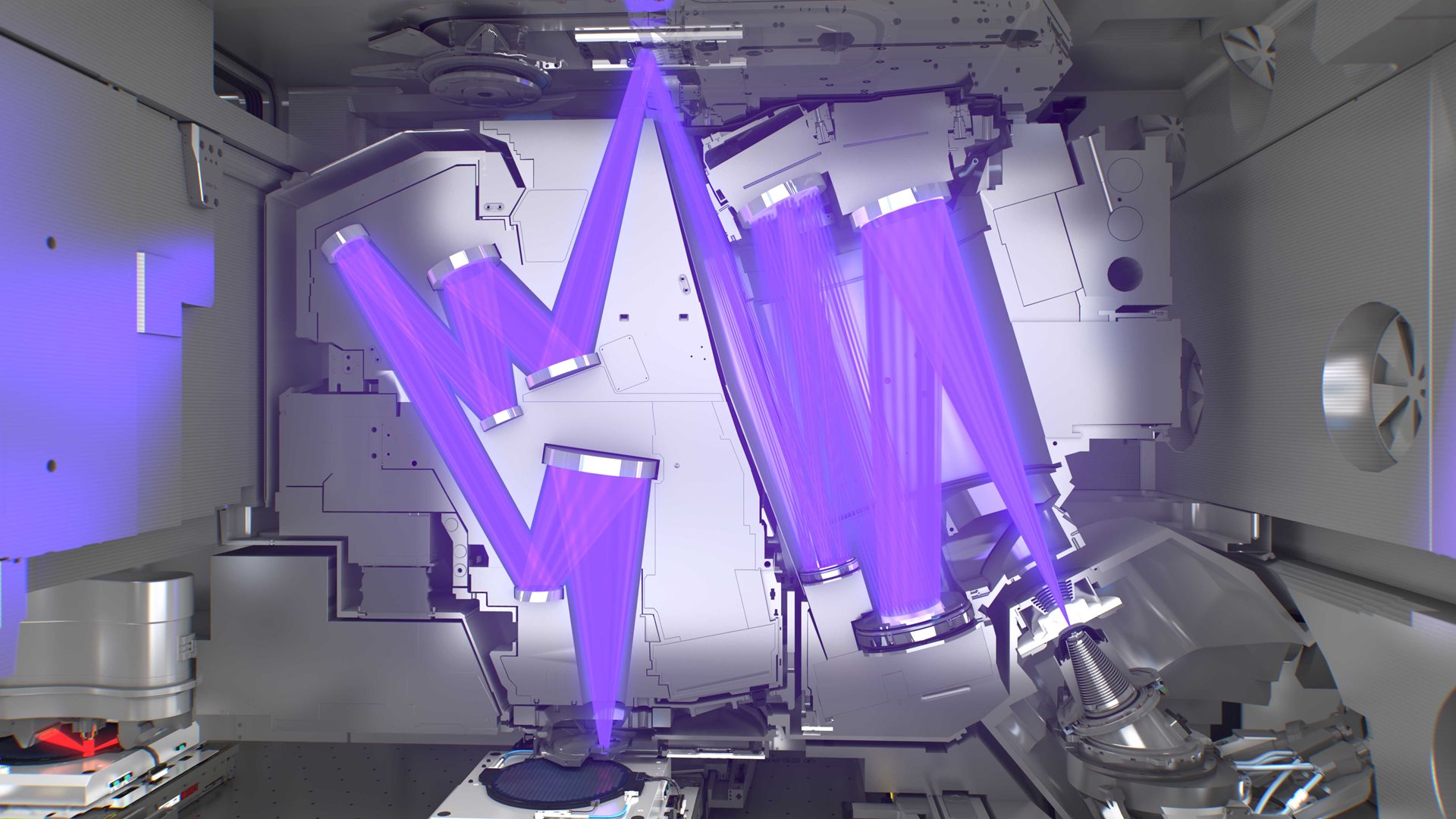
    That light source is extreme ultraviolet (EUV), with a wavelength of just 13.5nm. Getting there took ASML and its partners over 30 years. The Veritasium documentary The Machine That Saved Moore’s Law captures the absurdity of the engineering involved: you fire a high-powered laser at tiny droplets of molten tin, 50,000 times per second, each droplet hit twice: once to flatten it, once to vaporise it into a plasma that emits EUV light. That light is then bounced off a series of mirrors so perfectly smooth that if you scaled one up to the size of Germany, the largest bump would be a millimetre tall.

    Each EUV machine weighs about 180 tonnes, requires three Boeing 747s to ship, and costs upwards of €350 million. ASML recognised revenue on 48 EUV systems in 2025. Nobody else can build these machines. Intel tried to develop its own EUV capability decades ago and abandoned the effort. Nikon, once a competitor in DUV, never made the leap. ASML’s monopoly on EUV isn’t a moat. It’s an ocean.

    But ASML isn’t only EUV. The company also dominates DUV lithography (used for less advanced but still critical chip nodes), and it sells metrology and inspection systems through its Computational Lithography division. In FY2025, EUV accounted for 48% of systems revenue (€11.6 billion, up 39% year-on-year) with DUV and other products making up the rest. The installed base of lithography systems worldwide also generates recurring service and upgrade revenue. Installed base management contributed €8.2 billion in FY2025, about 25% of total sales.

    Financial Performance

    ASML’s financials over the past five years tell a story of accelerating demand for advanced chipmaking equipment, punctuated by the usual semiconductor-cycle swings.

    Metric FY2021 FY2022 FY2023 FY2024 FY2025
    Revenue (€B) 18.6 21.2 27.6 28.3 32.7
    Net income (€B) 5.9 5.6 7.8 7.6 9.6
    Net margin 31.7% 26.4% 28.3% 26.9% 29.4%
    Gross margin 52.7% 50.5% 51.3% 51.3% 52.8%
    EPS (€, basic) 14.36 14.14 19.91 19.25 24.73
    Bookings (€B) 26.2 30.7 20.0 18.9 28.0
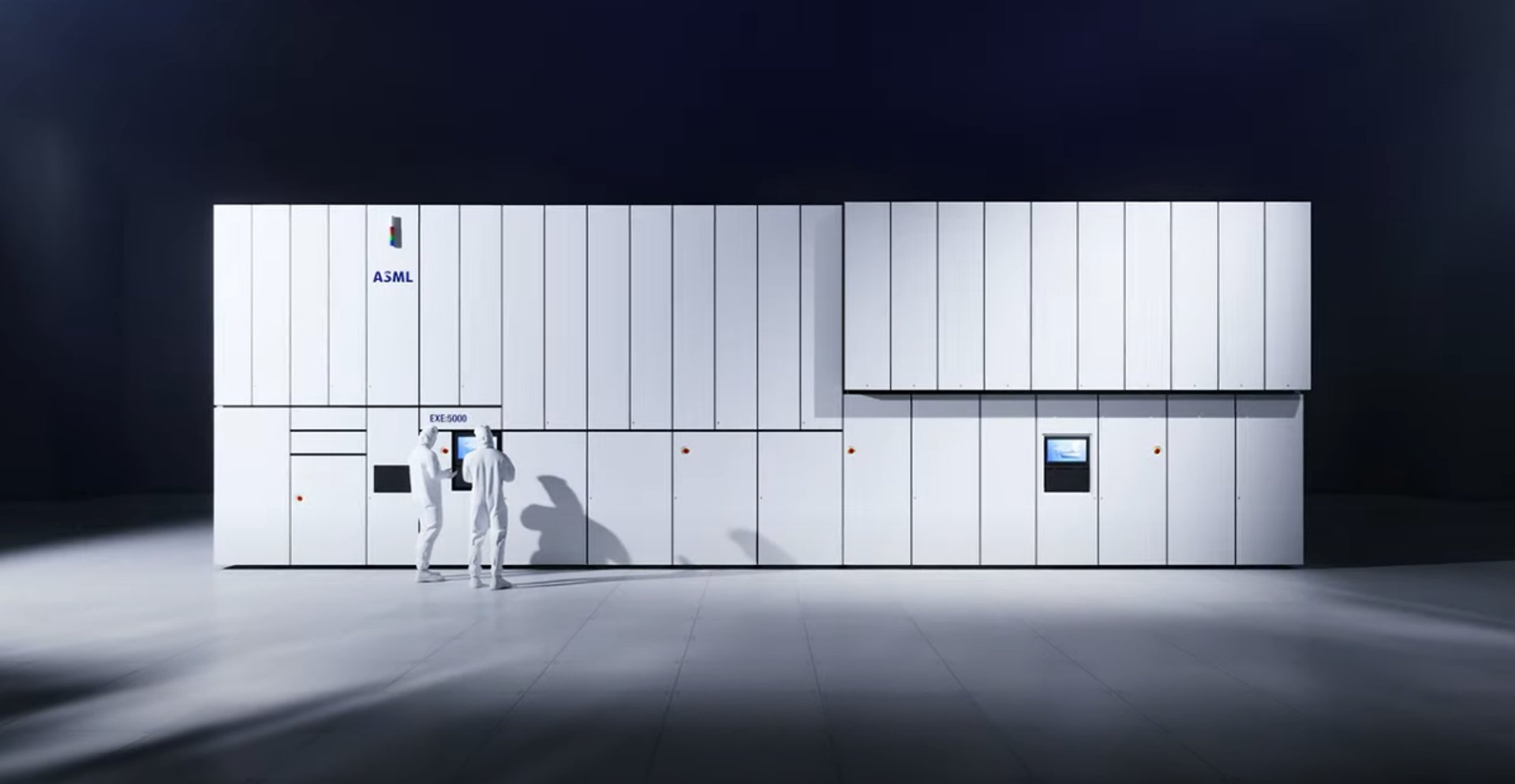
    ASML High-NA EUV lithography system, the next generation of semiconductor manufacturing technology
    ASML’s High-NA EUV technology. Source: ASML

    A few things stand out. Revenue nearly doubled from 2021 to 2025, driven by surging demand for EUV machines. But bookings tell the more interesting story: they peaked at €30.7 billion in 2022, then fell to €20.0 billion in 2023 and €18.9 billion in 2024 as customers digested post-pandemic inventory. In October 2024, ASML accidentally leaked Q3 results showing weaker-than-expected orders. The stock dropped 16% in a single session. And then the cycle turned. Q4 2025 alone brought in €13.2 billion in new bookings, nearly double analyst expectations, and full-year 2025 bookings hit €28.0 billion. Semiconductor cycles haven’t been repealed, but AI demand is providing a powerful upswing.

    Margins are striking. ASML consistently earns gross margins above 50% and net margins near 30%. For a hardware company shipping physical machines, those are software-like numbers. That’s monopoly pricing at work: when your customers have no alternative supplier, you set the terms.

    The backlog at the end of Q4 2025 stood at €38.8 billion, providing strong visibility for the next 12 to 18 months. Management guided FY2026 revenue at €34 to €39 billion, implying continued growth at the midpoint.

    Valuation

    ASML’s valuation is the question that keeps potential investors up at night. Let’s look at the numbers without flinching.

    Metric ASML Applied Materials KLA Corp Lam Research
    P/E (trailing) ~49x ~38x ~40x ~48x
    P/E (forward) ~34x ~26x ~32x ~28x
    EV/EBITDA (fwd) ~35x ~20x ~32x ~24x

    The entire semiconductor equipment sector trades at elevated multiples right now, inflated by AI capex expectations. ASML is the most expensive of the group, but the gap is smaller than you might expect. Lam Research trades at nearly the same trailing P/E (~48x), and KLA isn’t far behind (~40x). Applied Materials is the relative bargain at ~38x trailing.

    So the question isn’t “why is ASML expensive?” but rather “does ASML deserve a premium even within an already expensive sector?” The argument for yes: ASML has a monopoly. The others don’t. Applied Materials, KLA, and Lam Research all compete with each other in etch, deposition, and inspection. ASML competes with nobody in EUV. That structural advantage, plus the recurring installed base revenue, earns it a higher multiple.

    The argument for caution: at ~49x trailing earnings, the market is pricing in years of strong growth before ASML “grows into” this valuation. Historically, ASML’s P/E has ranged from the low 20s during down-cycles to the high 50s during peak euphoria. At current levels, it sits in the upper half of that range.

    One way to think about it: if ASML hits the midpoint of its 2026 guidance (~€36.5 billion revenue) and maintains a 29% net margin, that’s roughly €10.6 billion in net income, or about €27 per share. At €1,200, that’s around 44x forward earnings. For a monopoly growing at mid-teens with decades of runway, some investors can stomach that. Others will wait for a pullback. Both positions are reasonable.

    The Bull Case

    AI capex is still accelerating

    Every major AI model (GPT-5, Gemini, Llama) needs more compute, which means more advanced chips, which means more EUV machines. ASML’s own projections estimate the semiconductor market growing from around $600 billion in 2024 to over $1 trillion by 2030. The share of advanced nodes (where EUV is indispensable) keeps rising. SK Hynix confirmed this trajectory by placing a $8 billion order on 24 March 2026, the largest in ASML’s history, specifically for high-bandwidth memory (HBM) production, the chips that go into AI accelerators.

    High-NA EUV is the next growth driver

    ASML’s next generation machine, the Twinscan EXE:5000 (High-NA EUV), is now entering production at Intel and Samsung. These machines have a higher numerical aperture, enabling even finer chip patterns. They cost around $380 million (~€350 million) each, compared to roughly $200 million for the current generation. As leading chipmakers transition to 2nm and below, High-NA adoption should drive higher average selling prices and revenue growth well into the 2030s.

    Installed base generates recurring revenue

    With over 5,500 lithography systems in operation worldwide, ASML’s service and upgrade business generates predictable revenue that smooths out cyclical swings. In FY2025, installed base management contributed €8.2 billion in revenue (up 26% year-on-year). As the EUV installed base grows, this segment should compound. Customers can’t service these machines with third-party providers because the technology is too specialised.

    Geopolitical reshoring benefits ASML

    The global push to build domestic chip capacity (the CHIPS Act in the US, the European Chips Act, Japan’s semiconductor strategy) means more fabs being built in more places. Each new fab needs lithography equipment. The European Chips Act alone targets doubling EU chip production by 2030. More fabs, more ASML machines.

    The Bear Case

    China restrictions are a real revenue headwind

    China was ASML’s second-largest market in FY2024, accounting for roughly 30% of systems revenue. US-led export controls, tightened in late 2024 and early 2025, now bar ASML from selling any EUV machines and some advanced DUV systems to Chinese customers. ASML has acknowledged that Chinese revenue will decline materially in 2026. The company managed the transition better than feared by reallocating capacity to other customers, but losing a third of your addressable market is not trivial.

    Customer concentration is extreme

    ASML’s three largest customers (TSMC, Samsung, and Intel) collectively account for the vast majority of EUV orders. If one of them delays capital expenditure (as Intel did in 2023), it ripples through ASML’s bookings. This concentration also gives these customers meaningful negotiating power. When TSMC asks for better terms, ASML has limited ability to say no.

    Semiconductor cycles haven’t been abolished

    The AI boom has made people forget that semiconductors are cyclical. The booking slump of 2023 and 2024 happened less than two years ago. If AI capex slows, whether because of a macro downturn, overbuilding, or slower-than-expected AI revenue for hyperscalers, ASML’s orders will feel it. The backlog provides a cushion, but it doesn’t make the company immune to cycles.

    Valuation leaves little room for disappointment

    At ~49x trailing earnings, the market is pricing in continued strong execution and growth. Any miss on guidance, margin compression from High-NA ramp costs, or geopolitical shock could trigger a meaningful de-rating. We saw this in October 2024 when ASML accidentally leaked Q3 results showing weaker bookings. The stock dropped 16% in a single day.

    Dividend Profile

    ASML is not a dividend stock, but it does return capital. The company proposed €7.50 per share in dividends for FY2025 (a 17% increase over FY2024’s €6.40), yielding roughly 0.6% at current prices. The payout ratio sits around 30% of net income, which is conservative and leaves room for growth.

    More significant than the dividend is the buyback programme. ASML announced a new €12 billion share repurchase programme running through December 2028. Between dividends and buybacks, the company returns a substantial portion of its free cash flow. If you’re buying ASML for income, you’re buying the wrong stock. The thesis here is growth and capital appreciation, with the dividend as a modest bonus.

    How to Buy ASML in Europe

    ASML is one of the easiest European stocks to buy. It’s listed on Euronext Amsterdam under ticker ASML and on the NASDAQ under the same ticker. As a European investor, buying on Euronext avoids currency conversion fees entirely if you hold euros.

    Broker ASML available? Exchange Approx. fee per trade (€5,000)
    Interactive Brokers Yes Euronext AMS + NASDAQ €1.25 to €3.00
    Degiro Yes Euronext AMS + NASDAQ €2.00 (Euronext core selection)
    Trade Republic Yes LSX (Lang & Schwarz) €1.00
    Scalable Capital Yes gettex / Xetra €0.99 to €3.99

    If you plan to buy and hold, I’d lean towards Interactive Brokers or Degiro for direct Euronext access. Trade Republic and Scalable Capital route through alternative exchanges (LSX, gettex), which works fine for most retail orders but may have wider spreads during volatile sessions. For a full breakdown of costs and features, see our best brokers for European investors comparison. [AFFILIATE:IBKR] [AFFILIATE:DEGIRO]

    My Take

    I have a personal affinity for companies that build the foundational technology others depend on. In every gold rush, the most reliable profits go to whoever sells the shovels. ASML doesn’t just sell shovels for the AI gold rush. It is the only company that can make them.

    What drew me to ASML wasn’t a financial ratio. It was understanding what EUV lithography involves: firing lasers at tin droplets in a vacuum, bouncing light off mirrors accurate to the width of an atom, all 50,000 times per second. The fact that this works at all, and that one company in the Netherlands figured out how to make it work reliably enough to ship dozens of machines a year, is one of the most remarkable engineering achievements in human history. When I find a company where the technology itself creates an unassailable competitive advantage, that catches my attention.

    The risk is the price. At current multiples, you’re paying for excellence, and any stumble will hurt. I initiated a position in March 2026 because I believe the AI infrastructure buildout has years left to run and ASML sits at the very centre of it. But I’m not naive about cyclicality. I sized this position knowing that a 25 to 30% drawdown in a semiconductor downturn would not surprise me.

    Disclosure: I hold a long position in ASML, initiated March 2026.

    FAQ

    Is ASML a good stock to buy in 2026?

    ASML has strong fundamentals: monopoly position in EUV, growing backlog, and exposure to the AI capex cycle. However, the stock trades at a premium valuation that prices in continued growth. Whether it’s “good” depends on your time horizon and risk tolerance. This is not investment advice. Do your own research or consult a financial advisor.

    Why is ASML the only company that makes EUV machines?

    EUV lithography required over 30 years and billions in R&D to develop, involving breakthroughs in optics, laser technology, and precision engineering. ASML built this capability through deep partnerships with Carl Zeiss (optics) and Trumpf (laser source). The technical barriers are so high that no competitor, including Nikon, has been able to replicate the technology. Starting from scratch today would take decades and tens of billions of euros.

    How do China export restrictions affect ASML?

    US-led export controls prevent ASML from selling EUV systems and some advanced DUV systems to Chinese customers. China was roughly 30% of systems revenue in FY2024, so the impact is material. ASML has been reallocating capacity to customers in other regions, but the lost China revenue is a headwind for growth.

    Can I buy ASML on Euronext in euros?

    Yes. ASML’s primary listing is on Euronext Amsterdam (ticker: ASML). Most European brokers, including Interactive Brokers, Degiro, Trade Republic, and Scalable Capital, offer access. Buying on Euronext means you trade in euros and avoid currency conversion fees.

    Does ASML pay a dividend?

    Yes. ASML proposed €7.50 per share for FY2025, yielding approximately 0.6% at current prices. The dividend has grown consistently over the past decade, though the yield remains modest. ASML also returns capital through share buybacks.

    Methodology

    This stock review is based on ASML’s publicly filed annual reports and quarterly earnings releases, regulatory filings, third-party financial data from Yahoo Finance and Morningstar, and industry analysis from SEMI. The EUV technology explanation draws on the Veritasium documentary linked above. Valuation peer comparisons use trailing and forward estimates from consensus analyst data as of March 2026. All financial figures are in euros unless otherwise stated. I last verified these numbers on 25 March 2026.

    Disclaimer: This article is for informational and educational purposes only. It is not investment advice. I may hold positions in the securities discussed, and in the case of ASML, I do hold a long position initiated in March 2026. Past performance does not guarantee future results. Investing involves risk, including the possible loss of principal. Always do your own research or consult a qualified financial advisor before making investment decisions.

    Affiliate disclosure: Some links in this article are affiliate links. If you open an account through these links, The Bourse Report may receive a commission at no additional cost to you. This does not influence our editorial opinions. We recommend only brokers we’ve personally used and tested. See our editorial policy for details.