Choosing the best broker Europe 2026 has to offer is one of the most consequential financial decisions you’ll make, and it has nothing to do with which stock to buy. Two people making the exact same trades, in the exact same stocks, for the exact same amounts, will pay very different fees depending on the broker they chose. Over a decade of investing, those differences compound into thousands of euros. You’d rather be on the right side of that gap.
The trouble with most broker comparisons is that they show you the cost per trade and leave you to figure out the rest. That’s a bit like showing you the price per ingredient and expecting you to calculate what dinner costs. It depends entirely on what you’re cooking.
So instead of listing features and hoping you can map them to your situation, we built three investor profiles, ran the numbers using each broker’s official fee schedule, and let the maths tell the story. The results surprised us, and they might surprise you too.
Three Investors, Five Brokers, Verified Numbers
We created three profiles that cover the range of European retail investors we hear from most often. Each one has a name, a portfolio size, a trading style, and a specific set of needs. The brokers are Interactive Brokers, Trade Republic, Scalable Capital (Free and PRIME+ tiers), Degiro, and eToro.
Clara, 29, Lyon. Starting out.
Clara decided this year to start investing. She’s done her reading, she knows she wants a diversified ETF, and she’s set aside €10,000 from her savings. Her plan is to invest €200 per month through a savings plan, make two or three manual trades per year when she has extra cash, and otherwise leave things alone. She keeps about €2,000 at her broker as a buffer. She buys European ETFs only, so there’s no currency conversion involved.
Clara doesn’t need advanced tools or access to exotic markets. She needs something that’s cheap, simple, and regulated by a serious authority. She’ll check her portfolio on her phone once a week and forget about it the rest of the time. There are a lot of Claras in Europe, and for good reason: this is exactly the kind of steady, low-cost investing that the evidence says works best over the long run.
Marc, 42, Munich. Getting serious.
Marc has been investing for a few years and has built a €25,000 portfolio. He trades actively, about 35 times a year, mostly individual European stocks he researches himself. He doesn’t use a savings plan. He keeps €3,000 in cash for when he spots an opportunity. Like Clara, he sticks to EU markets for now.
Marc cares about execution speed, a decent trading interface, and keeping costs low across a higher volume of trades. He’s comfortable learning a more complex platform if the savings justify it.
Sophie, 38, Amsterdam. Going global.
Sophie has a €150,000 portfolio split roughly 70/30 between US and European stocks. She makes about 50 trades a year (15 European, 35 American), at an average of €3,000 per trade. Every month she converts around €5,000 from euros to dollars to fund her US positions. She doesn’t keep much idle cash at the broker because she prefers to stay fully invested. She’s also started learning about options and wants a platform that can handle them.
Sophie represents the investor who has outgrown the simple brokers. She needs global market access, competitive FX conversion, and products that go beyond stocks and ETFs. There are fewer Sophies than Claras, but the stakes are higher because the cost differences at this level are measured in hundreds of euros per year.
What Clara Actually Pays
We ran the numbers for Clara’s exact profile: 12 savings plan executions per year (one per month at €200), two manual trades at roughly €1,000 each, all in European ETFs, with €2,000 sitting in cash. Here’s what each broker costs her annually.
| Broker | Trading fees | Cash interest earned | Net annual cost |
|---|---|---|---|
| Trade Republic | €2 | €55 | −€53 (she earns money) |
| Scalable Capital (Free) | €2 | €0 | €2 |
| Scalable Capital (PRIME+) | €60 | €52 | €8 |
| Degiro | €12 | €0 | €12 |
| Interactive Brokers | €18 | €0 | €18 |
| eToro | €25 | €0 | €25 |
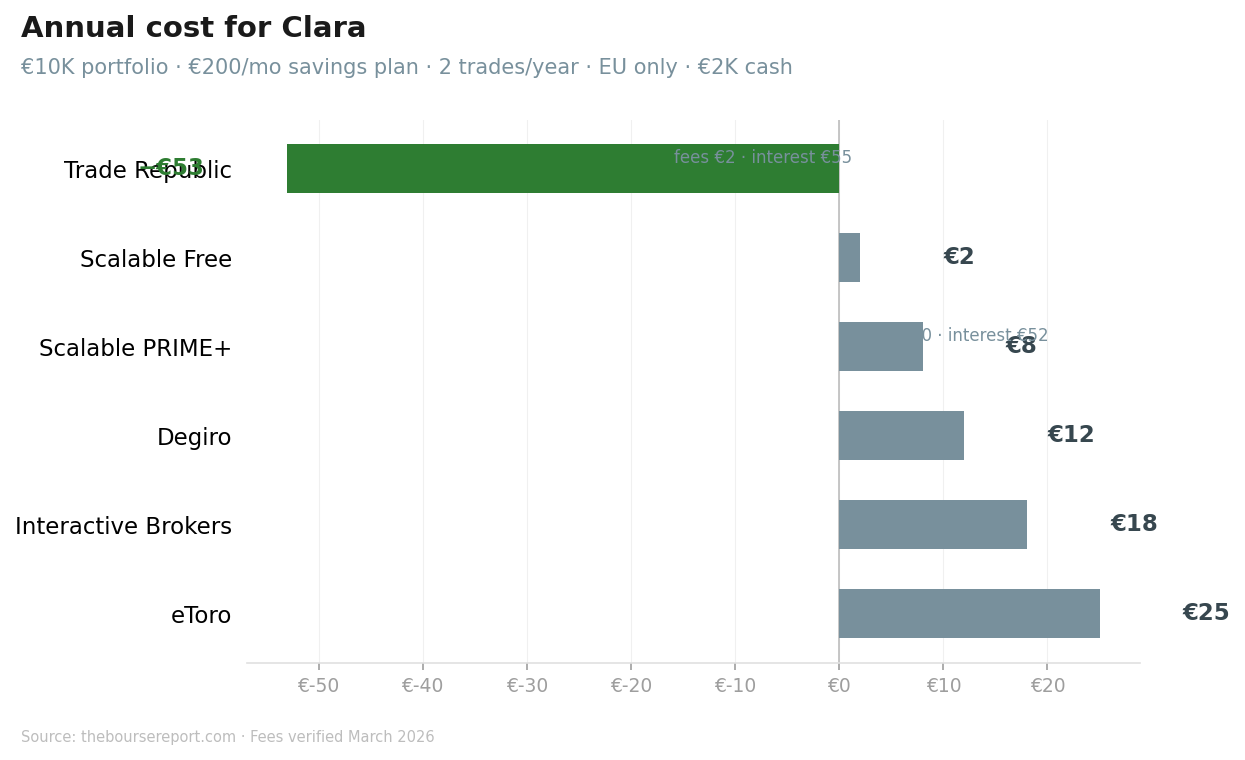
Trade Republic’s net cost is actually negative. Clara makes €53 per year just by having her cash there, because Trade Republic pays 2.75% interest on all uninvested cash with no minimum threshold. Her two manual trades cost €1 each. Her savings plan is free. For someone in Clara’s position, Trade Republic isn’t just the cheapest option; it’s the only one that pays her to use it.
Scalable Capital on the Free plan comes very close on trading fees (€0.99 per manual trade, savings plan free), but the Free plan pays no interest on cash, so she misses out on that €55. The PRIME+ plan at €4.99 per month would give her 2.6% interest, but the subscription adds up to €60 a year. For someone making only two manual trades, the subscription is hard to justify.
Interactive Brokers, which is genuinely the best broker on this list for larger and more complex portfolios, turns out to be one of the more expensive options for Clara. The reason is straightforward: IBKR doesn’t offer free savings plans. Each monthly execution costs €1.25 (the minimum fee on its Tiered plan), which adds up to €15 a year just for the savings plan, a cost that’s zero at Trade Republic and Scalable. And IBKR only pays interest on cash above €10,000, so Clara’s €2,000 buffer earns nothing.
For Clara’s profile, the answer is clear: Trade Republic first, Scalable Capital (Free) second.
Why Trade Republic over Scalable for beginners
Since both charge essentially the same trading fees, the question is worth answering properly. Three things tip the balance. First, Trade Republic has no subscription tiers to think about. You sign up, you trade, you’re done. Scalable’s three-tier model (Free, PRIME, PRIME+) is not complicated, but it introduces a decision that a new investor shouldn’t have to make on day one. Second, Trade Republic pays 2.75% interest on all cash from the first euro, while Scalable only pays interest on PRIME+. Third, Trade Republic holds a full banking licence from BaFin and the ECB, which means your cash is a genuine bank deposit protected by the German deposit guarantee scheme. At Scalable, your uninvested cash goes into a money market fund, which is different in both structure and legal protection.
What Marc Actually Pays
Marc’s 35 annual trades at an average of about €714 each, all in EU stocks, with €3,000 in cash.
| Broker | Trading fees | Cash interest earned | Net annual cost |
|---|---|---|---|
| Trade Republic | €35 | €83 | −€48 (earns money) |
| Scalable Capital (PRIME+) | €60 | €78 | −€18 |
| Scalable Capital (Free) | €35 | €0 | €35 |
| Interactive Brokers | €44 | €0 | €44 |
| eToro | €105 | €0 | €105 |
| Degiro | €174 | €0 | €174 |
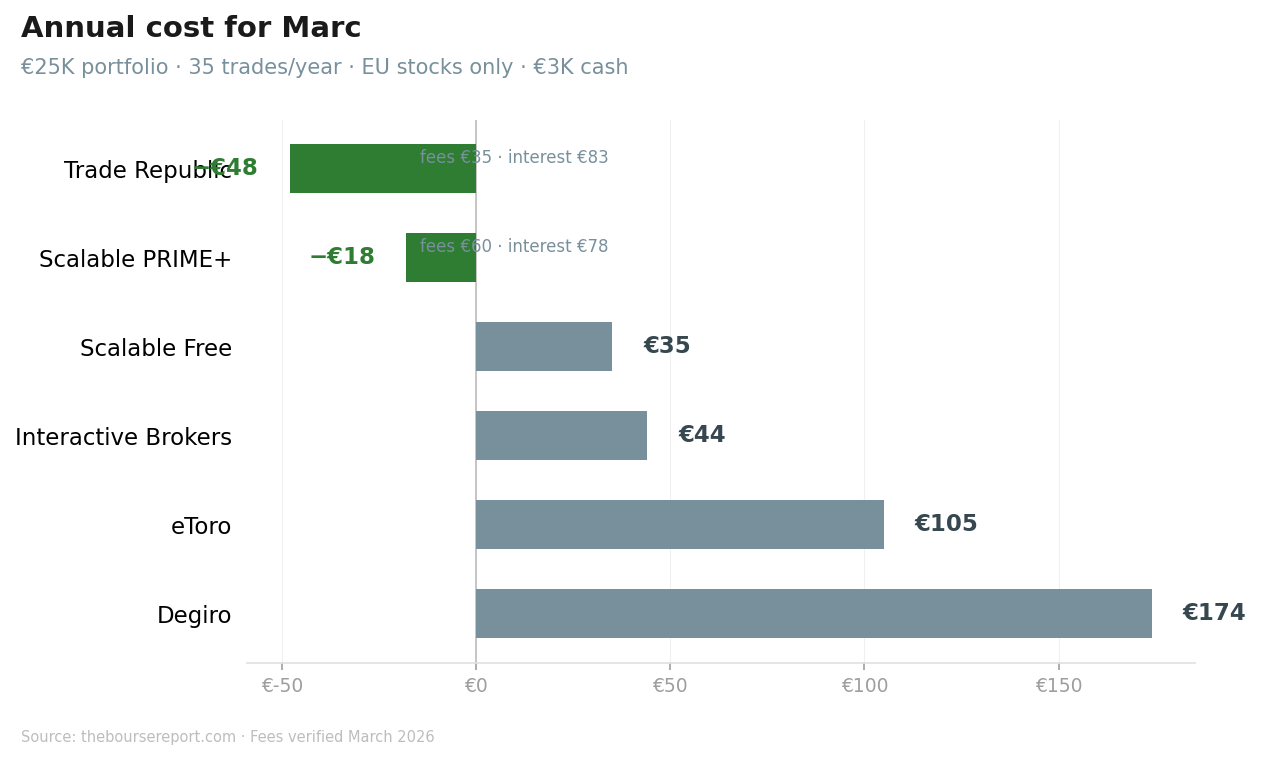
Degiro stands out here, and not in a good way. It was once the go-to low-cost broker in Europe, the platform that made cheap investing accessible to ordinary people. But at €3 to €4.90 per trade (depending on your home exchange), 35 trades a year adds up to €105–€172 plus a €2.50 connectivity fee. That is three to five times what Trade Republic charges for the same trades.
Trade Republic wins again on net cost because of the cash interest. But Scalable Capital PRIME+ deserves a closer look here. At €4.99 per month (€60 a year), all of Marc’s trades above €250 become free. Since his average trade is €714, every one of them qualifies. Add the 2.6% interest on his €3,000 in cash, and his net cost is −€18. For someone who trades at Marc’s frequency, the subscription starts paying for itself.
Interactive Brokers comes in at €44, which is competitive, but without the cash interest advantage. IBKR requires over €10,000 in uninvested cash before it pays anything, so Marc’s €3,000 earns nothing. On raw per-trade cost, IBKR at €1.25 is close to Trade Republic’s €1.00, but that small gap multiplied by 35 trades adds up.
For Marc’s EU-only profile: Trade Republic if he values simplicity and cash interest. Scalable PRIME+ if he trades often enough to make the subscription worthwhile.
What Sophie Actually Pays
This is where the picture changes completely. Sophie’s profile includes 15 European trades, 35 US trades, and monthly currency conversions of €5,000. The currency conversion is the key variable, because every time a European investor buys an American stock, their euros need to become dollars first, and each broker charges a very different rate for that conversion.
| Broker | Annual cost (trading + FX fees) |
|---|---|
| Interactive Brokers | €77 |
| Trade Republic | €170 |
| Scalable Capital (Free) | €170 |
| Scalable Capital (PRIME+) | €180 |
| Degiro | €299 |
| eToro | €620 |
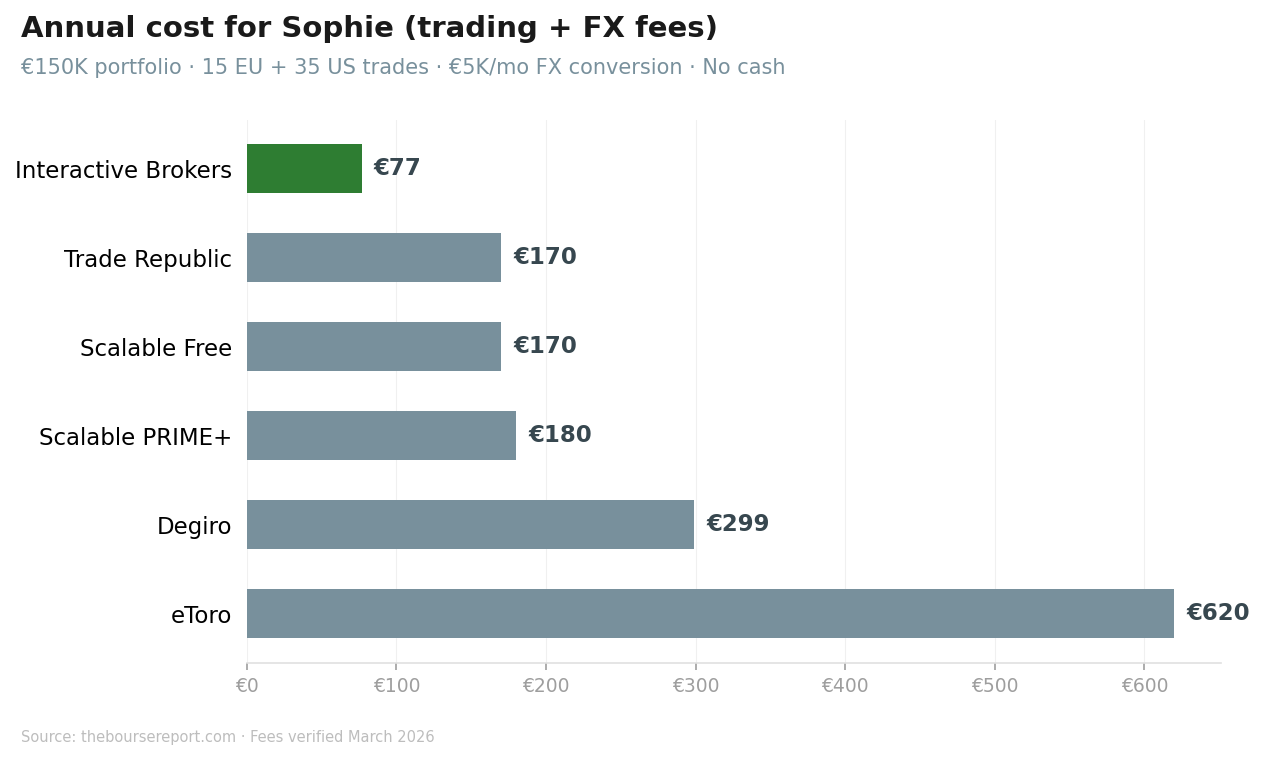
Interactive Brokers is the cheapest broker by a wide margin: €77 per year, less than half what Trade Republic charges. The reason is almost entirely down to currency conversion. IBKR converts euros to dollars at 0.03%, with a minimum fee of €1.84 per conversion. Trade Republic and Scalable charge 0.2%. Degiro charges 0.25%. eToro charges 0.75%. On €60,000 converted over a year, that’s €22 at IBKR versus €120 at Trade Republic versus €450 at eToro. The chart below isolates just the FX cost to show how dramatic the difference is.
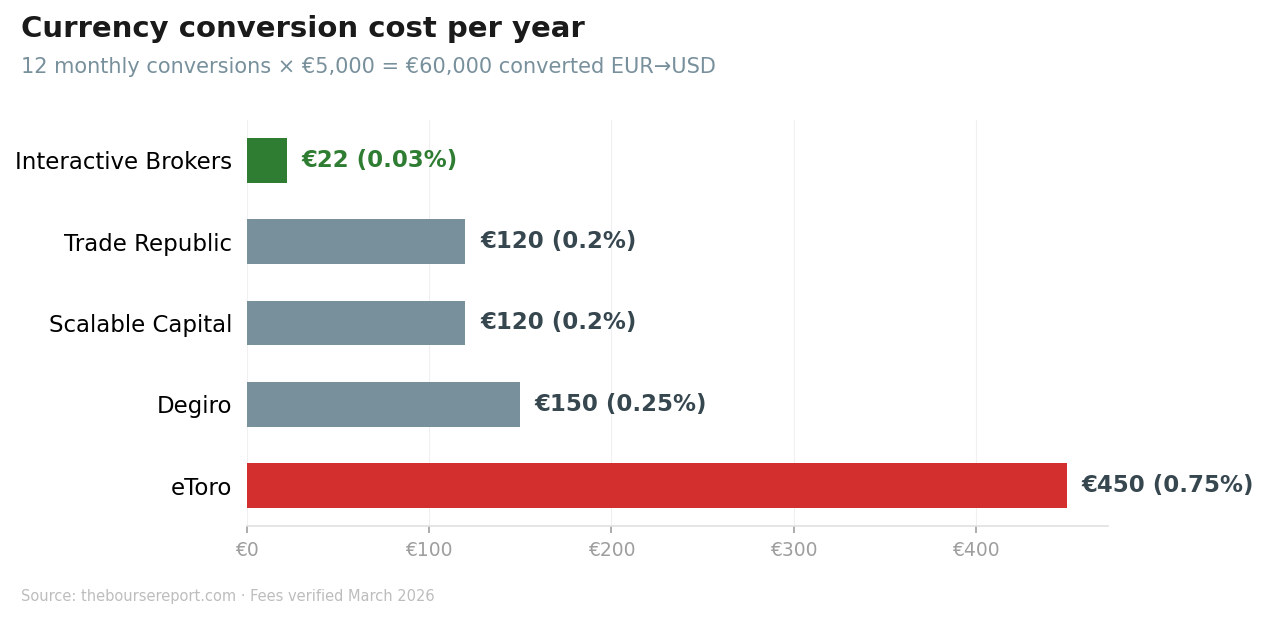
And there’s something the numbers can’t capture at all. IBKR is the only broker on this list where Sophie can trade options. It’s the only one that gives her access to 150+ exchanges in 30+ countries. If she wants to buy a Japanese stock, write a covered call on her Apple position, or trade futures on Eurex, she can do all of that from one account. Trade Republic and Scalable give her access to one or two exchanges. For someone whose investing has grown beyond European ETFs, that difference in product range is the real story.
For Sophie’s profile: Interactive Brokers, and it’s not close.
Read our full Interactive Brokers review →
Beyond the Spreadsheet
Cost is the easiest thing to compare, but once you’re actually using a broker every week, other things start to matter. Here’s what the numbers can’t tell you.
How safe is your money? Trade Republic, Scalable Capital, and Degiro all offer €100,000 in investor protection for cash deposits. Interactive Brokers and eToro offer €20,000. Your stocks and ETFs are held in segregated accounts at all of them (they’re legally yours, not the broker’s), so this is really about uninvested cash. If you keep significant cash at your broker, the difference between €20,000 and €100,000 protection is one worth knowing about. Trade Republic goes further: its full banking licence means your cash is a proper bank deposit, not a position in a money market fund.
How does it feel to use? Trade Republic is a phone app, clean and minimal. You can place a trade in about thirty seconds. Scalable Capital has both a web platform and an app, slightly more features, still intuitive. Degiro works but feels dated, like a car that runs fine but hasn’t been redesigned since 2015. IBKR is powerful and complex. The new Desktop app is a genuine improvement over the old Trader Workstation, but the learning curve is measured in days rather than minutes. eToro is polished and has a social feed where you can see what other investors are doing, which you’ll either find interesting or distracting.
What can you actually buy? This is where they really separate. Trade Republic and Scalable Capital give you stocks and ETFs on one or two exchanges (LS Exchange, gettex, Xetra). That’s plenty for most European investors buying mainstream ETFs and blue-chip stocks. Degiro covers about 30 exchanges. IBKR covers 150+ exchanges across 30+ countries, plus options, futures, bonds, and forex. eToro offers stocks, ETFs, and CFDs, which are leveraged instruments where most retail investors lose money (the regulatory warnings on their site are there for a reason). If you only buy European ETFs, you don’t need 150 exchanges. But if your ambitions grow, you’ll want a broker that can grow with you.
Who watches over them? Trade Republic and Scalable Capital are regulated by BaFin, Germany’s financial regulator, which is among the strictest in Europe. Trade Republic has additional ECB oversight through its banking licence. Degiro is regulated by BaFin and the Dutch AFM. IBKR is supervised by the Central Bank of Ireland. eToro is regulated by CySEC in Cyprus. All are legitimate EU regulators, but the intensity of oversight does vary. Think of it as the difference between getting your car inspected every year versus every three years. Both cars might be perfectly fine, but you have more recent information about one of them.
So Which Is the Best Broker Europe 2026?
If you recognise yourself in Clara’s profile (starting out, small portfolio, savings plan, EU markets), Trade Republic is the obvious choice. The fees are minimal, the cash interest is a genuine bonus, the app is straightforward, and you won’t outgrow it for a while. Scalable Capital (Free) is a strong alternative if you prefer a web platform or want access to Xetra.
If you’re closer to Marc (active trader, mid-sized portfolio, EU stocks), both Trade Republic and Scalable Capital work well. For frequent traders, Scalable PRIME+ starts making sense because the trades become free above €250 and the subscription is partly offset by cash interest. If you want the lowest per-trade cost without committing to a subscription, Trade Republic’s flat €1 is hard to beat.
If you’re in Sophie’s territory (large portfolio, US and international stocks, options), Interactive Brokers is the right answer. Its currency conversion alone saves you roughly €100 per year over the next cheapest alternative and over €400 per year over eToro. The platform requires patience to learn, but the savings compound every year, and no other broker gives you access to the same range of products and markets.
If you’re specifically interested in copy trading, eToro is the main option in Europe. Just know that the costs are meaningfully higher than alternatives, particularly once you account for the 0.75% FX markup on every deposit.
And Degiro? It was a pioneer. It made European low-cost investing possible for a generation of investors. But at €2 to €4.90 per trade (depending on your country) when competitors charge €1 or less, it is difficult to recommend for a new account in 2026. The ETF Core Selection at €1 per trade on Tradegate remains competitive, but for stocks, the newer platforms offer more for less. If you already have one and you are comfortable with it, there is no rush to switch. Read our full Degiro review.
| Broker | Best for | Trading fee | Regulation | Investor protection | Full review |
|---|---|---|---|---|---|
 Trade Republic |
Beginners, savers | €1 flat | BaFin + ECB | €100,000 | Review → |
 Scalable Capital |
ETF savings plans, active EU traders | €0.99 or PRIME+ | BaFin | €100,000 | Review → |
 Interactive Brokers |
Global investors, options, large portfolios | 0.05% / min €1.25 | Central Bank of Ireland | €20,000 | Review → |
 Degiro |
Budget ETF investors | €2–€4.90* | BaFin + AFM | €100,000 | Review → |
 eToro |
Copy trading | ~€1.38 + 0.75% FX | CySEC | €20,000 | Review → |
*Degiro’s EU stock fee depends on your home exchange: €2 per trade on Euronext Paris (FR accounts), €3 on Euronext Amsterdam/Dublin (NL/IE accounts), €4.90 on Xetra (DE accounts). Core Selection ETFs cost €1 on Tradegate regardless of country. See our full Degiro review.
What I Use, and What I Don’t Know Yet
I use Interactive Brokers. It’s where my portfolio lives: EU and US stocks, options, currency conversions. I’ve had the account for about three years. The learning curve was real, and the first month involved more confusion than I’d care to admit. But the costs are low, the execution is solid, and once you know the interface, it does exactly what it should.
I haven’t used Trade Republic, Scalable Capital, Degiro, or eToro with real money. Their sections in this article are based on official fee schedules, regulatory filings, platform documentation, and conversations with investors whose judgement I trust. I plan to open accounts at Trade Republic and Degiro in the coming months and will update this page with first-hand observations when I do. Until then, I’ve been clear about what comes from direct experience and what comes from research.
Frequently Asked Questions
Which broker is best for a beginner in Europe?
Trade Republic. It charges €1 per trade, offers free savings plans, pays 2.75% interest on cash, and has €100,000 investor protection under a full banking licence. Scalable Capital (Free plan) is a close second with nearly identical fees, but no cash interest on the free tier. See our guide on the best broker for beginners.
How much does currency conversion cost at European brokers?
It varies enormously. IBKR charges 0.03% (€3 on a €10,000 conversion). Degiro charges 0.25% (€25). eToro charges 0.75% to 1.0% (€75 to €100). If you buy US stocks regularly, FX conversion will likely be your single biggest annual cost. It’s the first thing to check when comparing brokers for international investing.
Is Interactive Brokers safe for European investors?
IBKR is regulated by the Central Bank of Ireland, publicly traded on NASDAQ, and has operated since 1978 with over $500 billion in client assets. Investor protection covers €20,000 per person, which is lower than the €100,000 at Trade Republic, Scalable, and Degiro. Your stocks and ETFs are held in segregated accounts (legally yours regardless of what happens to the broker), but cash is protected only up to the limit.
Can I buy US stocks from Europe?
Yes. All five brokers listed here give you access to US stocks on NASDAQ and NYSE. The difference is cost: every purchase involves converting euros to dollars, and the FX rate ranges from 0.03% (IBKR) to 1.0% (eToro). Over time, this fee matters more than the trading commission itself. See our guide on how to buy US stocks in Europe.
Which broker is cheapest for ETF savings plans?
Trade Republic and Scalable Capital both offer free ETF savings plans. Degiro offers 1,000+ ETFs in its Core Selection at €1 per trade on Tradegate, with the first monthly trade per ETF free. IBKR charges its normal commission (minimum €1.25) on recurring investments, which makes it the most expensive option for savings plans specifically. See our breakdown of the best broker for ETFs in Europe.
Methodology
Fee calculations are based on official broker pricing pages, verified in March 2026. Trading cost estimates use the specific investor profiles detailed above rather than generic assumptions, and were computed programmatically using a Python calculator to avoid rounding errors. Cash interest rates reflect published rates as of March 2026 and will change with ECB rate decisions. Currency conversion costs are calculated on actual FX conversion volumes for each profile. The author uses Interactive Brokers as his primary broker; the other four brokers were evaluated through fee schedules, regulatory filings, and community experience. Rankings reflect a long-term European retail investor perspective. For our full approach, see our editorial policy.
Disclaimer: This article is for educational purposes and does not constitute financial advice. We may earn affiliate commissions if you open an account through our links. This does not affect our rankings or increase your costs. Broker fees, features, and regulations change. Always verify current information on the broker’s official website. Investing carries risk, including potential loss of capital. See our full disclaimer.
Disclosure: This article contains affiliate links. We may earn a commission if you open an account through our links, at no additional cost to you. This does not influence our ratings or recommendations. See our full affiliate disclosure.