Tag: broker-review

  • Degiro Review 2026: Low Fees, but Is It Enough?

    Degiro Review 2026: Low Fees, but Is It Enough?

    Degiro logo - Degiro review Europe 2026
    Degiro β€” one of Europe’s original low-cost brokers

    This Degiro review Europe 2026 Europe covers everything you need to know before opening an account in 2026. Degiro made cheap investing possible on the continent. For years, it was the broker European investors recommended to each other in Reddit threads, personal finance blogs, and office conversations. Open an account in ten minutes, buy an ETF for almost nothing, done.

    That was true in 2018. In 2026, the landscape looks different. Trade Republic and Scalable Capital charge €1 or less per trade and pay interest on your cash. IBKR gives you 150+ exchanges and the lowest FX rates in Europe. Degiro still works, and it still costs less than a traditional bank. But I went through the numbers carefully, and the verdict surprised me: for anyone opening a new account today, Degiro is no longer the obvious choice it once was. Rating: 7.5/10

    Key Takeaways

    • ETF Core Selection: €1 per trade on Tradegate, first monthly trade free per ETF
    • EU stock fees vary by country: €2 (France), €3 (NL, Ireland), €4.90 (Germany) per trade
    • US stock fees: €2 per trade (€1 commission + €1 handling), plus 0.25% FX conversion
    • No custody fees, no inactivity fees, no withdrawal fees
    • Regulated by BaFin (Germany), supervised by AFM/DNB (Netherlands)
    • €100,000 cash deposit guarantee (German scheme), €20,000 investor compensation
    • 3.5 million customers across 15 European countries
    • Best suited for buy-and-hold ETF investors with portfolios under €50,000 who prioritise simplicity

    Key Facts at a Glance

    Feature Details
    Founded 2008 (Amsterdam)
    Parent company flatexDEGIRO SE (publicly traded, FTK on Xetra)
    Primary regulator BaFin (Germany)
    Additional oversight AFM and DNB (Netherlands)
    Investor protection (cash) €100,000 (German Deposit Guarantee)
    Investor compensation Up to €20,000 (90% of loss)
    Available in 15 European countries
    Total customers ~3.5 million (Q4 2025)
    Minimum deposit €0.01 (effectively none)
    EU stock fee €2–€4.90 (varies by home exchange)
    US stock fee €2 (€1 + €1 handling)
    ETF Core Selection €1 per trade (first monthly trade free on Tradegate)
    FX conversion 0.25%
    Custody fee None
    Inactivity fee None
    Options Yes (€0.75 per contract)
    Futures Yes (€0.75 per contract)
    Interest on cash No

    Who Is Degiro Best For?

    European ETF investors on a budget. If you buy one or two ETFs per month through the Core Selection, your total trading cost is €1 per trade on Tradegate. The first trade each month in a given ETF is free. For a simple buy-and-hold strategy using UCITS ETFs, Degiro remains competitive.

    Investors who want a clean, minimal platform. Degiro’s interface does one thing and does it without clutter. You log in, you place an order, you leave. If IBKR’s four platforms and dozens of settings feel like overkill, Degiro is the opposite end of that spectrum.

    People who already have a Degiro account and are happy with it. Switching brokers involves transferring holdings, tax paperwork, and time. If your Degiro account is doing what you need, there is no urgent reason to move. The fee gap with newer competitors is real but not catastrophic for small portfolios.

    Who Should Look Elsewhere?

    Active traders. At €3–€4.90 per EU stock trade (depending on your country), 35 trades a year costs €105–€172 at Degiro versus €35 at Trade Republic. The gap widens with every trade.

    Global investors who buy US stocks regularly. Degiro charges 0.25% on every currency conversion. On €10,000 converted to dollars, that is €25. IBKR charges 0.03% for the same conversion: €3. Over a year of monthly conversions, the difference adds up to hundreds of euros.

    Anyone who values responsive customer support. Degiro’s support is email-only in most countries. Response times can stretch to days or weeks based on user reports. If you need a question answered before placing a trade, this matters.

    Investors who want to earn interest on idle cash. Degiro pays nothing on uninvested cash. Trade Republic pays 2.75% from the first euro. On a €5,000 cash buffer, that is €137 per year you leave on the table at Degiro.

    Fees & Pricing

    Degiro charges two things on every trade: a commission and a €1 handling fee. The commission depends on which exchange you trade on and whether it counts as your home market.

    Stock Trading Fees

    Your “home exchange” is the main exchange of the country where you opened your account. Degiro waives the annual connectivity fee for your home exchange and charges a lower commission on it. Here is what you pay per trade:

    Exchange Commission Handling Total per trade
    Euronext Paris (home for FR accounts) €1 €1 €2
    Euronext Amsterdam (home for NL accounts) €2 €1 €3
    Euronext Dublin (home for IE accounts) €2 €1 €3
    Xetra (home for DE accounts) €3.90 €1 €4.90
    US exchanges (NYSE, NASDAQ) €1 €1 €2

    For non-home European exchanges, add a €2.50 annual connectivity fee per exchange. This is capped at €2.50 per exchange per calendar year, so it only matters in your first trade of the year on that exchange.

    ETF Fees

    Degiro’s ETF Core Selection is its strongest feature. It includes over 1,000 ETFs on the Tradegate exchange. For these ETFs, you pay €0 commission + €1 handling = €1 per trade. The first trade per ETF per calendar month is free (no handling fee either) if you buy on Tradegate.

    ETFs outside the Core Selection cost €2 commission + €1 handling = €3 per trade on most exchanges.

    In October 2025, Degiro redesigned the Core Selection around Tradegate. The connectivity fee for Tradegate is waived, which makes this the cheapest way to buy ETFs on the platform.
    Degiro ETF search and selection screen showing available ETFs for European investors
    Degiro’s ETF search β€” browsing available ETFs on the platform

    Currency Conversion

    Every time you buy a non-EUR asset (US stocks, UK stocks), Degiro converts your euros at a 0.25% markup. The platform does this automatically on every trade. You cannot convert currency manually or hold foreign cash balances the way you can at IBKR.

    On a €5,000 US stock purchase, that is €12.50 in conversion fees, on top of the €2 trading fee. For context, IBKR charges €1.50 for the same conversion.

    Total Annual Cost Examples

    Using the three investor profiles from our best brokers comparison, here is what Degiro costs per year. We use €3 per EU trade (the NL/IE rate) as a representative mid-range figure:

    Profile Degiro IBKR Trade Republic
    Clara (€10K, 2 trades/yr, EU ETFs) ~€12 ~€18 βˆ’β‚¬53 (earns interest)
    Marc (€25K, 35 trades/yr, EU stocks) ~€107 ~€44 βˆ’β‚¬48 (earns interest)
    Sophie (€150K, 50 trades/yr, US+EU) ~€299 ~€77 ~€170

    Note: Clara’s Degiro cost uses Core Selection ETFs at €1 per trade. Marc’s and Sophie’s use the €3 mid-range for EU stocks. Sophie’s includes 0.25% FX conversion on €60,000 in annual currency conversions. For the full methodology, see our best online brokers comparison.

    Degiro is competitive for Clara’s simple ETF strategy. For Marc and Sophie, it is the most expensive option of the three.

    What is Free

    No custody fee, no inactivity fee, no deposit or withdrawal fees, no account maintenance fee. Real-time quotes on your home exchange are free. The Core Selection ETFs have no connectivity fee on Tradegate.

    Platform & User Experience
    Degiro login screen showing the clean, minimal interface for European investors
    Degiro’s login screen β€” clean and minimal, reflecting the platform’s no-frills approach

    Degiro offers a web platform and a mobile app (iOS and Android). There is no desktop application.

    You can find a stock, place an order, and check your portfolio without reading a manual. I tested the web platform and the navigation is fast: search, order, confirm, done. Compared to IBKR’s four platforms and dozens of configuration options, Degiro strips everything back to the essentials.

    That simplicity has trade-offs. There are no price alerts. The charting tools are basic. Portfolio reporting shows your total profit and loss but does not break down performance by individual position in a useful way. Research tools are minimal: you get basic fundamentals but nothing like IBKR’s analyst reports, screeners, or news feeds.

    Available order types: market, limit, stop loss, stop limit. Trailing stop orders work on German exchanges (Xetra and Frankfurt) only. If you trade on Euronext, you cannot set a trailing stop.

    The mobile app mirrors the web experience. It supports 11 languages. App store reviews praise the basics, but investors who want alerts, advanced charts, or detailed position analytics run into the platform’s limits fast.

    Available Markets & Products

    Degiro gives you access to 50+ exchanges in about 30 countries. That is broader than Trade Republic (1 exchange) or Scalable Capital (2 exchanges), but far narrower than IBKR (150+ exchanges).

    Asset class Available? Notes
    Stocks Yes 50+ exchanges, 30 countries
    ETFs Yes 5,000+, including 1,000+ Core Selection
    Bonds Yes 600+ government and corporate bonds
    Options Yes €0.75 per contract (limited exchanges)
    Futures Yes €0.75 per contract (US and European)
    Crypto Yes Launched October 2025. 0.5% per trade (0.29% in NL)
    Investment funds Yes 64 fund providers
    Forex No
    CFDs No
    Fractional shares No

    The product range is decent for a European retail broker. You can buy stocks and ETFs on most major exchanges, trade options and futures if you upgrade to an Active or Trader account, and access bonds. The October 2025 crypto launch added Bitcoin, Ethereum, and other cryptocurrencies.

    Two notable gaps: no fractional shares (IBKR offers them, but Trade Republic and Scalable Capital do not either) and no forex trading. If you want to hold USD or GBP cash balances and convert at your own timing, IBKR is the only European-accessible broker that does this well.

    Safety & Regulation

    Degiro is a brand of flatexDEGIRO SE, a publicly traded company on the Frankfurt Stock Exchange (ticker: FTK). In 2025, the group reported €560 million in revenue and €160 million in net income. It is a real company with real financial statements anyone can read.

    Regulators: BaFin (German Federal Financial Supervisory Authority) is the primary regulator. The AFM (Netherlands Authority for Financial Markets) and DNB (Dutch Central Bank) provide additional oversight because Degiro’s original entity is Dutch.

    Cash protection: €100,000 per client under the German Deposit Guarantee Scheme. This covers uninvested cash.

    Investor compensation: Up to €20,000 (90% of losses) under the Dutch Investor Compensation Scheme if Degiro fails to return your assets.

    Asset segregation: Your stocks and ETFs are held in a separate legal entity (a Special Purpose Vehicle). You remain the beneficial owner. If Degiro goes bankrupt, your holdings are not part of the insolvency estate.

    The BaFin History

    In 2023, BaFin fined flatexDEGIRO €560,000 for fee disclosure failures under the German Securities Trading Act. BaFin also appointed a special representative to oversee the company’s remediation. That mandate ended in September 2024 after an independent audit confirmed the issues had been resolved.

    Should this concern you? The fine was for disclosure practices, not for mishandling client money or securities. BaFin’s intervention shows the regulatory system working: a problem was identified, the regulator acted, the company fixed it, and oversight returned to normal. Many long-established European brokers have received BaFin fines. The question is how the company responded, and in this case, the response satisfied the regulator within about 18 months.

    Degiro Review Europe: How It Compares

    Here is Degiro side by side with the brokers European investors compare it to most often. This table uses the same format and data points as our IBKR review for consistency:

    Feature Degiro IBKR Trade Republic Scalable Capital
    EU stock fee €2–€4.90 €3 / 0.05% €1.00 €0.99 (or €0 on PRIME+)
    US stock fee €2.00 ~$1.00 €1.00 €0.99
    FX conversion 0.25% 0.03% Variable (~0.2%) N/A (EUR only)
    ETF savings plans Core Selection (€1) Limited Free Free
    Options / Futures Yes (limited) Yes (full) No No
    Global exchanges 50+ (30 countries) 150+ (33 countries) 1 (LS Exchange) 2 (gettex + Xetra)
    Interest on cash No ~1.4% EUR (above €10K) Up to 2.75% Up to 2.6% (PRIME+)
    Minimum deposit €0.01 €0 €1 €1
    Regulation BaFin + AFM/DNB CBI (Ireland) BaFin + ECB BaFin
    Investor protection €100,000 €20,000 €100,000 €100,000
    Best for Budget ETF investors Global investors, options Beginners, savers ETF savings plans

    For a detailed head-to-head, see our IBKR vs Degiro comparison. For a broader overview, read our guide to the best online brokers for European investors.

    How to Open a Degiro Account

    [AFFILIATE:DEGIRO]

    Step 1: Go to degiro.com and select your country of residence. Degiro operates separate entities per country (degiro.fr, degiro.de, degiro.nl, etc.). Your country determines your home exchange and fee schedule.

    Step 2: Complete the registration form. Name, email, phone number, tax identification number. Degiro asks about your investment experience and financial situation to classify your account type (Basic, Active, or Trader).

    Step 3: Verify your identity. Upload a government-issued ID (passport or national ID card). Most European residents can verify through an automated process. Approval takes minutes to a few hours.

    Step 4: Fund your account. Bank transfer (SEPA) or iDEAL (Netherlands). Degiro provides a dedicated IBAN. Deposits are free. SEPA transfers arrive within 1 business day.

    Step 5: Start trading. Search for the stock or ETF you want, choose your order type (limit orders are recommended over market orders for better price control), and confirm. For Core Selection ETFs, make sure you select Tradegate as the exchange to get the €1 fee.

    Account Types

    Degiro offers four account profiles: Basic, Active, Trader, and Day Trader. Basic accounts are for buy-and-hold investors (no margin, no short-selling). Active and Trader accounts unlock derivatives and margin trading. You can upgrade for free at any time through your account settings.

    Frequently Asked Questions

    Is Degiro safe for European investors?

    Yes. Degiro is regulated by BaFin (Germany) with additional supervision from the AFM and DNB in the Netherlands. Your cash is protected up to €100,000 under the German Deposit Guarantee Scheme. Your stocks and ETFs are held in a segregated Special Purpose Vehicle, meaning they remain legally yours even if Degiro goes bankrupt. The parent company, flatexDEGIRO SE, is publicly traded on the Frankfurt Stock Exchange and reported €560 million in revenue in 2025.

    What are Degiro’s fees for stocks and ETFs?

    EU stock fees depend on your home exchange: €2 per trade for French accounts (Euronext Paris), €3 for Dutch and Irish accounts, and €4.90 for German accounts (Xetra). US stocks cost €2 per trade everywhere. ETFs in the Core Selection cost €1 per trade on Tradegate, with the first monthly trade in each ETF free. ETFs outside the Core Selection cost €3 per trade. There are no custody, inactivity, or withdrawal fees.

    How does Degiro’s ETF Core Selection work?

    The Core Selection includes over 1,000 ETFs available on the Tradegate exchange. You pay €0 commission + €1 handling fee = €1 per trade. The first purchase of each ETF per calendar month is completely free (no handling fee either). There is no connectivity fee for Tradegate. To get these prices, you must select Tradegate as the exchange when placing your order. If you buy the same ETF on a different exchange, you pay the standard €3 fee.

    How does Degiro compare to Interactive Brokers?

    For small portfolios invested in European ETFs, Degiro is simpler and roughly comparable in cost. For larger portfolios, international investing, or options trading, IBKR is cheaper and more capable. The biggest difference is currency conversion: Degiro charges 0.25% versus IBKR’s 0.03%. On €10,000 converted, that is €25 at Degiro versus €3 at IBKR. IBKR also offers 150+ exchanges (vs Degiro’s 50+), full options and futures trading, and interest on idle cash. Read our full IBKR vs Degiro comparison.

    Does Degiro pay interest on cash?

    No. Degiro does not pay interest on uninvested cash balances. For comparison, Trade Republic pays 2.75% on all cash with no minimum threshold, and IBKR pays approximately 1.4% on EUR balances above €10,000. If you keep significant cash at your broker, this is a real cost of using Degiro.

    Methodology

    This Degiro review is based on official fee schedules from degiro.ie, degiro.nl, degiro.de, and degiro.fr, verified in March 2026. Fee data was cross-referenced with BrokerChooser and EU Personal Finance. Regulatory information was confirmed with BaFin’s public register. Financial data for flatexDEGIRO SE comes from the company’s Q4 2025 earnings release. Competitor data was sourced from official broker websites. The author does not have a funded Degiro account; this review is based on fee schedules, regulatory filings, platform documentation, and conversations with Degiro users. Our broker ratings consider fees (30%), product range (20%), platform quality (20%), safety and regulation (15%), and customer service (15%). For our full approach, see our editorial policy.

    Disclaimer: The information in this article is for educational and informational purposes only and does not constitute financial advice. All investment decisions carry risk, and you should conduct your own research and consult a qualified financial adviser before making any investment decisions. Broker fees, features, and regulations change. Always verify current information on the broker’s official website. See our full disclaimer.

    Disclosure: This article contains affiliate links. We may earn a commission if you open an account through our links, at no additional cost to you. This does not influence our ratings or recommendations. See our full affiliate disclosure.
  • Best Online Brokers for European Investors 2026

    Best Online Brokers for European Investors 2026


    Choosing the best broker Europe 2026 has to offer is one of the most consequential financial decisions you’ll make, and it has nothing to do with which stock to buy. Two people making the exact same trades, in the exact same stocks, for the exact same amounts, will pay very different fees depending on the broker they chose. Over a decade of investing, those differences compound into thousands of euros. You’d rather be on the right side of that gap.

    The trouble with most broker comparisons is that they show you the cost per trade and leave you to figure out the rest. That’s a bit like showing you the price per ingredient and expecting you to calculate what dinner costs. It depends entirely on what you’re cooking.

    So instead of listing features and hoping you can map them to your situation, we built three investor profiles, ran the numbers using each broker’s official fee schedule, and let the maths tell the story. The results surprised us, and they might surprise you too.

    Three Investors, Five Brokers, Verified Numbers

    We created three profiles that cover the range of European retail investors we hear from most often. Each one has a name, a portfolio size, a trading style, and a specific set of needs. The brokers are Interactive Brokers, Trade Republic, Scalable Capital (Free and PRIME+ tiers), Degiro, and eToro.

    Clara, 29, Lyon. Starting out.

    Clara decided this year to start investing. She’s done her reading, she knows she wants a diversified ETF, and she’s set aside €10,000 from her savings. Her plan is to invest €200 per month through a savings plan, make two or three manual trades per year when she has extra cash, and otherwise leave things alone. She keeps about €2,000 at her broker as a buffer. She buys European ETFs only, so there’s no currency conversion involved.

    Clara doesn’t need advanced tools or access to exotic markets. She needs something that’s cheap, simple, and regulated by a serious authority. She’ll check her portfolio on her phone once a week and forget about it the rest of the time. There are a lot of Claras in Europe, and for good reason: this is exactly the kind of steady, low-cost investing that the evidence says works best over the long run.

    Marc, 42, Munich. Getting serious.

    Marc has been investing for a few years and has built a €25,000 portfolio. He trades actively, about 35 times a year, mostly individual European stocks he researches himself. He doesn’t use a savings plan. He keeps €3,000 in cash for when he spots an opportunity. Like Clara, he sticks to EU markets for now.

    Marc cares about execution speed, a decent trading interface, and keeping costs low across a higher volume of trades. He’s comfortable learning a more complex platform if the savings justify it.

    Sophie, 38, Amsterdam. Going global.

    Sophie has a €150,000 portfolio split roughly 70/30 between US and European stocks. She makes about 50 trades a year (15 European, 35 American), at an average of €3,000 per trade. Every month she converts around €5,000 from euros to dollars to fund her US positions. She doesn’t keep much idle cash at the broker because she prefers to stay fully invested. She’s also started learning about options and wants a platform that can handle them.

    Sophie represents the investor who has outgrown the simple brokers. She needs global market access, competitive FX conversion, and products that go beyond stocks and ETFs. There are fewer Sophies than Claras, but the stakes are higher because the cost differences at this level are measured in hundreds of euros per year.

    What Clara Actually Pays

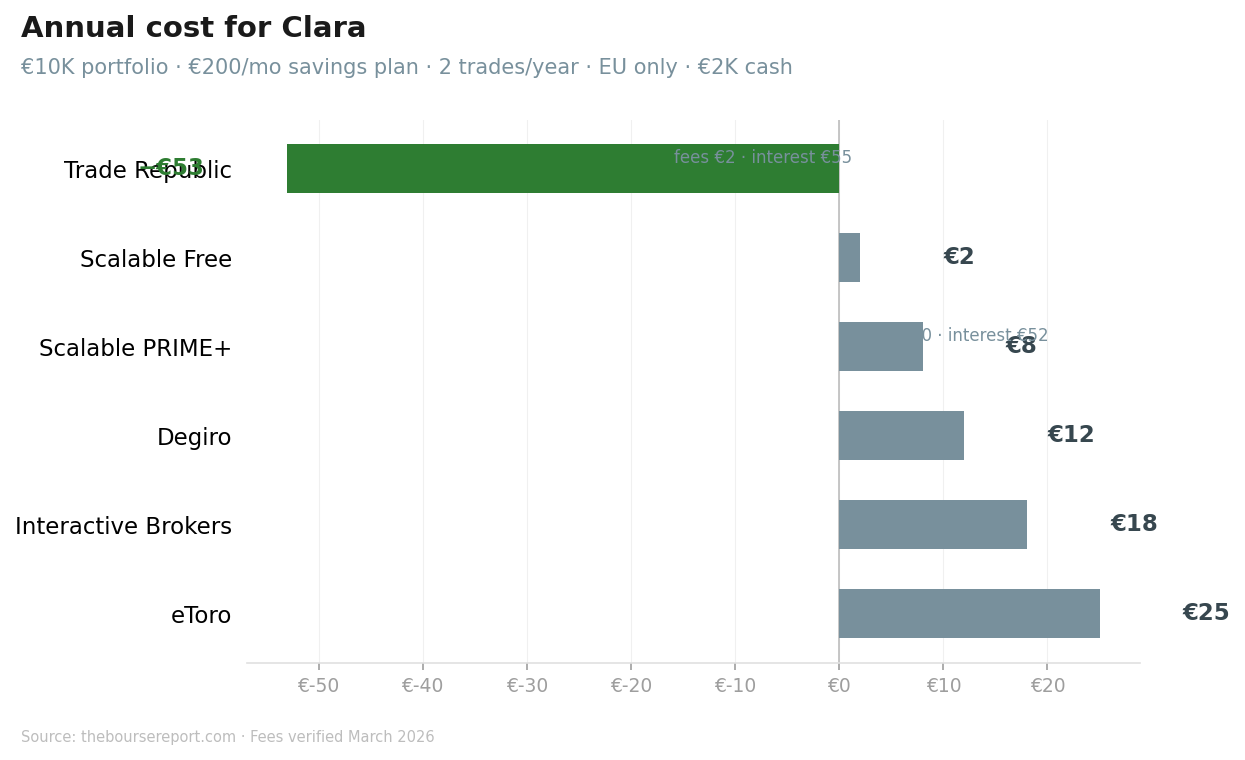
    We ran the numbers for Clara’s exact profile: 12 savings plan executions per year (one per month at €200), two manual trades at roughly €1,000 each, all in European ETFs, with €2,000 sitting in cash. Here’s what each broker costs her annually.

    Broker Trading fees Cash interest earned Net annual cost
    Trade Republic €2 €55 βˆ’β‚¬53 (she earns money)
    Scalable Capital (Free) €2 €0 €2
    Scalable Capital (PRIME+) €60 €52 €8
    Degiro €12 €0 €12
    Interactive Brokers €18 €0 €18
    eToro €25 €0 €25
    Bar chart comparing annual broker costs for Clara's beginner profile showing Trade Republic as cheapest at minus 53 euros

    Trade Republic’s net cost is actually negative. Clara makes €53 per year just by having her cash there, because Trade Republic pays 2.75% interest on all uninvested cash with no minimum threshold. Her two manual trades cost €1 each. Her savings plan is free. For someone in Clara’s position, Trade Republic isn’t just the cheapest option; it’s the only one that pays her to use it.

    Scalable Capital on the Free plan comes very close on trading fees (€0.99 per manual trade, savings plan free), but the Free plan pays no interest on cash, so she misses out on that €55. The PRIME+ plan at €4.99 per month would give her 2.6% interest, but the subscription adds up to €60 a year. For someone making only two manual trades, the subscription is hard to justify.

    Interactive Brokers, which is genuinely the best broker on this list for larger and more complex portfolios, turns out to be one of the more expensive options for Clara. The reason is straightforward: IBKR doesn’t offer free savings plans. Each monthly execution costs €1.25 (the minimum fee on its Tiered plan), which adds up to €15 a year just for the savings plan, a cost that’s zero at Trade Republic and Scalable. And IBKR only pays interest on cash above €10,000, so Clara’s €2,000 buffer earns nothing.

    For Clara’s profile, the answer is clear: Trade Republic first, Scalable Capital (Free) second.

    Why Trade Republic over Scalable for beginners

    Since both charge essentially the same trading fees, the question is worth answering properly. Three things tip the balance. First, Trade Republic has no subscription tiers to think about. You sign up, you trade, you’re done. Scalable’s three-tier model (Free, PRIME, PRIME+) is not complicated, but it introduces a decision that a new investor shouldn’t have to make on day one. Second, Trade Republic pays 2.75% interest on all cash from the first euro, while Scalable only pays interest on PRIME+. Third, Trade Republic holds a full banking licence from BaFin and the ECB, which means your cash is a genuine bank deposit protected by the German deposit guarantee scheme. At Scalable, your uninvested cash goes into a money market fund, which is different in both structure and legal protection.

    What Marc Actually Pays

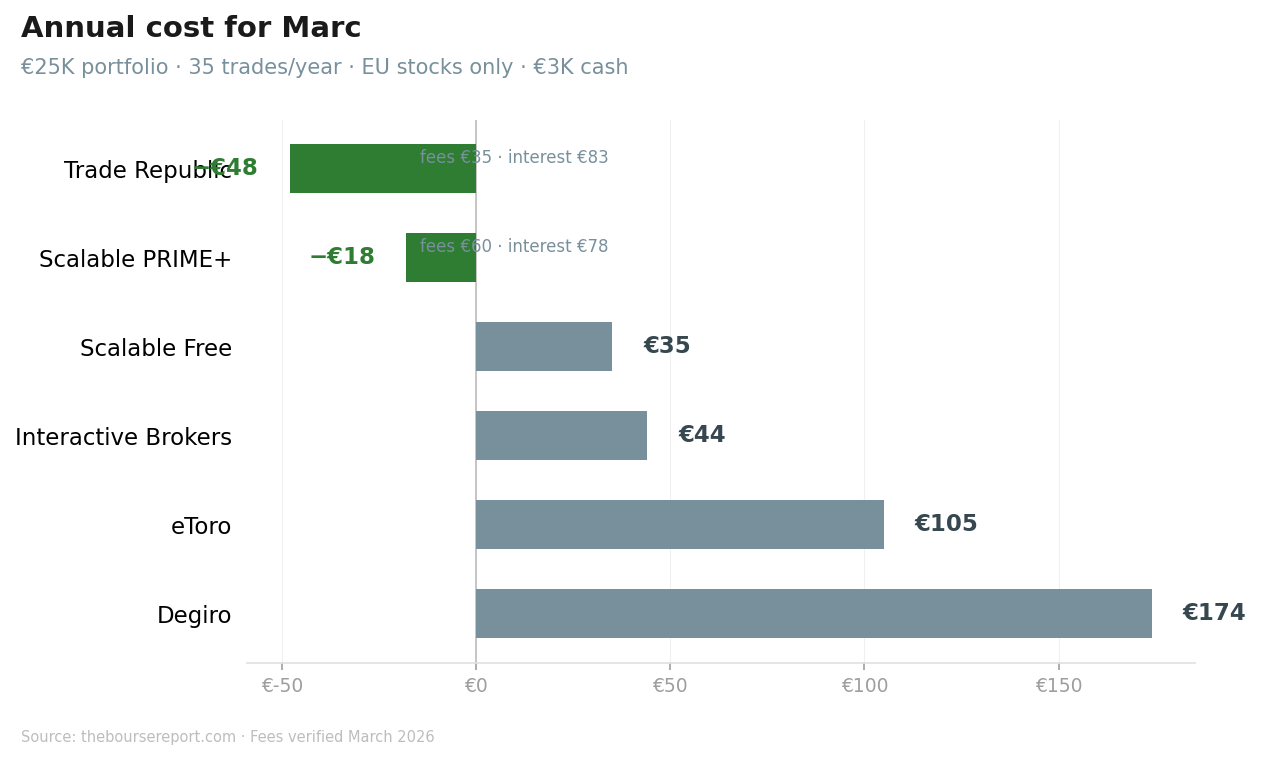
    Marc’s 35 annual trades at an average of about €714 each, all in EU stocks, with €3,000 in cash.

    Broker Trading fees Cash interest earned Net annual cost
    Trade Republic €35 €83 βˆ’β‚¬48 (earns money)
    Scalable Capital (PRIME+) €60 €78 βˆ’β‚¬18
    Scalable Capital (Free) €35 €0 €35
    Interactive Brokers €44 €0 €44
    eToro €105 €0 €105
    Degiro €174 €0 €174
    Bar chart comparing annual broker costs for Marc's active trader profile showing Trade Republic and Scalable PRIME plus as cheapest

    Degiro stands out here, and not in a good way. It was once the go-to low-cost broker in Europe, the platform that made cheap investing accessible to ordinary people. But at €3 to €4.90 per trade (depending on your home exchange), 35 trades a year adds up to €105–€172 plus a €2.50 connectivity fee. That is three to five times what Trade Republic charges for the same trades.

    Trade Republic wins again on net cost because of the cash interest. But Scalable Capital PRIME+ deserves a closer look here. At €4.99 per month (€60 a year), all of Marc’s trades above €250 become free. Since his average trade is €714, every one of them qualifies. Add the 2.6% interest on his €3,000 in cash, and his net cost is βˆ’β‚¬18. For someone who trades at Marc’s frequency, the subscription starts paying for itself.

    Interactive Brokers comes in at €44, which is competitive, but without the cash interest advantage. IBKR requires over €10,000 in uninvested cash before it pays anything, so Marc’s €3,000 earns nothing. On raw per-trade cost, IBKR at €1.25 is close to Trade Republic’s €1.00, but that small gap multiplied by 35 trades adds up.

    For Marc’s EU-only profile: Trade Republic if he values simplicity and cash interest. Scalable PRIME+ if he trades often enough to make the subscription worthwhile.

    What Sophie Actually Pays

    This is where the picture changes completely. Sophie’s profile includes 15 European trades, 35 US trades, and monthly currency conversions of €5,000. The currency conversion is the key variable, because every time a European investor buys an American stock, their euros need to become dollars first, and each broker charges a very different rate for that conversion.

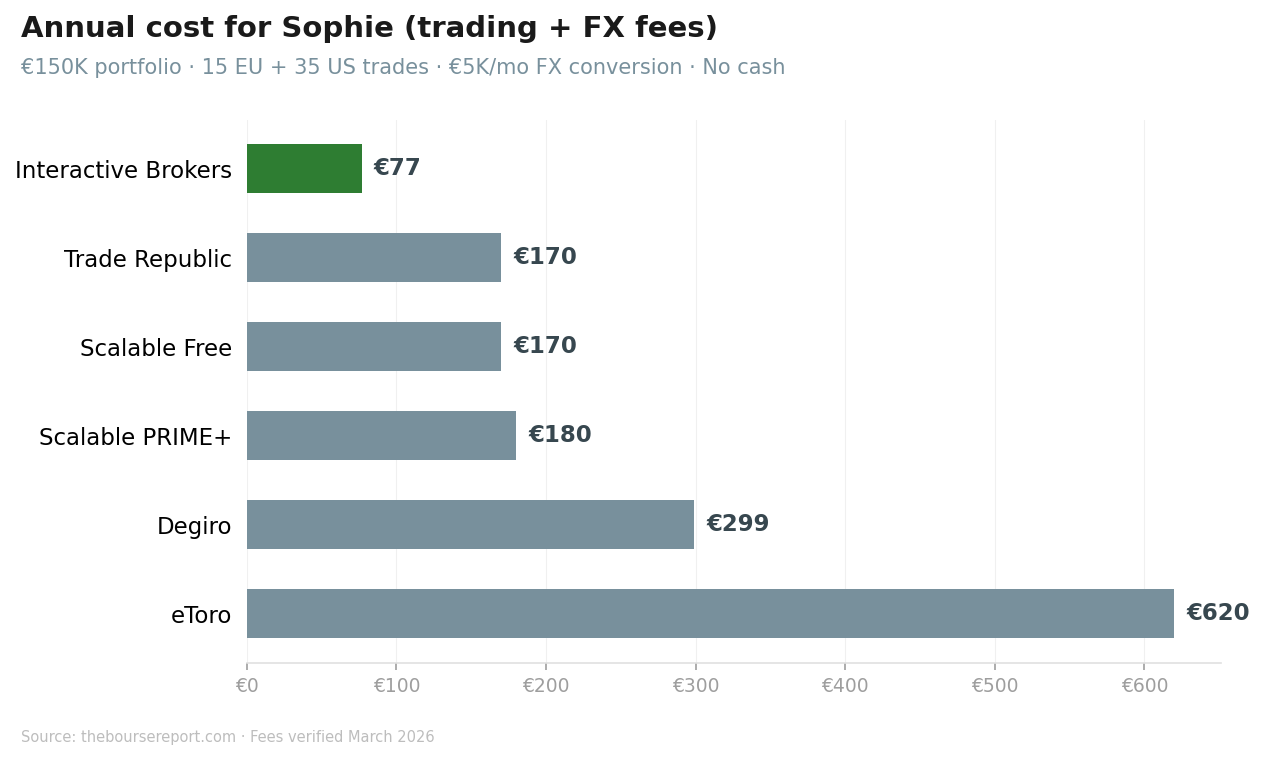
    Broker Annual cost (trading + FX fees)
    Interactive Brokers €77
    Trade Republic €170
    Scalable Capital (Free) €170
    Scalable Capital (PRIME+) €180
    Degiro €299
    eToro €620
    Bar chart comparing annual broker costs for Sophie's global investor profile showing Interactive Brokers as cheapest at 77 euros

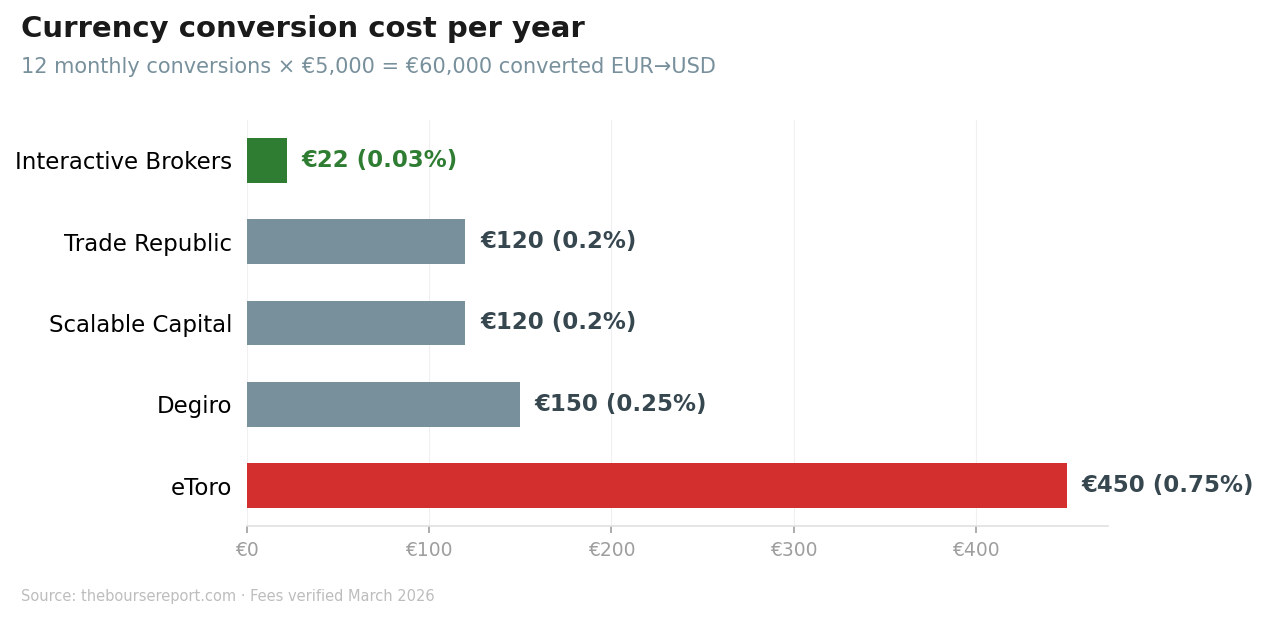
    Interactive Brokers is the cheapest broker by a wide margin: €77 per year, less than half what Trade Republic charges. The reason is almost entirely down to currency conversion. IBKR converts euros to dollars at 0.03%, with a minimum fee of €1.84 per conversion. Trade Republic and Scalable charge 0.2%. Degiro charges 0.25%. eToro charges 0.75%. On €60,000 converted over a year, that’s €22 at IBKR versus €120 at Trade Republic versus €450 at eToro. The chart below isolates just the FX cost to show how dramatic the difference is.

    Bar chart comparing annual currency conversion costs across brokers, IBKR at 22 euros versus eToro at 450 euros

    And there’s something the numbers can’t capture at all. IBKR is the only broker on this list where Sophie can trade options. It’s the only one that gives her access to 150+ exchanges in 30+ countries. If she wants to buy a Japanese stock, write a covered call on her Apple position, or trade futures on Eurex, she can do all of that from one account. Trade Republic and Scalable give her access to one or two exchanges. For someone whose investing has grown beyond European ETFs, that difference in product range is the real story.

    For Sophie’s profile: Interactive Brokers, and it’s not close.

    Read our full Interactive Brokers review β†’

    Beyond the Spreadsheet

    Cost is the easiest thing to compare, but once you’re actually using a broker every week, other things start to matter. Here’s what the numbers can’t tell you.

    How safe is your money? Trade Republic, Scalable Capital, and Degiro all offer €100,000 in investor protection for cash deposits. Interactive Brokers and eToro offer €20,000. Your stocks and ETFs are held in segregated accounts at all of them (they’re legally yours, not the broker’s), so this is really about uninvested cash. If you keep significant cash at your broker, the difference between €20,000 and €100,000 protection is one worth knowing about. Trade Republic goes further: its full banking licence means your cash is a proper bank deposit, not a position in a money market fund.

    How does it feel to use? Trade Republic is a phone app, clean and minimal. You can place a trade in about thirty seconds. Scalable Capital has both a web platform and an app, slightly more features, still intuitive. Degiro works but feels dated, like a car that runs fine but hasn’t been redesigned since 2015. IBKR is powerful and complex. The new Desktop app is a genuine improvement over the old Trader Workstation, but the learning curve is measured in days rather than minutes. eToro is polished and has a social feed where you can see what other investors are doing, which you’ll either find interesting or distracting.

    What can you actually buy? This is where they really separate. Trade Republic and Scalable Capital give you stocks and ETFs on one or two exchanges (LS Exchange, gettex, Xetra). That’s plenty for most European investors buying mainstream ETFs and blue-chip stocks. Degiro covers about 30 exchanges. IBKR covers 150+ exchanges across 30+ countries, plus options, futures, bonds, and forex. eToro offers stocks, ETFs, and CFDs, which are leveraged instruments where most retail investors lose money (the regulatory warnings on their site are there for a reason). If you only buy European ETFs, you don’t need 150 exchanges. But if your ambitions grow, you’ll want a broker that can grow with you.

    Who watches over them? Trade Republic and Scalable Capital are regulated by BaFin, Germany’s financial regulator, which is among the strictest in Europe. Trade Republic has additional ECB oversight through its banking licence. Degiro is regulated by BaFin and the Dutch AFM. IBKR is supervised by the Central Bank of Ireland. eToro is regulated by CySEC in Cyprus. All are legitimate EU regulators, but the intensity of oversight does vary. Think of it as the difference between getting your car inspected every year versus every three years. Both cars might be perfectly fine, but you have more recent information about one of them.

    So Which Is the Best Broker Europe 2026?

    If you recognise yourself in Clara’s profile (starting out, small portfolio, savings plan, EU markets), Trade Republic is the obvious choice. The fees are minimal, the cash interest is a genuine bonus, the app is straightforward, and you won’t outgrow it for a while. Scalable Capital (Free) is a strong alternative if you prefer a web platform or want access to Xetra.

    If you’re closer to Marc (active trader, mid-sized portfolio, EU stocks), both Trade Republic and Scalable Capital work well. For frequent traders, Scalable PRIME+ starts making sense because the trades become free above €250 and the subscription is partly offset by cash interest. If you want the lowest per-trade cost without committing to a subscription, Trade Republic’s flat €1 is hard to beat.

    If you’re in Sophie’s territory (large portfolio, US and international stocks, options), Interactive Brokers is the right answer. Its currency conversion alone saves you roughly €100 per year over the next cheapest alternative and over €400 per year over eToro. The platform requires patience to learn, but the savings compound every year, and no other broker gives you access to the same range of products and markets.

    If you’re specifically interested in copy trading, eToro is the main option in Europe. Just know that the costs are meaningfully higher than alternatives, particularly once you account for the 0.75% FX markup on every deposit.

    And Degiro? It was a pioneer. It made European low-cost investing possible for a generation of investors. But at €2 to €4.90 per trade (depending on your country) when competitors charge €1 or less, it is difficult to recommend for a new account in 2026. The ETF Core Selection at €1 per trade on Tradegate remains competitive, but for stocks, the newer platforms offer more for less. If you already have one and you are comfortable with it, there is no rush to switch. Read our full Degiro review.

    Broker Best for Trading fee Regulation Investor protection Full review
    Trade Republic logo
    Trade Republic
    Beginners, savers €1 flat BaFin + ECB €100,000 Review β†’
    Scalable Capital logo
    Scalable Capital
    ETF savings plans, active EU traders €0.99 or PRIME+ BaFin €100,000 Review β†’
    Interactive Brokers logo
    Interactive Brokers
    Global investors, options, large portfolios 0.05% / min €1.25 Central Bank of Ireland €20,000 Review β†’
    Degiro logo
    Degiro
    Budget ETF investors €2–€4.90* BaFin + AFM €100,000 Review β†’
    eToro logo
    eToro
    Copy trading ~€1.38 + 0.75% FX CySEC €20,000 Review β†’

    *Degiro’s EU stock fee depends on your home exchange: €2 per trade on Euronext Paris (FR accounts), €3 on Euronext Amsterdam/Dublin (NL/IE accounts), €4.90 on Xetra (DE accounts). Core Selection ETFs cost €1 on Tradegate regardless of country. See our full Degiro review.

    What I Use, and What I Don’t Know Yet

    I use Interactive Brokers. It’s where my portfolio lives: EU and US stocks, options, currency conversions. I’ve had the account for about three years. The learning curve was real, and the first month involved more confusion than I’d care to admit. But the costs are low, the execution is solid, and once you know the interface, it does exactly what it should.

    I haven’t used Trade Republic, Scalable Capital, Degiro, or eToro with real money. Their sections in this article are based on official fee schedules, regulatory filings, platform documentation, and conversations with investors whose judgement I trust. I plan to open accounts at Trade Republic and Degiro in the coming months and will update this page with first-hand observations when I do. Until then, I’ve been clear about what comes from direct experience and what comes from research.

    Frequently Asked Questions

    Which broker is best for a beginner in Europe?

    Trade Republic. It charges €1 per trade, offers free savings plans, pays 2.75% interest on cash, and has €100,000 investor protection under a full banking licence. Scalable Capital (Free plan) is a close second with nearly identical fees, but no cash interest on the free tier. See our guide on the best broker for beginners.

    How much does currency conversion cost at European brokers?

    It varies enormously. IBKR charges 0.03% (€3 on a €10,000 conversion). Degiro charges 0.25% (€25). eToro charges 0.75% to 1.0% (€75 to €100). If you buy US stocks regularly, FX conversion will likely be your single biggest annual cost. It’s the first thing to check when comparing brokers for international investing.

    Is Interactive Brokers safe for European investors?

    IBKR is regulated by the Central Bank of Ireland, publicly traded on NASDAQ, and has operated since 1978 with over $500 billion in client assets. Investor protection covers €20,000 per person, which is lower than the €100,000 at Trade Republic, Scalable, and Degiro. Your stocks and ETFs are held in segregated accounts (legally yours regardless of what happens to the broker), but cash is protected only up to the limit.

    Can I buy US stocks from Europe?

    Yes. All five brokers listed here give you access to US stocks on NASDAQ and NYSE. The difference is cost: every purchase involves converting euros to dollars, and the FX rate ranges from 0.03% (IBKR) to 1.0% (eToro). Over time, this fee matters more than the trading commission itself. See our guide on how to buy US stocks in Europe.

    Which broker is cheapest for ETF savings plans?

    Trade Republic and Scalable Capital both offer free ETF savings plans. Degiro offers 1,000+ ETFs in its Core Selection at €1 per trade on Tradegate, with the first monthly trade per ETF free. IBKR charges its normal commission (minimum €1.25) on recurring investments, which makes it the most expensive option for savings plans specifically. See our breakdown of the best broker for ETFs in Europe.

    Methodology

    Fee calculations are based on official broker pricing pages, verified in March 2026. Trading cost estimates use the specific investor profiles detailed above rather than generic assumptions, and were computed programmatically using a Python calculator to avoid rounding errors. Cash interest rates reflect published rates as of March 2026 and will change with ECB rate decisions. Currency conversion costs are calculated on actual FX conversion volumes for each profile. The author uses Interactive Brokers as his primary broker; the other four brokers were evaluated through fee schedules, regulatory filings, and community experience. Rankings reflect a long-term European retail investor perspective. For our full approach, see our editorial policy.

    Disclaimer: This article is for educational purposes and does not constitute financial advice. We may earn affiliate commissions if you open an account through our links. This does not affect our rankings or increase your costs. Broker fees, features, and regulations change. Always verify current information on the broker’s official website. Investing carries risk, including potential loss of capital. See our full disclaimer.

    Disclosure: This article contains affiliate links. We may earn a commission if you open an account through our links, at no additional cost to you. This does not influence our ratings or recommendations. See our full affiliate disclosure.
  • Interactive Brokers Review Europe 2026: Pros & Cons β€” The Bourse Report

    This Interactive Brokers review Europe is based on three years of hands-on use as a European investor. Here’s the bottom line.

    Verdict: Interactive Brokers (IBKR) is the most complete broker available to European investors. It offers the widest market access, the lowest currency conversion fees, and a product range no competitor matches β€” from stocks and ETFs to options, futures, and bonds across 150+ exchanges worldwide. The trade-off is complexity: IBKR’s platforms have a learning curve, and the account opening process takes longer than neobrokers. If you’re investing more than €10,000 and want serious tools, IBKR is hard to beat. Rating: 9.0/10

    Key Takeaways

    • Access to 150+ exchanges in 30+ countries β€” unmatched in Europe
    • Currency conversion at just 0.03% (vs 0.25% at Degiro, 0.75% at eToro)
    • No custody fees, no inactivity fees, no platform fees
    • EU stocks from €3 flat or 0.05% for larger orders
    • Regulated by the Central Bank of Ireland (EU entity) β€” €20,000 investor protection
    • Pays interest on uninvested cash (above €10,000 threshold)
    • Best suited for portfolios above €10,000 and investors comfortable with a professional-grade platform

    Key Facts at a Glance

    Feature Details
    Founded 1978 (USA)
    EU entity Interactive Brokers Ireland Limited
    EU regulator Central Bank of Ireland
    Investor protection €20,000 (90% of loss)
    Available in EU-wide via Irish entity + UK via FCA
    Minimum deposit €0 (cash accounts); $2,000 (margin)
    EU stock fees €3 flat (<€6,000) or 0.05% (>€6,000)
    US stock fees $0.005/share (min $1)
    FX conversion 0.03% (2 bps min $2)
    Custody fee None
    Inactivity fee None
    Options / Futures Yes (Eurex, CBOE, CME, and more)
    Interest on cash ~1.4% EUR (on balance above €10K)
    Listed company NASDAQ: IBKR

    Who Is IBKR Best For?

    IBKR makes sense if you recognise yourself in one or more of these profiles:

    Multi-currency investors. If you buy US stocks, European ETFs, and perhaps some UK or Asian equities, IBKR’s 0.03% FX conversion rate saves you real money over time. On a €50,000 portfolio with regular currency conversions, the difference between IBKR’s 0.03% and Degiro’s 0.25% adds up to hundreds of euros per year.

    Active and options traders. IBKR is one of the very few European-accessible brokers offering full options and futures trading on Eurex, CBOE, and other major derivatives exchanges. If you trade options, this is effectively your only serious choice in Europe.

    Investors with portfolios above €10,000. IBKR’s fee structure rewards larger accounts. The interest on idle cash only kicks in above the €10,000 threshold. The platform’s complexity is justified when you’re managing a meaningful portfolio across multiple asset classes.

    Buy-and-hold investors who want low ongoing costs. Zero custody fees, zero inactivity fees, zero platform fees. Once your money is in IBKR, it costs you nothing to hold it there. Combined with commission-free ETFs on select exchanges and fractional shares, long-term investors are well served.

    Interactive Brokers Review Europe: Who Should Look Elsewhere?

    Complete beginners. If you’ve never invested before and want the simplest possible experience, Trade Republic or Scalable Capital offer a gentler introduction. You can always migrate to IBKR later as your needs grow.

    Small portfolios under €5,000. IBKR’s strengths β€” currency conversion rates, interest on cash, advanced order types β€” don’t provide meaningful savings on a small account. A neobroker with €1 flat fees and no minimum makes more sense at this stage.

    People who only buy ETF savings plans. If your entire strategy is a monthly €200 ETF savings plan, Trade Republic and Scalable Capital offer this commission-free with a simpler interface. IBKR does offer recurring investments, but it’s not its strongest feature.

    Fees & Pricing

    IBKR offers two pricing models for European investors: Fixed and Tiered. The right choice depends on where you trade and how much.

    European Stocks & ETFs

    Pricing model Fee Minimum Maximum
    Fixed 0.05% of trade value €3.00 No cap
    Tiered 0.05% of trade value €1.25 €29 (Xetra only)

    For most European retail investors buying on Euronext or Xetra, the Tiered plan is cheaper for smaller orders (under €6,000), while the Fixed plan becomes competitive for medium-sized orders on Euronext. The €29 cap on Tiered only applies to Xetra β€” on other exchanges, there is no cap.

    US Stocks

    On the Pro (Tiered) plan: $0.005 per share, minimum $1.00, maximum 1% of trade value. For a typical 50-share purchase of a US stock, you’d pay approximately $1.00. This is significantly cheaper than Degiro’s €2.00 per US trade and a fraction of what most European neobrokers charge after FX conversion.

    Currency Conversion

    The FX conversion rate is probably IBKR’s single biggest advantage over every other European broker. At 0.03% (with a $2 minimum), nobody else comes close. Look at the numbers:

    Broker FX rate Cost to convert €10,000 to USD
    IBKR 0.03% €3.00
    Degiro 0.25% €25.00
    Trade Republic Variable ~€15-20
    eToro 0.75-1.0% €75-100

    If you regularly buy US stocks or non-EUR assets, IBKR’s FX rate alone can save you €50-200+ per year compared to alternatives.

    Total Annual Cost Examples

    What does all of this actually cost you in a year? Here’s a rough estimate for three portfolio sizes, assuming 12 trades per year (1/month), a 60/40 EU/US split, and one currency conversion per month:

    Portfolio size IBKR (Tiered) Degiro Trade Republic
    €10,000 ~€50 ~€60 ~€32
    €50,000 ~€62 ~€96 ~€44
    €100,000 ~€74 ~€132 ~€56

    Note: Trade Republic appears cheaper on raw trading fees, but remember it only gives you access to a single exchange (LS Exchange via Tradegate) with wider spreads, no options, and limited order types. The total cost of ownership for active multi-market investors strongly favours IBKR.

    What’s Free

    No custody fee, no inactivity fee, no platform fee, no account maintenance fee. Many EU-listed ETFs are commission-free on select exchanges. Fractional shares are available for US and EU stocks.

    Platform & User Experience

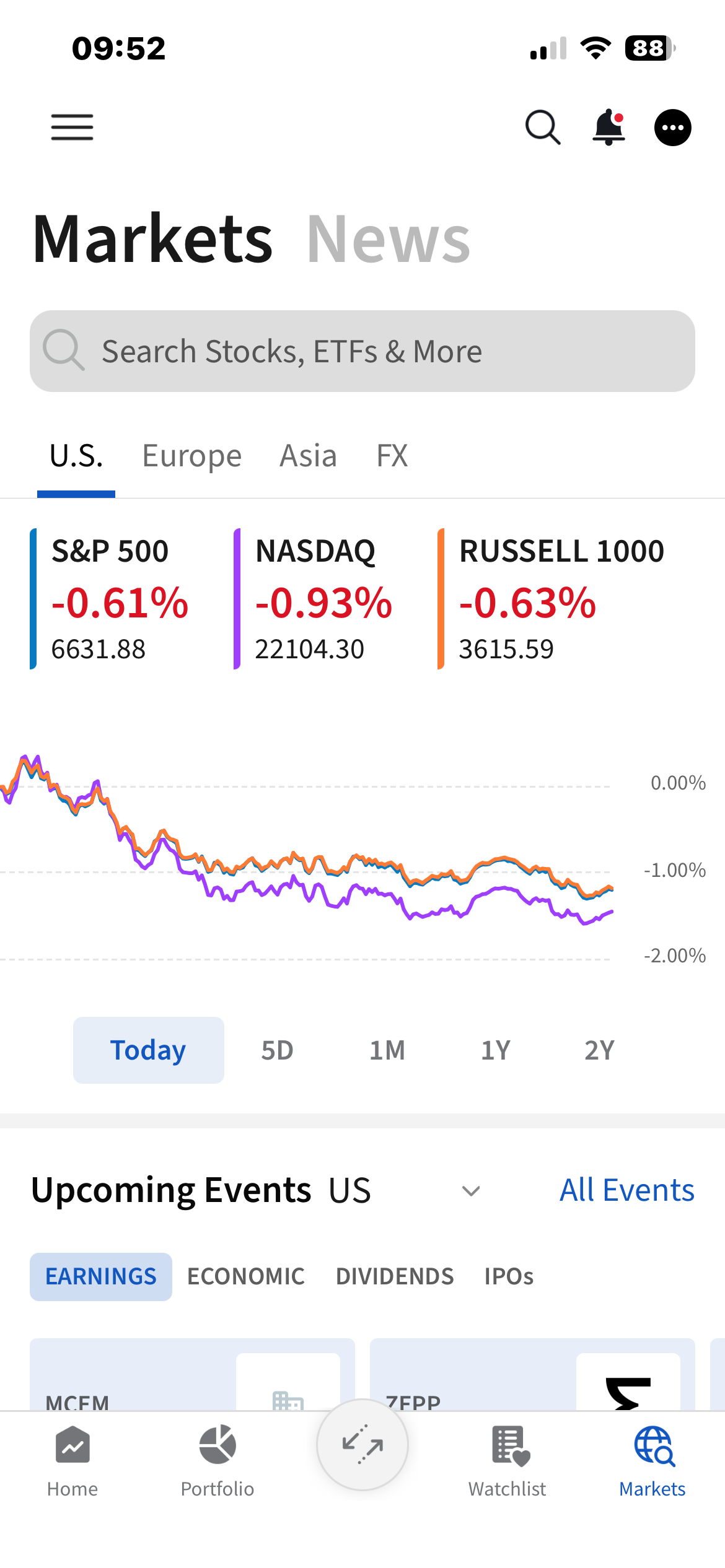
    IBKR Mobile app markets screen showing S&P 500, NASDAQ, and Russell 1000 indices - Interactive Brokers review Europe
    IBKR Mobile β€” Markets overview with live index data

    IBKR gives you four different ways to trade, which is great once you know which one you want β€” and confusing when you’re just starting out:

    IBKR Desktop (recommended for most users). The newest platform, launched in 2024-2025 and continuously improved through 2026. Clean, modern interface that wraps IBKR’s full functionality in a design that feels contemporary. Portfolio analytics, watchlists, news, and trading are all well-integrated. If you’re starting with IBKR today, this is the platform to use.

    Trader Workstation (TWS). The legacy professional platform. Extremely powerful β€” advanced charting, algorithmic trading, complex option strategies, real-time risk management. But the interface looks like it was designed in 2005 (because it was). Worth learning if you trade options or need advanced order types. Otherwise, IBKR Desktop does everything most investors need.

    Web Portal (Client Portal). A browser-based interface for account management, simple trading, and reporting. Functional but limited compared to the desktop apps. Useful for quick checks on the go.

    IBKR GlobalTrader (mobile). A simplified mobile app aimed at casual investors. Fractional shares, automatic currency conversions, streamlined order entry. A good option if you primarily invest via mobile and don’t need advanced tools.

    IBKR Mobile (mobile). The full-featured mobile companion to TWS. More complex than GlobalTrader but gives you access to everything, including options trading on the go.

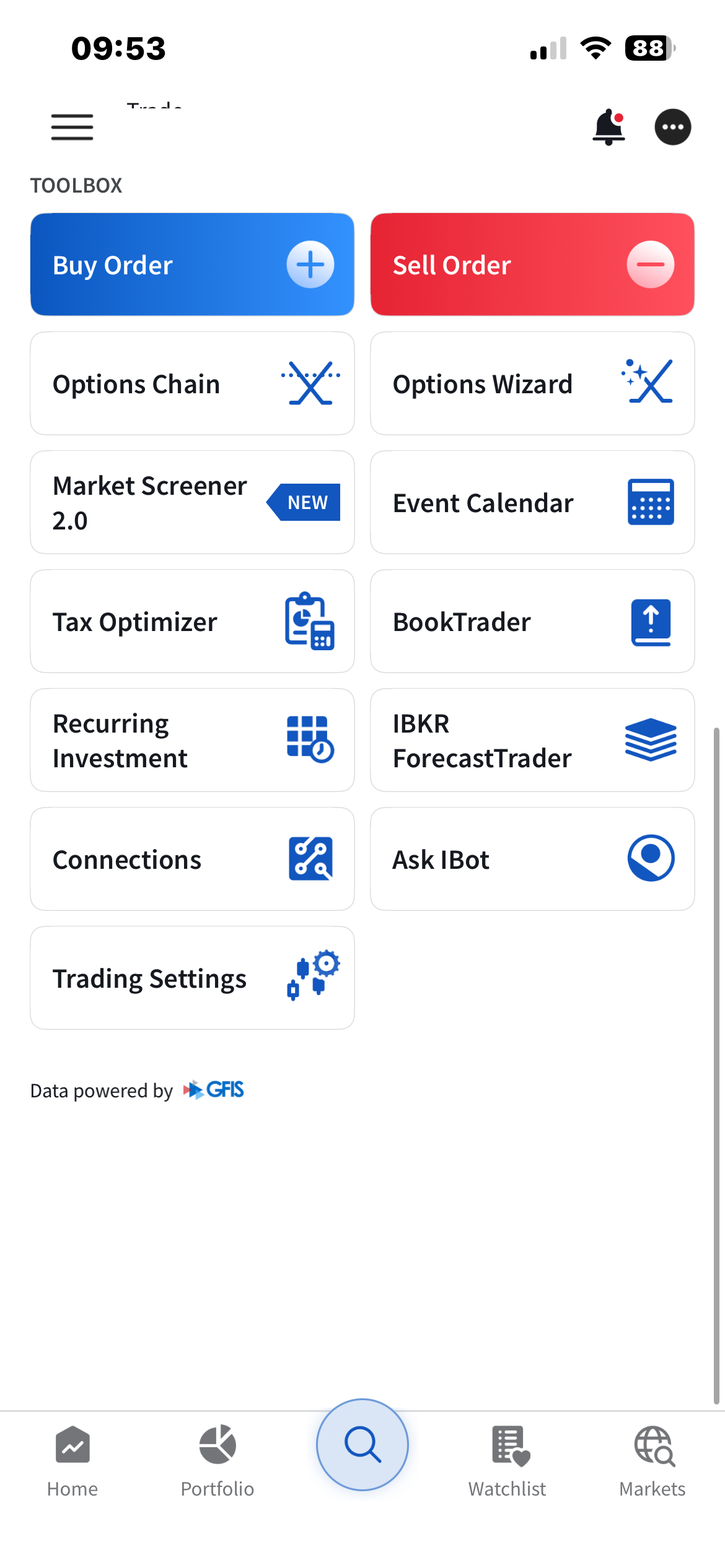
    IBKR Mobile trading toolbox showing Options Chain, Options Wizard, Market Screener, Tax Optimizer, and more
    The IBKR Mobile toolbox β€” Options Chain, Market Screener, Tax Optimizer, and more

    People talk a lot about the learning curve, and yes, it exists β€” but mostly for TWS. IBKR Desktop is honestly fine. If you’ve used any online banking app, you’ll find your way around within an afternoon. TWS is another story β€” you’ll want to set aside a weekend if you plan to use its full feature set.

    Reporting & Tax Documents

    IBKR generates detailed activity statements that are useful for tax reporting. European users can download annual statements breaking down realised gains, dividends received (with withholding tax detail per country), and interest earned. For French investors, IBKR provides an IFU (ImprimΓ© Fiscal Unique) β€” though the format may require some manual adjustment when filing with impots.gouv.fr. German investors get a tax report compatible with their SteuererklΓ€rung workflow, though it’s not as seamless as with BaFin-licensed neobrokers that handle Abgeltungsteuer automatically.

    The Flex Query system is a powerful tool for customising reports β€” you can create exactly the export format your accountant needs. It’s a feature no neobroker offers.

    Available Markets & Products

    If there’s one reason IBKR keeps winning over European investors, it’s the sheer range of what you can trade. No other broker available in Europe comes close:

    Asset class Coverage
    Stocks 150+ exchanges in 30+ countries
    ETFs Global (UCITS + US ETFs for qualifying investors)
    Options Eurex, CBOE, CME, and 20+ exchanges
    Futures Eurex, CME, ICE, and more
    Bonds Government and corporate (US, EU)
    Forex 23 currencies at interbank rates
    Mutual funds 40,000+ funds
    Fractional shares US and EU stocks

    A note on US ETFs in Europe. Due to PRIIPs regulation, European retail investors cannot buy US-domiciled ETFs like VOO or VTI. IBKR is the only major European-accessible broker that provides a pathway around this: you can apply for Elective Professional Client status under MiFID II, which removes the PRIIPs restriction. The requirements are strict (two of three criteria: €500K+ portfolio, professional financial experience, or 10+ large trades per quarter), but if you qualify, IBKR makes the process straightforward. For everyone else, IBKR’s UCITS ETF selection is comprehensive and includes commission-free options on select exchanges.

    Safety & Regulation

    IBKR has been around since 1978 and is publicly traded on NASDAQ (ticker: IBKR). They reported client equity north of $500 billion in 2025. For a European retail investor, that track record matters.

    European entity: Interactive Brokers Ireland Limited, authorised and regulated by the Central Bank of Ireland.

    Investor protection: €20,000 under the Irish Investor Compensation Scheme, covering up to 90% of losses in the event of broker insolvency. This is the standard EU level β€” the same protection you get at any EU-regulated broker.

    Additional safeguards: Client assets are held in segregated accounts, separate from IBKR’s own funds. As a publicly traded company, IBKR publishes audited financial statements and is subject to reporting requirements from the SEC, FINRA, and multiple EU regulators simultaneously.

    Bottom line on safety: IBKR is about as solid as it gets for European retail investors. Public listing, multiple regulators watching, 45+ years of operations, half a trillion in client assets. The neobrokers are getting there, but they’re not there yet.

    What Happens if IBKR Goes Bankrupt?

    People ask this a lot, so here’s the short answer: your stocks, ETFs, and bonds are held in segregated accounts and legally remain yours β€” they don’t sit on IBKR’s balance sheet. If IBKR somehow went under, your holdings would be transferred to another broker. Cash is covered up to €20,000 by the Irish Investor Compensation Scheme. Realistically, IBKR is NASDAQ-listed with a market cap above $70 billion and has been around since 1978, so the risk is very low β€” but it’s good to know how the protections work.

    My Personal Experience

    I’ve been using Interactive Brokers for about three years now. Deposits and withdrawals have always gone through without any issues β€” money arrives quickly and the process is straightforward.

    My main reason for switching to IBKR was options trading. My traditional bank simply didn’t offer it, and when I looked at what was available to European investors, IBKR was really the only serious option. Getting access to options did require going through a fair amount of disclaimers and questionnaires β€” they want to make sure you understand what you’re getting into. But honestly, every financial platform does something similar these days, and once you qualify, the access is granted immediately.

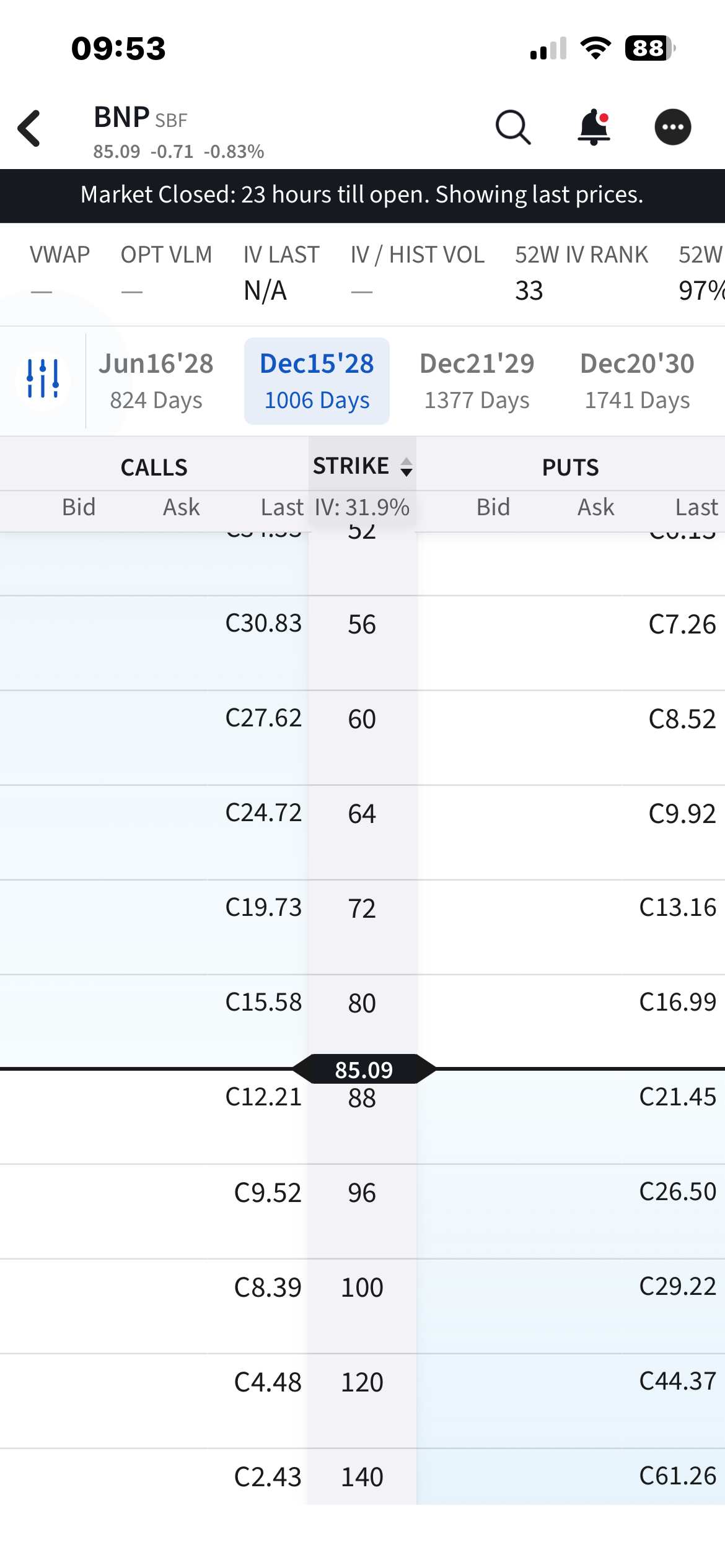
    Options chain for BNP on IBKR Mobile showing calls and puts with strikes and implied volatility
    Options chain for BNP on IBKR Mobile β€” calls, puts, strikes, and implied volatility at a glance

    The interface takes some getting used to, no question. But I think that’s true of any powerful tool. There are a lot of options, a lot of features, and it can feel overwhelming in the first couple of weeks. Then gradually you start discovering what you can actually do with it, and the depth becomes impressive rather than intimidating. My advice: start with simple stock or ETF trades to get comfortable with the layout before venturing into anything more complex.

    One thing I genuinely appreciate is how IBKR handles risk warnings. If you place a market order, for instance, you get a clear warning that the fill price might differ from what you expect β€” and they automatically add protective limits. Small details like that show they’ve thought about protecting retail investors, not just providing tools.

    Reports and bank statements are all accessible and easy to export. I haven’t needed to contact customer support yet, so I can’t comment on that side of things β€” which in itself probably says something about how smoothly the platform runs day to day.

    How IBKR Compares

    Numbers tell the story better than words. Here’s IBKR side by side with the brokers European investors most commonly consider:

    Feature IBKR Degiro Trade Republic Scalable Capital
    EU stock fee €3 / 0.05% €2–€4.90* €1.00 €0.99 (or €0 on PRIME+)
    US stock fee ~$1.00 €2.00 €1.00 €0.99
    FX conversion 0.03% 0.25% Variable N/A (EUR only)
    ETF savings plans Limited Free (core) Free Free
    Options / Futures βœ“ Limited βœ— βœ—
    Global exchanges 150+ 30+ 1 (LS Exchange) 2 (gettex + Xetra)
    Interest on cash ~1.4% EUR βœ— Up to 2.75% Up to 2.6% (PRIME+)
    Minimum deposit €0 €0.01 €1 €1
    Regulation CBI (Ireland) BaFin (Germany) BaFin + ECB BaFin
    Investor protection €20,000 €100,000 €100,000 €100,000
    Best for Serious investors Budget ETF investors Beginners ETF savings plans

    *Degiro’s EU stock fee varies by your home exchange: €2 per trade on Euronext Paris (FR accounts), €3 on Euronext Amsterdam/Dublin (NL/IE accounts), €4.90 on Xetra (DE accounts). See our full Degiro review for the complete fee breakdown.

    For a detailed head-to-head, see our IBKR vs Degiro comparison. For a broader overview, read our guide to the best online brokers for European investors.

    How to Open an Account

    Opening an IBKR account takes longer than a neobroker β€” expect 1-3 business days rather than minutes. Not a dealbreaker, but worth knowing upfront.

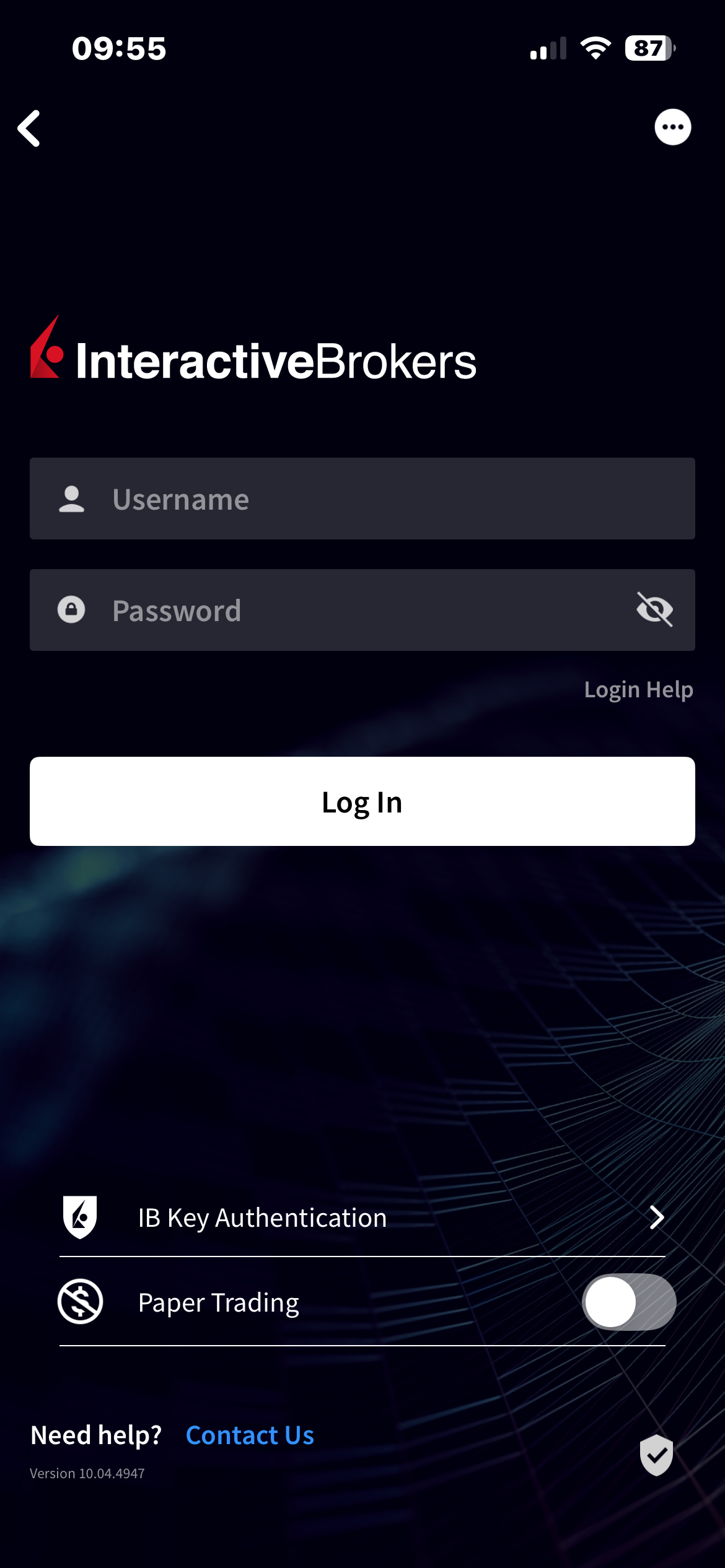
    IBKR Mobile login screen with IB Key Authentication and Paper Trading options
    IBKR Mobile login β€” with IB Key two-factor authentication and paper trading toggle

    Step 1: Start the application. Go to interactivebrokers.ie (the Irish entity for EU residents) and click “Open Account.” You’ll choose between an Individual or Joint account.

    Step 2: Complete the questionnaire. IBKR asks detailed questions about your financial situation, investment experience, and trading objectives. This is a MiFID II requirement β€” answer honestly, as it determines which products you can access. If you want options trading, you’ll need to demonstrate relevant experience.

    Step 3: Verify your identity. Upload a government-issued ID (passport or national ID card) and proof of address (utility bill or bank statement, less than 6 months old). EU residents can usually verify via an automated process.

    Step 4: Fund your account. Bank transfer (SEPA) is the most common method for European investors. IBKR provides a dedicated IBAN. Transfers typically arrive within 1 business day. There’s no minimum deposit for cash accounts.

    Step 5: Choose your platform. Download IBKR Desktop for the best experience. You can always add TWS later if you need advanced features.

    Step 6: Set your base currency and pricing model. Choose EUR as your base currency (you can hold multiple currencies). Select between Tiered and Fixed pricing β€” you can change this at any time in account settings.

    Tips for New IBKR Users

    Start with IBKR Desktop, not TWS. The new desktop platform gives you everything you need for investing without the complexity of Trader Workstation. You can always upgrade later.

    Convert currency manually. If you’re buying US stocks, don’t let IBKR auto-convert at trade time. Instead, manually convert EUR to USD in the currency section first β€” this ensures you get the best rate and have full control over timing.

    Enable two-factor authentication immediately. IBKR supports their own IB Key app or a third-party authenticator. You’re holding real money across global markets β€” don’t skip this.

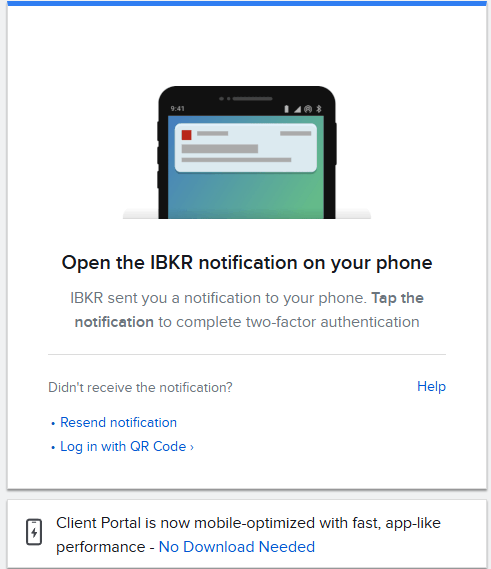
    IBKR two-factor authentication prompt asking you to confirm login on your phone
    IBKR’s two-factor authentication β€” confirm every login on your phone

    Try paper trading first. IBKR lets you switch to a simulated trading mode right from the login screen. It’s a free way to get comfortable with the interface and test strategies without risking real money.

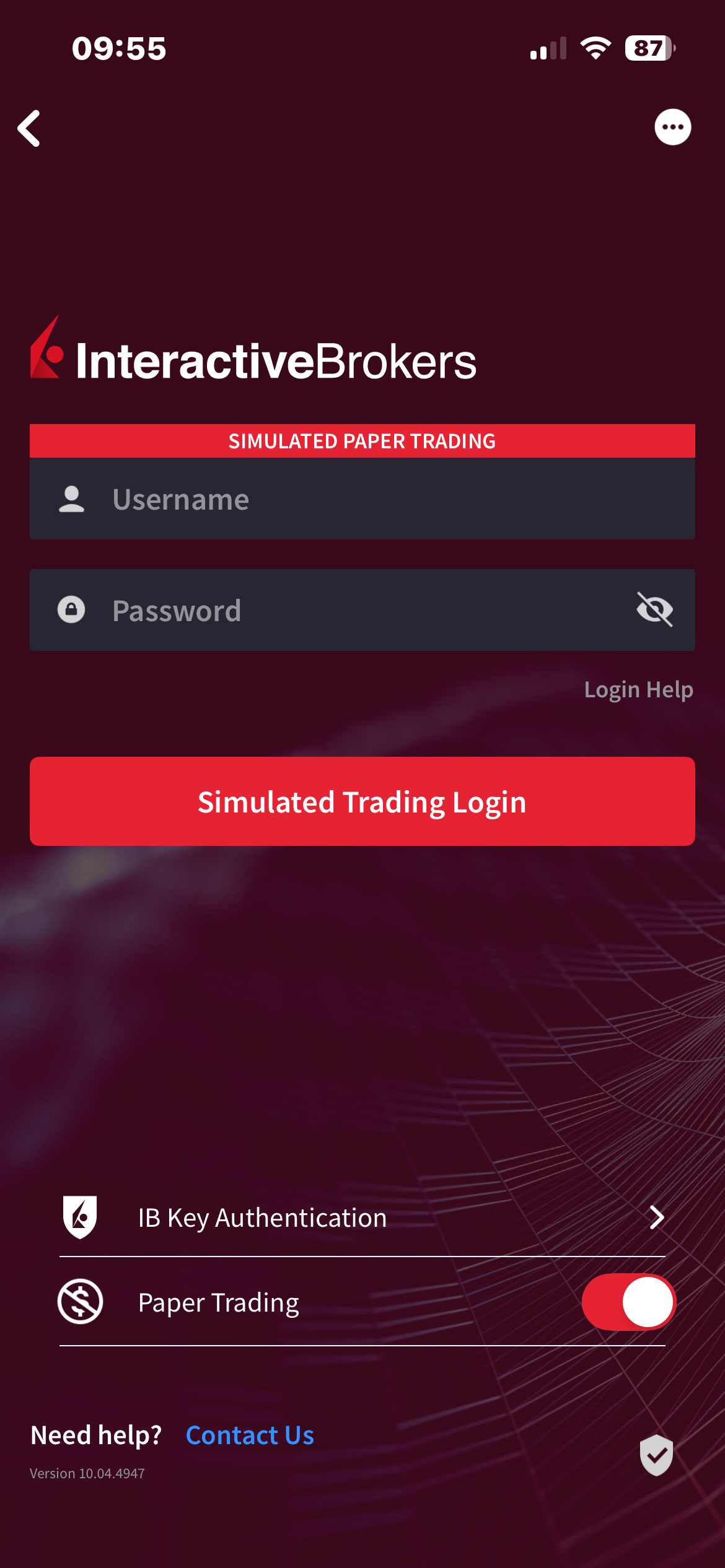
    IBKR Mobile paper trading login screen with simulated trading mode toggled on
    Paper trading mode β€” toggle it on from the login screen to practise risk-free

    Check your market data subscriptions. IBKR provides free delayed data for most markets, but real-time data requires a subscription. For most buy-and-hold investors, delayed data is perfectly adequate β€” don’t pay for real-time unless you actively day-trade.

    Frequently Asked Questions

    Is Interactive Brokers safe for European investors?

    Yes. Interactive Brokers Ireland Limited is authorised and regulated by the Central Bank of Ireland. Client assets are held in segregated accounts, and investors are protected up to €20,000 under the Irish Investor Compensation Scheme. IBKR is also a publicly traded company on NASDAQ (ticker: IBKR) with decades of operating history and over $500 billion in client equity, making it one of the most financially stable brokers accessible to Europeans.

    What are IBKR’s fees for European stocks and ETFs?

    On the Fixed plan, European stocks and ETFs cost 0.05% of the trade value with a minimum of €3.00. On the Tiered plan, the same rate applies but with a lower minimum of €1.25 and a cap of €29 on Xetra. Many UCITS ETFs are commission-free on select exchanges. There are no custody fees, no inactivity fees, and no platform fees.

    Can I buy US ETFs on Interactive Brokers in Europe?

    European retail investors cannot directly buy US-domiciled ETFs (like VOO or VTI) due to PRIIPs regulation. However, IBKR offers a pathway: you can apply for Elective Professional Client status under MiFID II if you meet at least two of three criteria β€” a portfolio exceeding €500,000, professional experience in the financial sector, or 10+ significant trades per quarter. If you don’t qualify, IBKR has a comprehensive range of UCITS-compliant ETFs that track the same indices.

    Does Interactive Brokers pay interest on cash in Europe?

    Yes, but with conditions. IBKR pays interest on uninvested EUR cash balances exceeding €10,000. As of early 2026, the rate is approximately 1.4% per annum on EUR balances. Below the €10,000 threshold, no interest is earned. Additionally, accounts with total equity below €100,000 receive a proportionally reduced rate. For comparison, Trade Republic pays up to 2.75% on all cash with no threshold.

    Is Interactive Brokers good for beginners?

    It depends on your willingness to learn. IBKR’s new Desktop platform and GlobalTrader mobile app have significantly improved the beginner experience since 2024. However, the account opening process is more involved than neobrokers, and features like multi-currency management and pricing plan selection can be confusing at first. If you’re investing for the first time with a small amount, Trade Republic or Scalable Capital offer a gentler start. If you’re willing to spend an afternoon learning the interface, IBKR rewards you with lower long-term costs and vastly more capability.

    What is the minimum deposit for Interactive Brokers in Europe?

    There is no minimum deposit for cash (non-margin) accounts at Interactive Brokers. You can open an account and deposit any amount. Margin accounts require a minimum of $2,000 (or equivalent in EUR). Note that some features, like interest on cash, only become meaningful above €10,000.

    Methodology

    This Interactive Brokers review Europe is based on hands-on testing of the IBKR Desktop, TWS, and GlobalTrader platforms using a live funded account. Fee data was verified against IBKR’s official European commission schedule in March 2026. Regulatory information was confirmed with the Central Bank of Ireland’s register. Competitor data was sourced from official broker websites and cross-referenced with independent review sites including BrokerChooser and EU Personal Finance. Trustpilot ratings were checked at the time of writing.

    Our broker ratings consider fees (30%), product range (20%), platform quality (20%), safety and regulation (15%), and customer service (15%). For our full approach, see our editorial policy.

    Disclaimer: The information in this article is for educational and informational purposes only and does not constitute financial advice. All investment decisions carry risk, and you should conduct your own research and consult a qualified financial adviser before making any investment decisions. Broker fees, features, and regulations change β€” always verify current information on the broker’s official website. See our full disclaimer.

    Disclosure: This article contains affiliate links. We may earn a commission if you open an account through our links, at no additional cost to you. This does not influence our ratings or recommendations. See our full affiliate disclosure.