Yes, you can buy US stocks from Europe. You do it through a broker that gives you access to NYSE and NASDAQ, you fill out a tax form called the W-8BEN, and you pay attention to currency conversion costs. That is the short version. This guide covers everything else you need to know to buy US stocks Europe in 2026, including the brokers that actually work, what they cost, and the tax rules most guides gloss over.
Key Takeaways: Buy US Stocks Europe
- European investors can buy individual US stocks freely. The PRIIPs regulation only blocks US-domiciled ETFs and funds, not individual shares.
- Three brokers dominate US stock access for Europeans: Interactive Brokers, Degiro, and Trade Republic. They differ significantly on currency conversion costs.
- You need a W-8BEN form to reduce US dividend withholding tax from 30% to 15% (for most EU countries). Your broker usually handles this during account setup.
- The US does not tax capital gains for non-resident investors. You only owe capital gains tax in your home country.
- Currency conversion is the hidden cost. On a €10,000 purchase, the difference between brokers ranges from €2 to €75.
Individual Stocks vs US ETFs: the PRIIPs Distinction
Before anything else, a clarification that trips up many European investors. The EU’s PRIIPs regulation (Packaged Retail and Insurance-based Investment Products), in force since January 2018, requires that any “packaged” investment product sold to EU retail investors comes with a Key Information Document (KID). US-domiciled ETFs and mutual funds do not produce KIDs. So European brokers are legally required to block you from buying them.
Individual US stocks are not packaged products. They are not affected by PRIIPs. You can buy Apple, Microsoft, Nvidia, or any other company listed on NYSE or NASDAQ from a European brokerage account with no regulatory restrictions.
If you want broad US market exposure through an ETF, you need a UCITS-compliant version domiciled in Europe. Providers like iShares, Vanguard, and Xtrackers all offer UCITS equivalents of popular US ETFs. For example, the iShares Core S&P 500 UCITS ETF (ticker: CSPX on London Stock Exchange, SXR8 on Xetra) tracks the same index as the US-domiciled SPY or VOO.
This guide focuses on how to buy US stocks Europe — individual shares, directly.
Which Broker to Use (and What It Actually Costs)
Three brokers cover the vast majority of European investors buying US stocks (we compared them all in our best brokers for European investors guide). Each has a different fee model, and the real cost difference is not in trading commissions. It is in currency conversion.
When you buy a US stock, you are buying in US dollars. Your account holds euros. Someone has to convert the currency, and that conversion has a cost. Here is how the three main options compare:
| Broker | US Stock Commission | FX Conversion Cost | FX Method | Total Cost on €10,000 Purchase |
|---|---|---|---|---|
| Interactive Brokers | $0.005/share, min $1 (Pro Fixed plan; Tiered starts at $0.0035/share, min $0.35) | 0.002% (min $2) manual; 0.03% auto | Manual or automatic | ~€4 (manual FX + commission) |
| Degiro | €1 per transaction | 0.25% (embedded in spread) | Automatic only | ~€26 (commission + FX) |
| Trade Republic | €1 per transaction | Not published precisely; estimated at 0.5-0.7% based on user reports | Automatic only | ~€51-71 (estimated commission + FX) |
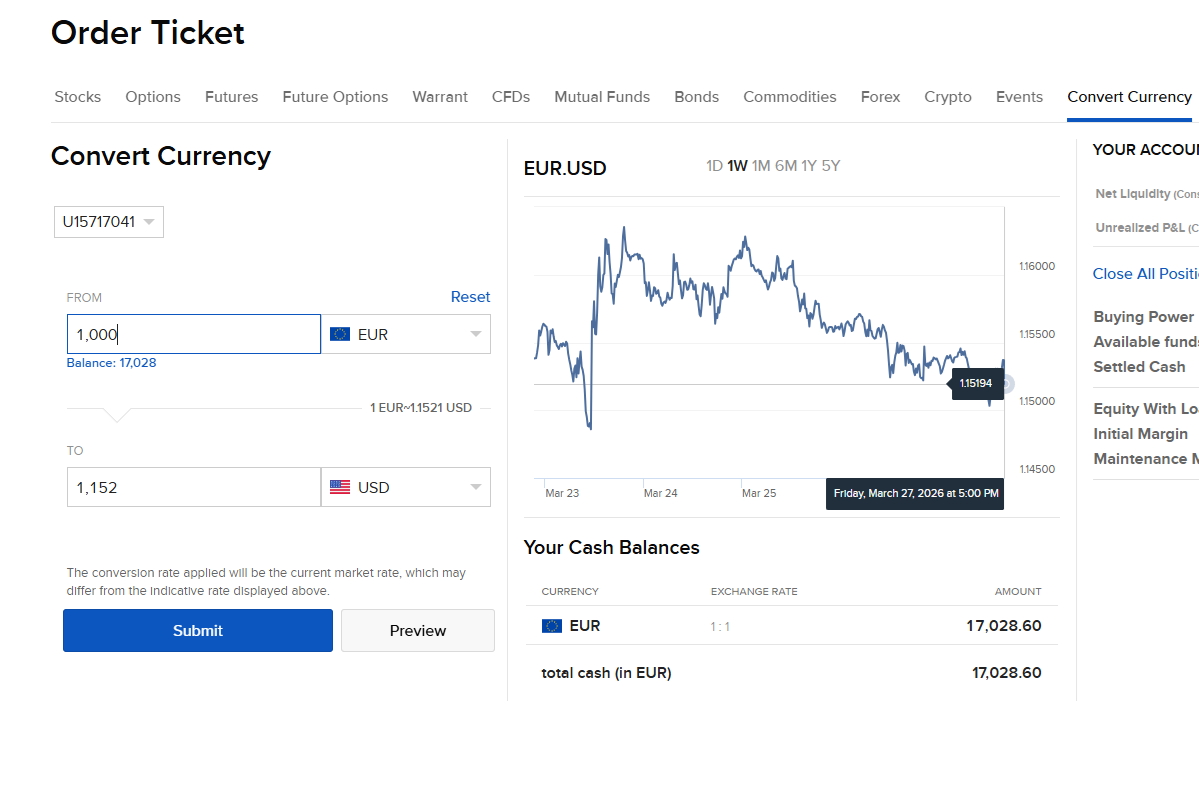
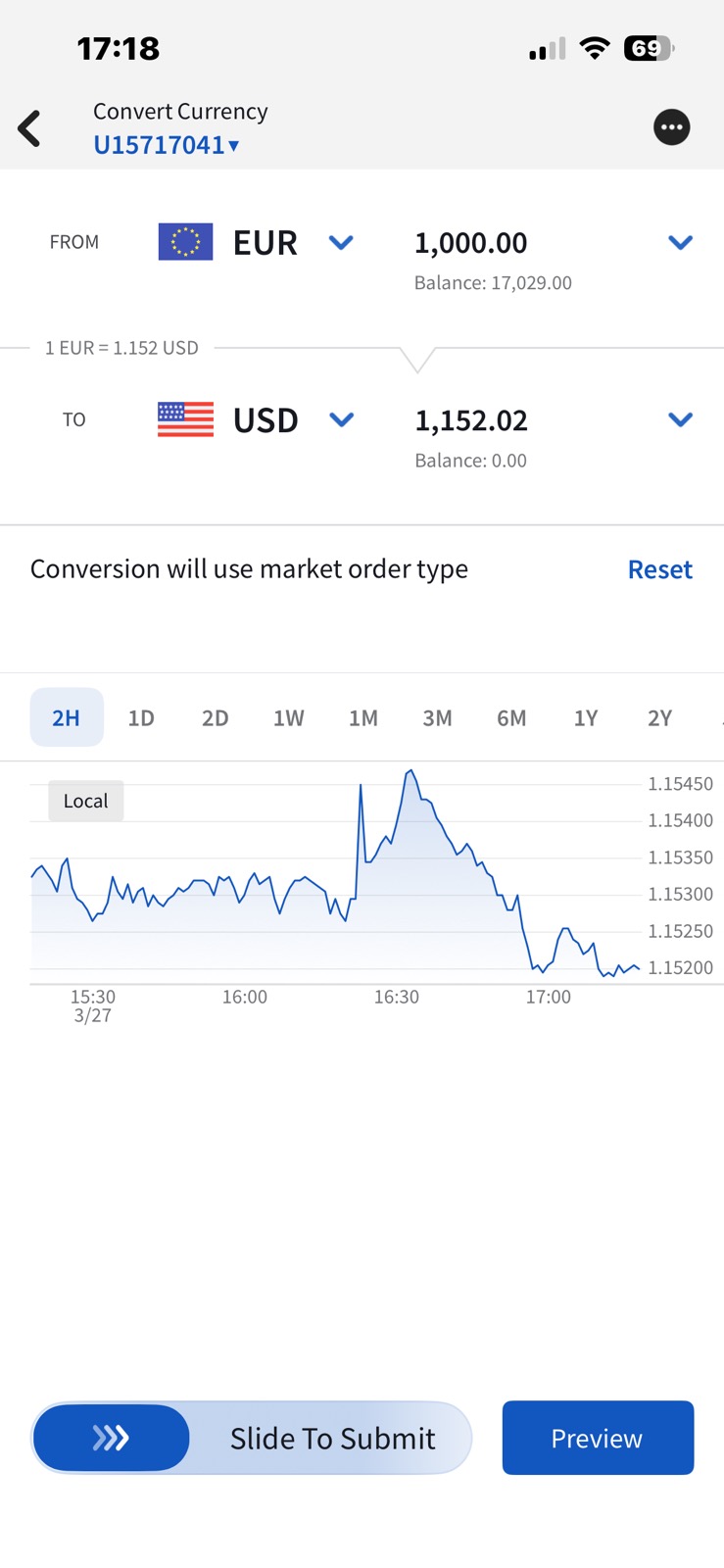
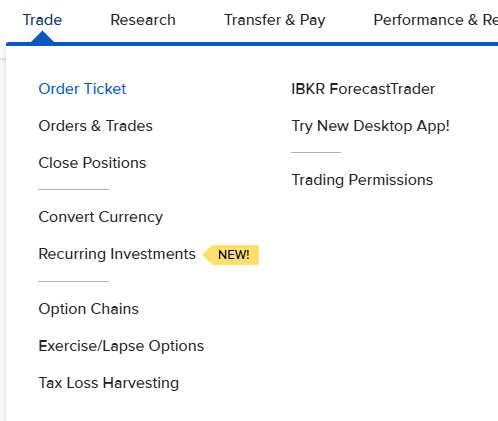
I use IBKR for my own US stock purchases. The currency conversion process is straightforward: two clicks to access the conversion tool from the main menu, you select your source currency (EUR), enter the amount, select USD as the target, and the screen immediately shows you the number of dollars you will receive. The whole thing takes under a minute. It is not hidden behind menus or buried in settings. Once you have done it once, you will not think twice about it.
The table tells most of the story. On a single €10,000 trade, the FX cost difference between IBKR and Trade Republic can be €50 or more. Over a year of regular investing, this compounds.
IBKR gives you the option to convert currency manually before placing a trade. You go to the currency conversion tool, convert EUR to USD at a 0.002% fee (that is 0.2 basis points, or roughly $2 on a $10,000 conversion), then use the settled USD to buy your stock. It takes an extra step, but the savings are substantial.
Degiro and Trade Republic handle FX automatically. You place the order in euros, they convert at the time of execution, and the spread is baked into the price you see. Simpler process, higher cost.
A note on euro-denominated US stocks
Some US companies have shares listed on European exchanges. Apple, for instance, trades on Xetra under the ticker APC. You buy it in euros, no currency conversion needed. But there are trade-offs: liquidity is lower, bid-ask spreads are wider, and the share price still moves with EUR/USD because the underlying business earns dollars. You avoid the explicit FX fee but take on an implicit one through wider spreads. For large-cap stocks with active European listings, this can work. For smaller US companies, the European listing may have very thin volume.
Buy US Stocks Europe: Step by Step with IBKR
Here is the actual process to buy US stocks Europe step by step, using Interactive Brokers as the example because it offers the most control.
1. Open and fund your account
Account opening takes 1-3 business days. You will need proof of identity (passport or national ID) and proof of address. IBKR’s EU entity is Interactive Brokers Ireland Limited, regulated by the Central Bank of Ireland. During the application, IBKR asks you to complete the W-8BEN form electronically. Do this. It reduces your US dividend withholding tax from 30% to 15%. More on this below.
Fund your account via bank transfer in EUR. SEPA transfers are free and typically arrive within one business day.
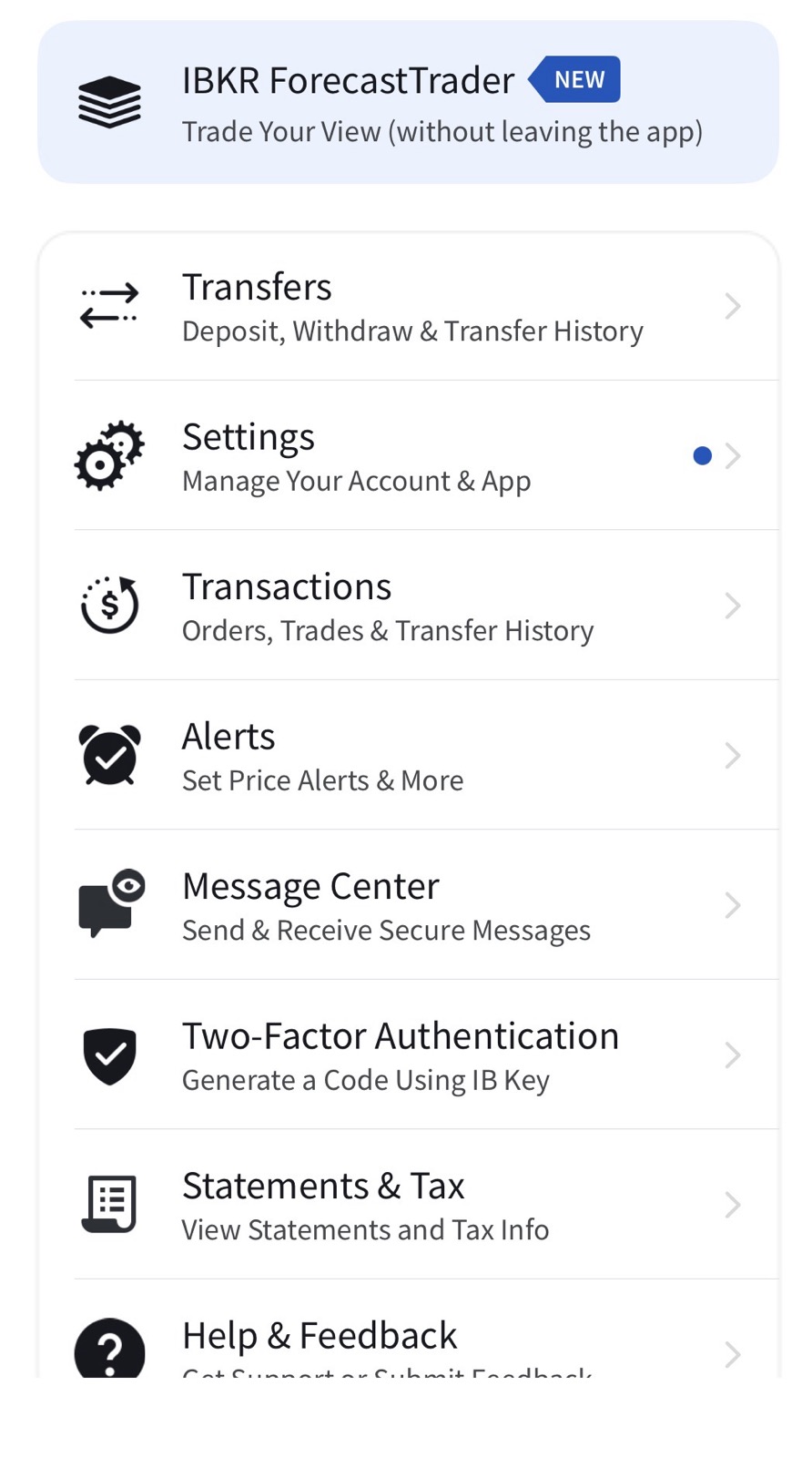
2. Convert EUR to USD
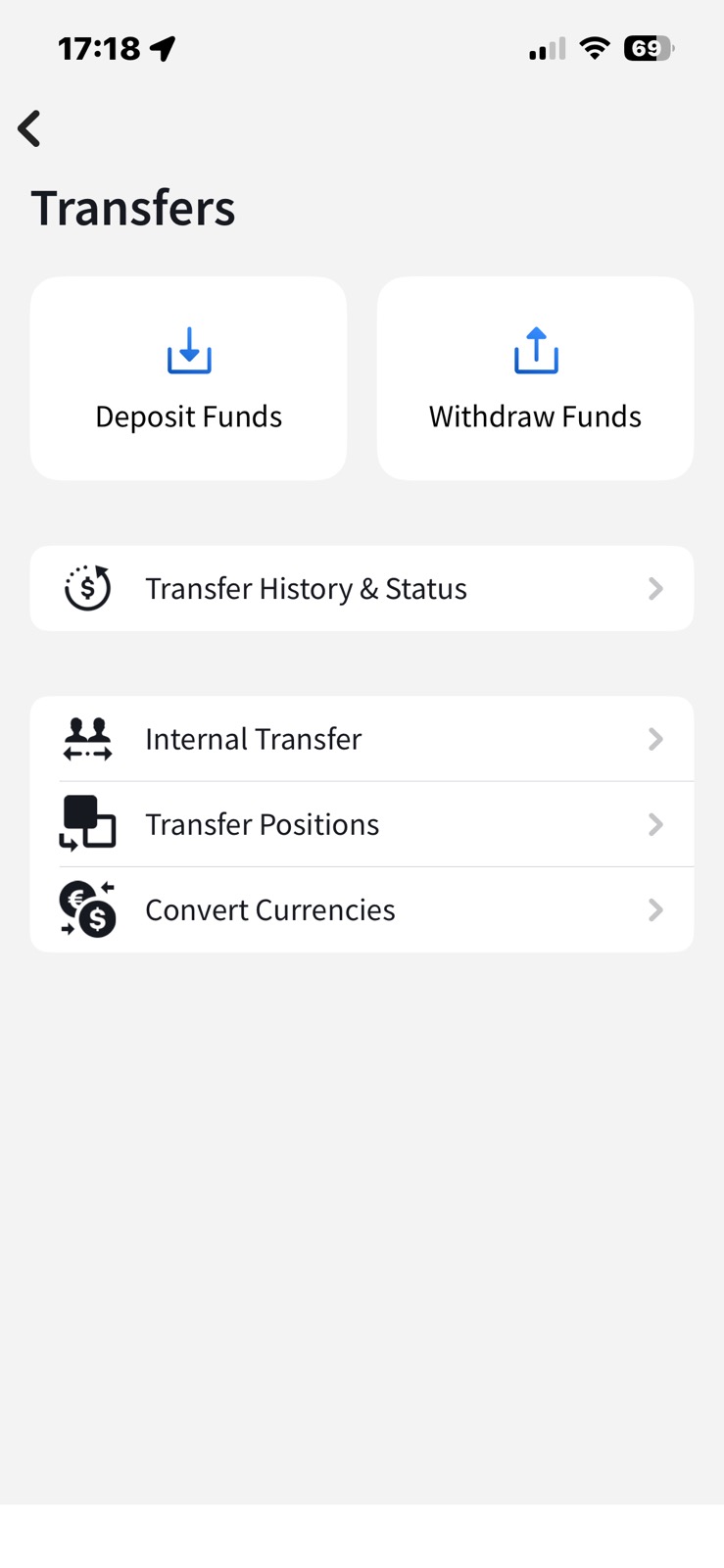
In the IBKR Client Portal, go to Transfer & Pay, then Convert Currency. Enter the amount of EUR you want to convert. IBKR shows you the live interbank rate plus the 0.002% fee. For a €10,000 conversion, the fee is approximately $2.
The converted USD settles in two business days (T+2). You can trade immediately on margin if you have a margin account, or wait for settlement if you have a cash account.
3. Place your order
Search for the stock by ticker or name. Make sure you select the US exchange (NYSE or NASDAQ), not a European listing. Choose your order type. Limit orders are generally better than market orders for US stocks during European trading hours, because you are trading during pre-market or early session when spreads can be wider.
US markets are open from 15:30 to 22:00 CET (9:30 AM to 4:00 PM Eastern). IBKR also offers extended-hours trading from 10:00 to 02:00 CET, though liquidity is lower outside regular hours.
4. Settlement
US stocks settle on T+1 (one business day after the trade). This changed from T+2 in May 2024. Your shares appear in your portfolio immediately but are not technically yours until settlement completes.
The W-8BEN Form and US Dividend Tax
If you own US stocks that pay dividends, the US government withholds tax on those payments before they reach your account. The standard rate is 30%. The W-8BEN form (Certificate of Foreign Status of Beneficial Owner for United States Tax Withholding and Reporting) allows you to claim a reduced rate under your country’s tax treaty with the US.
For most EU countries, the treaty rate is 15%. Here are the rates for the largest European markets:
| Country | Treaty Rate on Dividends | Notes |
|---|---|---|
| France | 15% | Credit claimable against French income tax (PFU or barème) |
| Germany | 15% | Credited against Kapitalertragsteuer (26.375% total with Soli) |
| Netherlands | 15% | Credited against Box 3 or Box 2 tax depending on situation |
| Ireland | 15% | Credited against Irish income tax on dividends |
| Spain | 15% | Credited against Spanish income tax |
| Italy | 15% | Credited against 26% Italian capital income tax |
| Belgium | 15% | Credited against 30% Belgian withholding tax on dividends |
| Sweden | 15% | Credited against Swedish capital income tax (30%) |
| Switzerland | 15% | Reclaimable via DA-1 form in Swiss tax return |
Without the W-8BEN, you pay 30%. With it, you pay 15%. On a $1,000 annual dividend, that is $150 in your pocket instead of $300 going to the IRS. Most brokers ask you to complete the form during account opening. If yours did not, check your account settings. The form is valid until the last day of the third calendar year after you sign it (sign in 2026, valid through 31 December 2029), then needs renewal.
One important point: the US does not tax capital gains for non-resident investors. If you buy Apple at $200 and sell at $250, the $50 profit is not taxed by the US. You owe capital gains tax only in your home country, under your local rules. This catches people off guard in the opposite direction: they worry about being taxed twice on gains, but there is no US tax on the gain at all.
The Costs That Catch People Off Guard
Trading commissions and currency conversion are the obvious costs. There are three others that deserve attention.
Dividend withholding drag
Even with the W-8BEN reducing withholding to 15%, you still lose 15% of every dividend payment upfront. Most EU countries let you claim this as a credit against your domestic tax bill, so it is not a net loss if your local tax rate on dividends exceeds 15%. But if your country’s rate is exactly 15%, you break even. If it is lower (rare for dividends), you may not recover the full amount. Check your specific situation.
Currency risk
When you hold US stocks as a euro-based investor, you are exposed to EUR/USD fluctuations. If the dollar weakens 10% against the euro, your US stock portfolio loses 10% in euro terms, even if the stock prices are flat. This works both ways: a strengthening dollar boosts your returns. Over long periods (10+ years), currency movements tend to partially wash out, but over shorter periods they can materially affect your returns. Some investors accept this as part of global diversification. Others prefer to concentrate on European stocks for their individual holdings and use UCITS ETFs (which can be hedged) for US exposure.
Estate tax risk for large portfolios
The US imposes estate tax on US-situated assets held by non-residents, including US stocks. The exemption threshold for non-residents is only $60,000 (compared to $15 million for US citizens in 2026). Above that threshold, rates start at 18% and go up to 40%. Some US tax treaties provide higher thresholds or credits. France, for example, has a treaty that effectively eliminates double estate taxation for most cases. Germany has a similar provision.
But not all EU countries have comprehensive estate tax treaties with the US. If you hold a large US stock portfolio (above $60,000), look into whether your country’s treaty covers this. For most retail investors with diversified portfolios, this is unlikely to be a problem. For concentrated positions in US stocks, it is worth researching.
Buy US Stocks Europe: Direct Shares or UCITS ETFs?
This is the real decision for most European investors. You can get US market exposure two ways, and each has advantages.
| Direct US Stocks | UCITS ETFs (US market trackers) | |
|---|---|---|
| What you get | Ownership of individual companies | Basket of hundreds or thousands of US companies |
| PRIIPs | No restriction | Must be UCITS-domiciled (Ireland, Luxembourg) |
| Dividend tax | 15% US withholding (with W-8BEN), then home country tax | 15% US withholding at fund level (Irish-domiciled), then home country tax on distribution or accumulation |
| Currency conversion | You handle it (or broker auto-converts) | Buy in EUR on Xetra, no conversion needed |
| Estate tax risk | Yes, if portfolio exceeds $60,000 | No (UCITS fund is Irish/Luxembourg-domiciled) |
| Diversification | Concentrated (you pick stocks) | Broad (hundreds of holdings) |
| Best for | Investors with conviction in specific companies | Investors wanting broad US exposure with minimal hassle |
Irish-domiciled UCITS ETFs benefit from Ireland’s US tax treaty, which means the fund itself pays only 15% withholding on US dividends. This is the same rate you would pay directly with a W-8BEN. But the UCITS route avoids the US estate tax issue entirely, and if you buy an accumulating fund on Xetra, you never touch USD at all.
If you want to buy US stocks Europe, the practical answer for most people is this: use UCITS ETFs for broad US market exposure, and buy individual US stocks only when you have a specific thesis about a company you want to own directly. (For an example of what that looks like, see our ASML stock review.)
Frequently Asked Questions About How to Buy US Stocks Europe
Can Europeans buy US stocks?
Yes. Individual US stocks (Apple, Microsoft, Tesla, etc.) are fully accessible to European retail investors through brokers like Interactive Brokers and Degiro. The PRIIPs regulation only restricts US-domiciled ETFs and funds, not individual stocks.
Can I buy US ETFs in Europe?
Not US-domiciled ones like SPY, VOO, or QQQ. The PRIIPs regulation blocks European retail investors from buying them because they lack a Key Information Document (KID). Instead, buy the UCITS equivalent: CSPX or SXR8 for S&P 500, EQQQ for NASDAQ-100. Same index, different legal wrapper.
Do I pay tax twice on US stock dividends?
Not if you claim the credit. The US withholds 15% (with W-8BEN). Your home country then taxes the dividend income under its own rules but typically gives you a credit for the US tax already paid. The result is you pay the higher of the two rates, not both stacked. Check your specific country’s rules.
What happens if I do not file a W-8BEN?
The US withholds 30% of every dividend payment instead of 15%. On $1,000 in annual dividends, that costs you an extra $150. Most brokers prompt you to complete this form during account setup. If you missed it, update it in your account tax settings.
Is it cheaper to buy Apple on Xetra in euros or on NASDAQ in dollars?
It depends on your broker’s FX fee. On IBKR, buying on NASDAQ after a manual currency conversion costs about 0.002% in FX fees. On Degiro, the auto-FX charge of 0.25% applies if you buy on NASDAQ, but there is no FX charge on Xetra. However, the Xetra listing typically has wider bid-ask spreads. For large orders (above €5,000), buying on NASDAQ via IBKR is usually cheaper overall. For smaller orders on Degiro, Xetra may be the better choice to avoid FX costs.
Disclaimer: This article is for informational purposes only and does not constitute investment, tax, or legal advice. Tax rules vary by country and individual circumstances. Consult a qualified tax adviser in your country of residence before making investment decisions. Information is accurate as of the date of publication but may change.
Some links in this article are affiliate links. If you open an account through these links, The Bourse Report may receive a commission at no extra cost to you. This does not affect our editorial independence or the opinions expressed. See our full affiliate disclosure.