Tag: Iran War

  • European Defense Stocks 2026: The Rotation Inside the Drop

    European Defense Stocks 2026: The Rotation Inside the Drop

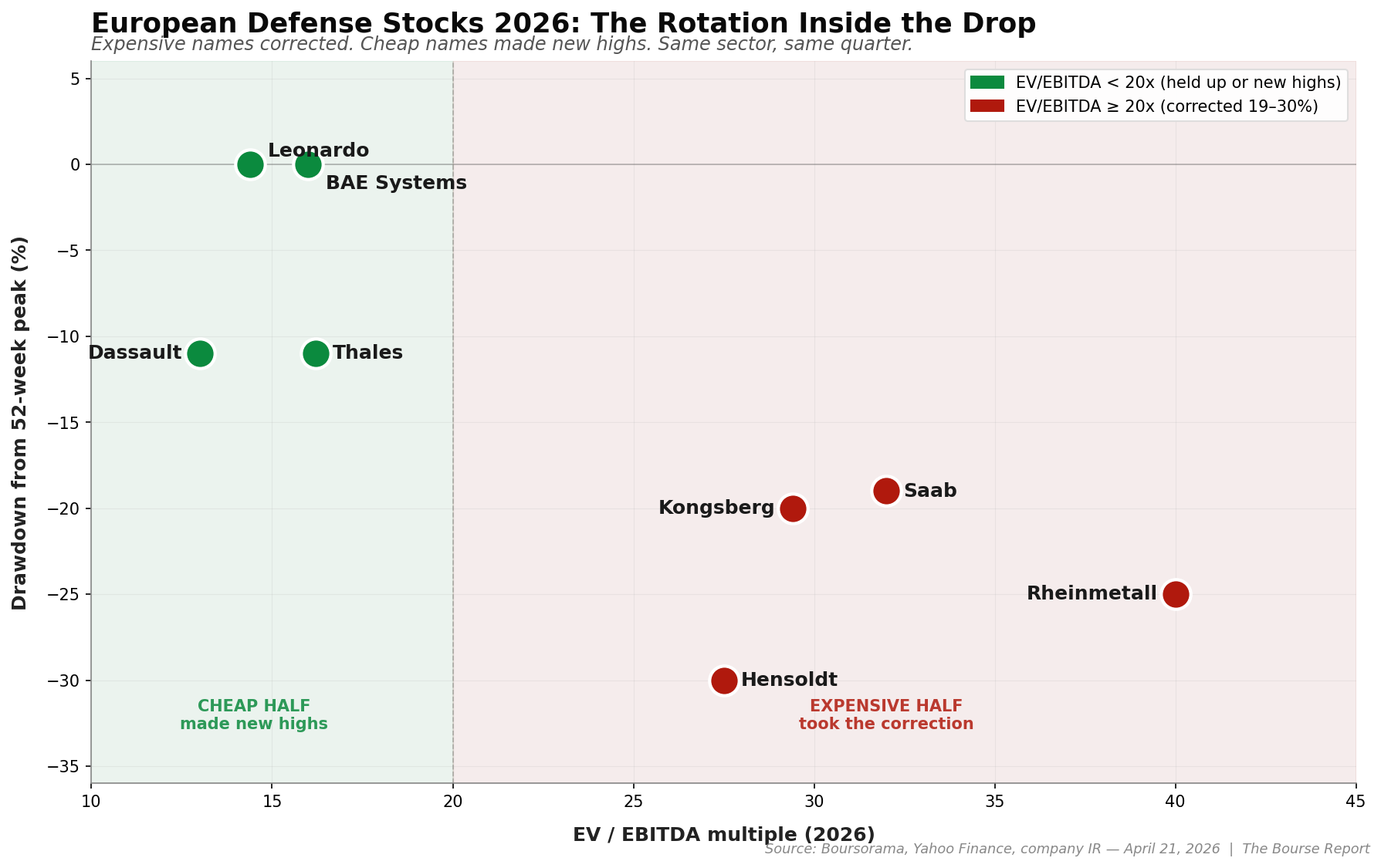
    European defense stocks 2026 broke apart into two very different groups inside the same basket. Rheinmetall traded at €2,008 on March 3. Today it trades at €1,495, a 25% fall from peak in seven weeks. Saab is down 19% from its January high. Hensoldt is 30% off its peak. Dassault and Thales are both 11% below their own recent highs.

    Over the same window, BAE Systems hit a new 52-week high and is up 31.6% year to date. Leonardo is up 30.4% and is trading near its 52-week high too. Same sector, same tailwinds, same quarter. The spread between the worst and the best performer inside the European defense basket is now close to 60 percentage points.

    The story in the press is that European defense stocks “corrected” in March. That framing is lazy. What happened is a surgical rotation. The market sold the expensive names with the biggest 2024-25 rallies, and kept buying the cheaper names with direct exposure to the parts of defense spending that are now accelerating: sensors, electronics, missiles, counter-drone systems. That dispersion, not the headline direction, is the only thing worth trading in this sector right now.

    My thesis in one sentence: the European defense trade is no longer a beta call, it is a dispersion call, and the map below tells you where the money is already moving.

    The one variable that matters: valuation dispersion

    Across European defense stocks in 2026, the cheapest name in the basket trades at 14.4x EV/EBITDA. The most expensive trades at roughly 40x. Same sector, same order book story, nearly 3x differential. That is the single number that explains the entire 2026 tape.

    Here is what the multiples look like, dated April 21, 2026:

    NameTickerFwd P/EEV/EBITDABacklog / RevYTD 2026From 52-wk peak
    LeonardoLDO.MI~27x TTM14.4x2.4x+30.4%near high
    ThalesHO.PA24.8x16.2x1.6x~flat-11%
    BAE SystemsBA.L23.5x~16x TTM3.0x+31.6%at high
    HensoldtHAG.DE42-48x25-30x3.6x+9.6%-30%
    KongsbergKOG.OL~41x29.4xn/v~-6%-20%
    SaabSAAB-B.ST46.4x30-34x2.6x~flat-19%
    RheinmetallRHM.DE36-38x~40x6.4x+20%-25%
    Dassault Av.AM.PA20.6xn/v6.3x~flat-11%

    Two things jump out of that table, and only two.

    First, the three cheapest names on EV/EBITDA (Leonardo 14.4x, Thales 16.2x, and BAE on forward P/E 23.5x) are the three names that either held up or made new highs in 2026. The three most expensive names on EV/EBITDA (Saab 30-34x, Hensoldt 25-30x, Rheinmetall ~40x) are the three names that took the biggest hits from their peaks. That is not a coincidence, and it is not a “risk-off” pattern. It is the market re-pricing how much of the structural rearmament story was already in the multiple.

    Second, the backlog-to-revenue ratios are not the differentiator. Rheinmetall (6.4x) and Dassault (6.3x) both have enormous order books, and they performed differently. Leonardo (2.4x) has a lower ratio but converted better in 2025 and rallied. The dispersion is not about visibility, it is about what investors are willing to pay for the same visibility.

    The pullback was surgical, not sector-wide

    If this were a generic sector correction, everything would have fallen together. It did not. The MSCI Europe Aerospace and Defence index fell 9.2% in March, its worst month in five years, and that number is accurate at the index level. But inside the index, the pain concentrated in three specific names, and BAE plus Leonardo ran the other way.

    Look at the peak dates. Rheinmetall topped out March 3. Saab topped out January 19. Hensoldt topped out February. In every case, the peak was set before the Iran war ceasefire on April 8 and before the Ukraine deal headlines on April 10. So the correction cannot be blamed on those events. Those events accelerated a move that had already started inside the expensive half of the basket.

    The Reuters and Invezz analysis pin the pullback on three overlapping drivers: profit-taking after a parabolic 2024-25, stretched forward multiples (sector peaked at ~29x forward P/E), and a shift in narrative around what “future defense spending” actually buys. The third driver is the one I think matters most, and it is the one that explains why the dispersion came out this way instead of the reverse.

    Demand is shifting inside defense, not adding on top

    The structural rearmament story is still in place. Every NATO member except Spain signed onto the 5% of GDP target by 2035 at the Hague summit in 2025 (3.5% core defense, 1.5% security-related). Germany’s 2026 defense budget sits at €117.2 billion with a path to €162 billion by 2029. France is at €68.5 billion in 2026 and targeting 3.5% of GDP beyond. Those numbers are not in question.

    What changed is where the money goes inside that envelope. The Ukraine war and the Iran war together delivered a lesson that European procurement chiefs now state openly: modern combat is fought with thousands of cheap drones and layered sensor networks, not dozens of expensive legacy platforms. Ukraine burns ~9,000 drones per day. Iran produces ~400 Shahed drones per day. The price per unit on those weapons runs from hundreds to a few thousand euros. That is not a narrative, it is a unit economics fact.

    Europe is responding with a specific redistribution. France committed €8.5 billion to multiplying drone and missile stocks by 400% before 2030. Germany committed €10 billion specifically to military drones. The EU launched the European Drone Defence Initiative with over €1 billion of R&D, targeted at a 360-degree counter-drone shield by 2027. Bank of America’s European defense team publicly rotated its top picks toward missile, drone, and counter-drone technology in Q1.

    Match that to the company mix. Thales makes defense electronics, radars, missile systems, and cyber. Leonardo owns MBDA through its stake in the missile joint venture, plus helicopters and electronics. Hensoldt makes radar and sensors. Saab makes Gripen fighters (platform) and A26 submarines (platform) but also missiles and electronics. Kongsberg makes strike missiles and naval systems. Rheinmetall is primarily tanks, artillery, ammunition, and vehicles. BAE is a diversified prime with heavy US exposure and strong submarine and air programs.

    The names with the highest share of sensors, electronics, missiles, and counter-drone in the mix are the ones that held up. The names most levered to tanks, artillery, and legacy platforms are the ones that corrected. The dispersion is doing exactly what the demand redistribution would predict.

    Execution risk is the under-priced problem

    The tell that the market has started to doubt the expensive names is not the share price, it is what the companies themselves are guiding.

    Rheinmetall’s full-year 2025 results printed sales of €9.9 billion, up 29%, and a record €63.8 billion order backlog, up 36%. Headline results were strong. Then management guided 2026 sales to €14-14.5 billion against analyst consensus of €15 billion. That is a 3-7% miss on the number that was supposed to justify a 40x EV/EBITDA multiple. The stock went from €2,008 to €1,495 in six weeks. That is what a miss looks like when the valuation assumes perfection.

    Hensoldt shows the same pattern in more extreme form. Q1 2026 order intake grew 62% to €4.7 billion and backlog crossed €8.8 billion, 3.6x annual revenue. Impressive. Revenue growth in the same quarter was 9.6%. Order-to-revenue conversion is running at roughly one-sixth of the order intake growth rate. At 42-48x forward P/E, the stock needs that gap to close fast. The 30% drawdown from peak says the market is not waiting.

    Saab raised its medium-term organic growth target from 18% to 22% after 2025 results. Even so, independent analysts at Seeking Alpha downgraded the stock citing a 60%+ history of missing forecasts at the company, and a 40-50x P/E multiple. When the bear case is structural (company has missed guidance repeatedly in the past) rather than cyclical, the multiple is the weak point.

    Leonardo delivered full-year 2025 revenue of €18.6 billion (+9.8%), earnings of €1.22 billion (+14%), and guided for €25 billion of new orders in 2026 against a prior €23.8 billion run-rate. Clean execution, confirmed guidance, and it trades at 14.4x EV/EBITDA. The market is rewarding it with a 30% year-to-date rally and price near 52-week highs.

    Execution gap, not geopolitics, is the variable that cracked the premium names. And execution gap is what the dispersion is re-pricing in real time.

    What could go wrong

    Three scenarios would invalidate the dispersion thesis. I list them in order of probability.

    Iran ceasefire breaks and triggers a sector-wide rally. The ceasefire expires April 22. President Trump has called extension “highly unlikely” and Iran seized a US-flagged vessel on April 19-20. The Strait of Hormuz is partially re-blockaded already. If the ceasefire fails and a shooting phase resumes, defense stocks rally together, and the dispersion compresses. The cheap names gain less than the expensive ones in a beta rip, because they started closer to fair value. In that scenario, Rheinmetall, Saab, and Hensoldt could outperform Leonardo and BAE for a few weeks. My thesis would under-perform. I would not change positioning in the first week of that rally, because a breakdown is likely to be short-lived or partial, but I would tighten stops.

    Ukraine-Russia reaches a real deal. Ukraine’s top negotiator signalled progress on April 10 and the sector dropped on that single headline. A real deal would cut the Eastern European procurement curve more than an Iran escalation would add. This is a larger risk than Iran because Ukraine is a bigger share of the European order book thesis. If a deal materializes in the next 2-4 weeks, I would expect the entire basket to repair lower, with the cheaper names (Leonardo, Thales, BAE) taking smaller losses because the re-rating room is already gone. In that scenario the dispersion thesis actually holds.

    German budget execution slips. The €117.2 billion 2026 defense budget is legal authority, not delivered revenue. If German procurement gets stuck in the Bundeswehr’s historical execution bottleneck, Rheinmetall’s guidance becomes structurally at risk, and a second guidance miss in Q2 or H1 could take the multiple from 40x to 25x. That is a 30-35% downside from here even without any geopolitical event. This is the quiet risk inside the expensive names.

    The one scenario I rule out is a sudden re-rating of the cheap names higher. Leonardo at 14.4x EV/EBITDA is already doing the work on its price. BAE at 23.5x forward P/E is fairly priced. The upside from here is earnings growth, not multiple expansion.

    My view

    I would not buy Rheinmetall here. The 25% drawdown is not the buying opportunity it looks like. It is the market taking down a multiple that was priced for zero execution risk, against a company that just missed its own 2026 guidance. I would revisit below €1,300, or after one clean quarter that proves the €14-14.5 billion guide is deliverable.

    I would not chase BAE. +31.6% year to date at a 52-week high, with a forward P/E of 23.5x, is not cheap and not expensive. If you do not already own it, wait for a 10% pullback on any headline, and buy in pieces. It is the single best-run name in the basket and its record £83.6 billion backlog covers almost three years of revenue. For readers outside France, this is the quality core of a defense allocation.

    The dispersion trade I do find interesting is long Leonardo and Thales, underweight Rheinmetall and Saab, inside a defense-sector allocation. Leonardo at 14.4x EV/EBITDA is the cheapest pure-play in the basket with the fastest-closing execution gap. Thales at 16.2x with +27% Q1 orders growth and a book-to-bill above 1.0 is the purest play on the electronics, missiles, and sensors pivot. Both are PEA-eligible for French readers.

    For a single-name thesis piece, the cleanest call right now is: wait on Rheinmetall, own Leonardo or Thales in a taxable account, and let the dispersion do the work. I would add to positions in both on any 5-8% pullback from here, and I would not touch Rheinmetall until Q2 2026 reports in late July.

    What would change my mind: a clean Rheinmetall Q2 beat that re-anchors the €14-14.5 billion guide, a German supplementary budget that adds to 2026 outlays, or a sustained Iran war escalation that pushes oil above $120 and re-rates the entire basket. Absent those catalysts, the dispersion plays out.

    A note for French readers on PEA eligibility

    For readers holding a PEA (Plan d’Épargne en Actions), one name in this basket is off-limits. BAE Systems is listed in London and post-Brexit UK stocks are no longer PEA-eligible. If you want BAE exposure, it has to sit in a CTO (compte-titres ordinaire) and you accept the flat tax on gains and dividends.

    Everything else discussed in this piece is PEA-eligible. Rheinmetall (Germany), Thales (France), Leonardo (Italy), Dassault Aviation (France), Hensoldt (Germany), Saab (Sweden), and Kongsberg (Norway, EEA with a tax treaty) all qualify under the EU/EEA rule. If you want defense exposure inside the PEA wrapper, the cheaper end of the dispersion (Leonardo, Thales, Dassault) also happens to map onto PEA-eligible names. That is a useful coincidence, not a recommendation.

    See my full PEA guide (in French) for the eligibility framework and fiscal treatment.

    Disclaimer

    This article is educational content and does not constitute financial advice, investment advice, or a solicitation to buy or sell any security. All figures are sourced from public company filings and financial press as of April 21, 2026, and prices may have moved since publication. Defense stocks carry specific geopolitical and execution risks that may be material for your personal situation. You are responsible for your own investment decisions. If you are unsure, consult a regulated financial advisor.

    Keep Reading

  • BNP Paribas at €91: Why I Hold Before the April 30 Print, and the Sanctions Tail Risk

    BNP Paribas at €91: Why I Hold Before the April 30 Print, and the Sanctions Tail Risk

    BNP Paribas closed at €91.37 on Euronext Paris in the second week of April 2026. Two months earlier, on February 27, it touched €97.35. The next morning, joint US and Israeli strikes on Iran opened an active war. What had been a geopolitical headline became the daily operating reality for any European bank with exposure to the Middle East. The stock has since settled about six percent below that high. The sell-off started the day of the strikes, not because of anything specific to BNP.

    On April 30 at 06:00 CET, BNP reports its first-quarter results. The BNP Paribas Q1 2026 print is the next hard data point for what is my largest position in a European bank, built over several years. I want to walk through three things here: what the April 30 report needs to show for the investment case to hold, where I would add or lighten my position from today’s price, and the one risk I think deserves more attention than it is getting. That risk is the collision between the 2026 expansion of US sanctions law and BNP’s own 2014 guilty plea over sanctions violations involving Sudan, Cuba, and Iran.

    What the BNP Paribas Q1 2026 report needs to show

    The only number that matters in this report is how much revenue BNP’s investment banking arm, called Corporate and Institutional Banking (CIB), generates relative to the ambitious targets management committed to reaching by 2028.

    The story behind those targets is straightforward. In September 2025, BNP’s leadership announced they were aiming for a 13% return on the bank’s equity by 2028. In plain terms, that means BNP wants to earn about €13 for every €100 of its own capital, up from roughly 10.8% in 2024. They reconfirmed that goal in February 2026 when they published their full-year results. Around the same time, the European Central Bank (the regulator that supervises large eurozone banks) approved a €1.15 billion share buyback programme. That buyback only works if the profitability targets stay on track.

    CIB is the division that has to deliver. In the first quarter of 2025, CIB brought in €5.28 billion in revenue, a record for the division. Trading and market-making activities (what BNP calls “Global Markets”) grew more than 17% year-on-year. The equity and prime services desk, which handles stock trading and lending for hedge funds, grew 42%.

    Those are the benchmarks the BNP Paribas Q1 2026 report will be measured against. If CIB revenue comes in below €5 billion with flat or declining trading activity, the 2028 target starts to look unrealistic, and the stock deserves to trade lower. If CIB matches or exceeds €5.3 billion, especially if trading revenue holds up through the war-driven volatility since late February, then the path to 2028 remains credible and the buyback is money well spent.

    The cash return to shareholders is already locked in

    BNP paid €5.16 per share in dividends for 2025, a 7.7% increase over 2024. The first half (€2.59) was paid in September 2025. The second half (€2.57) arrives on May 20, 2026. At €91.37 per share, that works out to a 5.6% yield: for every €100 invested in BNP stock today, you collect €5.60 in annual dividends.

    Add the €1.15 billion buyback, which represents roughly another 1% of the company’s market value, and total cash returned to shareholders for 2025 reaches about 6.6% at today’s price. That is a concrete number, already approved, not a projection.

    BNP’s stated policy is to distribute 60% of its profits each year: 50% as dividends, 10% as buybacks. Even a weak first quarter would not threaten next year’s dividend, because the bank’s capital cushion (its CET1 ratio, a regulatory measure of financial strength) sat comfortably above its target at the end of 2025. Management has the balance sheet to keep paying. The open question is whether profit growth accelerates that return or just sustains it.

    The next paragraph applies specifically to French-resident investors. If you are not based in France, skip to the next section.

    For investors holding BNP inside a PEA (the French tax-advantaged equity savings plan), the maths tilt further in favour of the position. Dividends received inside the PEA avoid the 12.8% income tax that applies in a standard brokerage account. Social contributions of 17.2% apply only when you withdraw, and only under certain conditions. The practical difference: the same €5.16 dividend yields 5.6% gross inside the PEA versus roughly 4.0% after tax in a standard account. Over years of compounding, that gap is not trivial. Full breakdown in the PEA guide.

    The stock is priced for things to go wrong

    At €91.37, BNP trades at approximately 0.76 times the net value of its tangible assets (think of it as paying 76 cents for every euro of hard equity the bank owns). That is below the long-run average for large European banks, below where the Italian bank Intesa Sanpaolo trades today, and well below what BNP’s own profitability would justify if the 2028 target lands.

    Here is the simplest way to think about what the stock could be worth if management delivers. At a 13% return on equity, BNP generates roughly €13 of profit per €100 of book value. If the market re-prices the stock from 0.76 times book to just 0.9 times (still conservative by historical European standards), the share price moves from €91.37 to around €108. That is an 18% capital gain, before collecting three years of 5-6% annual dividends and 1-2% annual buyback yield. The total return over the period lands in the mid-30% range without assuming anything aggressive.

    This is not a lonely view. The Boursorama consensus page tracks 19 analysts covering BNP. Their average 12-month price target sits around €101, with a high of €110 and a low of €87. Fourteen are rated as buyers, four as holds, one as a sell. The professional research community already sees roughly 10% upside over the next year. My position is not contrarian on the direction of the stock. Where I differ from the consensus is on the weight I give to the sanctions risk.

    The flip side holds too. At 0.76 times book, the market has already marked the stock down for the profitability target to miss by a meaningful margin. If management delivers even 11.5% returns instead of 13%, the stock at today’s price is close to fair value. The current price assumes mediocre execution. That asymmetry, where a miss is largely priced in but delivery is not, is the reason I did not trim when the stock hit €97 in February.

    What I worry about

    I own this stock. I also hold an honest view of what could sink it. Three things concern me, ranked by severity.

    BNP’s 2014 sanctions settlement is no longer a closed chapter. In January 2026, the law firm Holland & Knight flagged that the US Office of Foreign Assets Control (OFAC, the agency that enforces economic sanctions) doubled its statute of limitations from five years to ten. That change is now in effect. BNP’s 2014 guilty plea and the $8.9 billion settlement with the US Department of Justice covered transactions from 2004 through 2012 involving Sudan, Cuba, and Iran, including $650 million of Iran-linked payments routed through Dubai. The settlement resolved the historical exposure. It did not grant permanent immunity.

    Under the old five-year rule, almost nothing from the settlement era could be reopened. Under the new ten-year rule, any contact with sanctioned parties after the settlement, even indirect, even through a chain of intermediary banks, is legally reachable for the first time.

    Since February 28, 2026, OFAC has expanded its sanctions list in multiple rounds, targeting entities and tankers tied to Iranian oil flows. The European Union added its own Iran-related designations in March. American Banker reported in 2026 that OFAC is explicitly prioritising enforcement against financial intermediaries and “gatekeepers.” No regulator has publicly opened a new file on BNP. That is not the point. Three things have moved in the same direction at the same time: the legal window for past violations is now twice as wide, the political pressure around Iran is the most intense in a decade, and BNP sits at the intersection of the one historical case regulators still cite and the enforcement category OFAC has said it will focus on. I have not seen these factors reflected in the analyst models I have read on BNP Paribas Q1 2026.

    This is the part that concerns me most. The Iran conflict is not a single shock that the market absorbs and moves past. It is a slow accumulation. Each new round of OFAC sanctions widens the list of counterparties every European bank has to screen against. Each vessel or shell company flagged in a transaction chain creates a fresh compliance question to trace and report.

    Each month the war continues raises the probability that a regulatory investigation lands somewhere in European banking, not necessarily on BNP, but somewhere in the sector, and that alone would be enough to reprice the entire group. Unlike the 2014 case, where the problem was historical and closed when the fine dropped, an active war generates new exposure windows in real time, while the rules are being rewritten underneath the banks. The longer the war lasts, the wider this risk becomes. Time does not heal it. Time compounds it.

    A faster ECB rate-cutting cycle compresses lending profits. BNP’s 2026 guidance assumes interest rates come down gently. If the European Central Bank cuts rates more aggressively in the second half of 2026, BNP’s retail operations in France and Belgium earn less on the spread between what they pay depositors and what they charge borrowers. The effect would shave half a percentage point to a full percentage point off the profitability trajectory and push the 2028 target out by a year. The stock would not collapse, but the recovery story would slow.

    A European recession hits the property loan book. BNP has significant exposure to commercial real estate, particularly in Germany and France. If the European economy lands harder than current consensus (which assumes 0.8 to 1.1% GDP growth in 2026), loan losses rise and the buyback gets smaller. This is not a 2026 concern yet, but a 2027 watch item.

    Where I stand

    I hold. Above €97, I lighten. Below €80, I add. Between the two, I do nothing.

    €97 is the price the stock hit the day before the Iran strikes. It assumed a calm geopolitical backdrop and a fresh profitability target with the wind behind it. If BNP returns to €97 without meaningful clarity on the sanctions risk described above, the risk-reward balance starts to tilt against holding a full position, and I would sell 10 to 15% to rotate into a name with fewer open-ended regulatory questions.

    €80 is the other boundary. At that price, BNP would trade at roughly 0.67 times its tangible book value and yield 6.4% in dividends alone. The 2028 profitability target would have to collapse to below 11% to justify that valuation. I do not think the numbers support that, and I would add at or below €80.

    Between €80 and €97, the base case is intact and I let the dividends and buyback do their work. The April 30 print is the next decision point. If CIB revenue comes in at or above €5.3 billion and trading holds up, the 2028 path is sound. If CIB comes in below €5 billion with weak trading, I hold, but I pause automatic reinvestment of the May 20 dividend until I see a second quarter of data.

    Why not Santander, Intesa, or Société Générale? I considered the peers before concentrating on BNP. Santander has a stronger growth story through its Latin American operations, but its geographic mix disqualifies it from the PEA, the French tax-advantaged wrapper that matters most for after-tax returns. Intesa Sanpaolo runs a cleaner retail franchise in Italy and posted a record €9.3 billion in net profit in 2025, with its own Q1 2026 report due on May 5. But Intesa has already repriced to about 1.4 times book value, and the valuation gap I still see in BNP no longer exists there. Société Générale is cheaper at about 0.7 times book, but that discount reflects a smaller investment banking franchise. I stayed in BNP because nothing else in European banking offers the same combination of PEA eligibility, scale, explicit capital return policy, and a credible profitability target backed by a record-setting investment bank.

    Keep Reading

    Disclaimer

    This article is personal commentary for educational purposes. It is not investment advice, not an offer to buy or sell securities, and not a recommendation tailored to your situation. European bank stocks carry specific risks: sensitivity to interest rates, changing capital requirements, credit losses, and geopolitical disruption. The ongoing Iran conflict, including the February 28, 2026 US-Israeli strikes and the intensified US sanctions enforcement posture in 2026, changes the risk profile of any bank with historical exposure to Middle East counterparties, BNP Paribas included. Past settlements do not protect against future investigations under the new ten-year statute of limitations now in force. I am a retail investor writing about my own position. Before acting on anything here, verify every number at the primary source, consider your own tax residence and risk tolerance, and speak to a regulated financial adviser if you are unsure.

    Position disclosure

    I have held BNP Paribas in my PEA for several years and accumulated the position over multiple entries. It is my largest single European bank holding. I have not added since the February 28, 2026 strikes on Iran and I have not sold any shares in 2026. I have no long or short position in Santander, Intesa Sanpaolo, Société Générale, ING, Unicredit, or any other European bank mentioned in this article. I will reinvest the May 20, 2026 dividend into the same position unless Q1 2026 materially misses the CIB run-rate discussed above.

  • TotalEnergies at €79: You Are Betting on Brent, Nothing Else

    TotalEnergies at €79: You Are Betting on Brent, Nothing Else

    The One Variable That Matters

    TotalEnergies trades at €79.42. Five weeks ago, before the US and Israel launched Operation Epic Fury against Iran on February 28, it traded around €57-60. The stock has gained 37% year-to-date. Brent crude moved from roughly $70 to $109 over the same period, after Iran closed the Strait of Hormuz and shut down about 20% of global seaborne oil trade.

    Remove the earnings models, the segment breakdowns, the peer multiples. The question is: where does Brent go from here? And that depends on a geopolitical outcome that no financial model can predict.

    The Oil Brent Explains 100% of the Added Value

    The company’s cash flow sensitivity runs at roughly $3 billion per $10/bbl move in Brent. At $109, that is $10-12 billion in additional annual cash flow compared to FY2025’s average of roughly $75/bbl. Even accounting for the 15% of production shut down in Iraq, Qatar, and offshore UAE since mid-March, the net cash flow effect is overwhelmingly positive. Management has confirmed that an $8/bbl Brent increase offsets all lost Middle East cash flow.

    The stock price reflects this arithmetic. Before the war, TotalEnergies was priced for Brent in the $70-80 range and traded at €57-60. At €79, the market is pricing Brent somewhere in the $90-100 range on a sustained basis. The analyst consensus target of €74.97 is stale; most of those targets were set before February 28.

    So the question is binary. If you believe the war keeps Brent above $100 for six months or more, TotalEnergies has room to reach €90-95. If you believe a ceasefire reopens Hormuz and sends Brent back to $70-80, the stock corrects to €55-65. That is a 15-25% drop from current levels.

    Four Scenarios, One Variable

    The usual consensus of the potential scenarios is:

    Scenario 1: Prolonged war, no escalation (Brent $110-130). The conflict grinds on for six months or more. Hormuz remains partially closed. Oil supply stays constrained. TotalEnergies benefits from elevated prices on 85% of its production while its trading desk continues to profit from dislocated Middle East cargoes (already $1B+ in trading gains from 70+ distressed shipments). Fair value: €90-95, representing 13-20% upside.

    Scenario 2: Ceasefire within three months (Brent $80-90). Diplomatic resolution reopens Hormuz. Oil prices retreat but stay above pre-war levels because of supply chain damage and restocking. The stock gives back most of its war premium. Fair value: €65-75, representing 6-18% downside.

    Scenario 3: Rapid resolution, Hormuz fully reopens (Brent $70-80). A quick end to hostilities. Oil markets normalize. TotalEnergies returns to its pre-war valuation range, though LNG supply tightness may persist. Fair value: €55-65, representing 18-31% downside.

    Scenario 4: Escalation, $150+ oil (Brent $130-150+). The conflict widens. Physical damage to Gulf infrastructure increases. Oil spikes above $130. TotalEnergies benefits from price, but faces growing risk of asset destruction in Iraq and UAE, plus near-certain windfall taxation from the EU. At $130+ oil, the macro picture deteriorates fast: the ECB has already paused rate cuts, inflation forecasts are rising, and demand destruction in Europe and Asia becomes a real constraint. The 1970s analog is worth remembering: oil companies boomed in the first phase of the crisis and suffered in the recession that followed. Fair value: €95-110+, representing 20-39% upside, but with much higher variance and significant tail risk from both asset losses and a global economic slowdown.

    Why TotalEnergies Is Different from the Competition

    TotalEnergies separates from Shell, BP, and Equinor on several structural points.

    The integrated trading operation is a war-time moat. While Shell and BP also have trading desks, TotalEnergies has used the Hormuz disruption more aggressively than any peer. The company bought 70+ distressed Middle East oil cargoes from UAE and Oman at a discount in March alone (double the February pace), reselling into a $109+ Brent market. This generated over $1 billion in trading profit. Pure upstream players like Equinor cannot replicate this.

    The LNG portfolio gains from the disruption. Qatar’s North Field operations are shut down, removing significant LNG supply from global markets. European TTF gas prices have doubled to €50-70/MWh from pre-war levels of €30-35. TotalEnergies’ non-Qatar LNG volumes (Australia, Nigeria, US) are now selling into a supply-squeezed market. The company is the world’s third-largest LNG trader at 43.9 Mt of annual sales. This is a structural advantage that BP (smaller LNG book) and Shell (less diversified sourcing) match only partially.

    85% of production sits outside the war zone. TotalEnergies’ Middle East assets (Iraq, Qatar, UAE offshore) account for about 15% of total production and only 10% of upstream cash flow due to higher host-country taxation. The remaining 85% in Brazil, West Africa, the North Sea, and the Americas produces at full capacity into $109 Brent. Equinor, with its concentrated Norwegian exposure, benefits from high oil prices but lacks the diversification and the trading upside. BP’s balance sheet is weaker (no A+ credit rating) and its upstream portfolio less productive.

    The balance sheet can absorb a bad outcome. A+ credit rating (S&P), 1.2x debt/EBITDA, dividend breakeven at $25/bbl Brent, and over $25 billion in liquidity. A sudden drop to $70 Brent would hit the stock price, but the company can finance its operations, its capex, and its dividend at that level without touching its credit lines. The dividend at €3.40/share (4.3% yield) remains covered under every scenario except a prolonged period below $40 oil, which no one is forecasting.

    What Could Go Wrong Beyond Brent

    Two structural risks deserve mention even in a Brent-focused thesis.

    Qatar North Field delay is a real problem. The North Field East expansion was TotalEnergies’ centerpiece LNG growth story (6.25% NFE stake plus 9.375% in North Field South, roughly 3.5 Mtpa combined equity volumes at full capacity, first LNG expected late 2026). QatarEnergy has suggested infrastructure damage could take up to five years to repair. If accurate, TotalEnergies’ 70%+ LNG cash flow growth target by 2030 is in serious trouble. This is structural damage that persists regardless of where oil goes.

    Windfall tax risk is elevated. The EU imposed a windfall tax on energy companies in 2022 when oil spiked after Ukraine. With Brent at $109, the political pressure for a repeat is high. France, where TotalEnergies is headquartered, is particularly exposed to this. A 20-30% windfall surcharge could reduce 2026 earnings by $2-4 billion. This risk grows with every month that oil stays above $100.

    My View: Do Not Buy at €79

    TotalEnergies is the best European oil major. That is not the same as saying it is a buy.

    At €79, the stock has already absorbed the good news. The 37% YTD rally tracks the Brent move almost perfectly. The trading desk profits, the LNG windfall, the balance sheet strength: the market sees all of it. The current price implies Brent stays in the $90-100 range for the foreseeable future. If you buy here, you are not buying TotalEnergies the company. You are buying a continuation of the Iran war.

    Look at the four scenarios through the lens of expected value, not just direction. The prolonged war case (Brent $110-130) adds 13-20%. Both de-escalation paths subtract 6-31%. The escalation path offers 20-39% on paper but comes with windfall tax risk ($2-4B earnings hit) and physical asset destruction in Iraq, Qatar, and UAE. Only one of the four scenarios delivers clean upside from €79. That is a bad bet at any price, and it is a terrible bet at an all-time high.

    The asymmetry gets worse when you consider timing. Geopolitical outcomes are binary and sudden. A ceasefire announcement, a Hormuz reopening, a diplomatic back-channel: any of these could materialize over a weekend and send the stock to €65 by Monday. The upside scenarios, by contrast, require months of sustained conflict to play out. You are paying for time you may not get.

    My position: stay out at €79. Wait for €65-70.

    A pullback to that range (from profit-taking, partial de-escalation, or a ceasefire scare) changes the math entirely. At €65-70, you get a 4.5-5% dividend yield, a margin of safety against war resolution, and exposure to a company that remains best-in-class regardless of where oil settles. The integrated model, the LNG portfolio, the 12.6% ROCE, the A+ balance sheet: none of that disappears at a lower price. You just get it cheaper.

    For existing shareholders, holding is defensible. The dividend is rock-solid at $25/bbl breakeven, the trading operation is printing money, and the business quality speaks for itself. Selling into strength is also defensible if you want to lock in a 37% gain and re-enter lower.

    The bottom line: TotalEnergies is the right company in this sector. For more equity analysis, see our ASML stock review. €79 is the wrong price. The stock is a war premium sitting on top of a great business, and war premiums disappear faster than they build.


    Disclaimer

    This is an opinion piece, not investment advice. All analysis reflects the author’s personal views as of April 5, 2026, based on publicly available information. The situation in the Middle East is evolving rapidly and facts may have changed between writing and reading.

    The author is not a licensed financial advisor, broker, or analyst. This report does not constitute a recommendation to buy, sell, or hold any security. TotalEnergies SE (EPA: TTE) is discussed for informational and educational purposes only.

    All forward-looking statements, including Brent price scenarios, fair value estimates, and cash flow projections, are speculative and based on the author’s interpretation of company disclosures and market conditions. They carry substantial uncertainty. Geopolitical outcomes are inherently unpredictable. Past stock performance and financial results are not indicative of future returns.

    Key data sources: TotalEnergies FY2025 annual report, company investor presentations, publicly available broker research, market data as of April 5, 2026. Some figures are approximations derived from these sources.

    Disclosure: The author holds a position in TotalEnergies SE at the time of writing, having sold roughly half of his position near current prices in recent days. That sale is consistent with the view expressed in this report: the company is excellent, but the risk/reward at €79 favors taking profits rather than adding exposure. The author receives no compensation from TotalEnergies. Readers should factor this position and recent activity into their assessment of the opinions above, conduct their own due diligence, and consult a qualified financial advisor before making any investment decision. All investments carry risk, including the possible loss of principal.

    Keep Reading