
Tag: stock-review

  • BNP Paribas at €91: Why I Hold Before the April 30 Print, and the Sanctions Tail Risk

    BNP Paribas at €91: Why I Hold Before the April 30 Print, and the Sanctions Tail Risk

    BNP Paribas closed at €91.37 on Euronext Paris in the second week of April 2026. Two months earlier, on February 27, it touched €97.35. The next morning, joint US and Israeli strikes on Iran opened an active war. What had been a geopolitical headline became the daily operating reality for any European bank with exposure to the Middle East. The stock has since settled about six percent below that high. The sell-off started the day of the strikes, not because of anything specific to BNP.

    On April 30 at 06:00 CET, BNP reports its first-quarter results. The BNP Paribas Q1 2026 print is the next hard data point for what is my largest position in a European bank, built over several years. I want to walk through three things here: what the April 30 report needs to show for the investment case to hold, where I would add or lighten my position from today’s price, and the one risk I think deserves more attention than it is getting. That risk is the collision between the 2026 expansion of US sanctions law and BNP’s own 2014 guilty plea over sanctions violations involving Sudan, Cuba, and Iran.

    What the BNP Paribas Q1 2026 report needs to show

    The only number that matters in this report is how much revenue BNP’s investment banking arm, called Corporate and Institutional Banking (CIB), generates relative to the ambitious targets management committed to reaching by 2028.

    The story behind those targets is straightforward. In September 2025, BNP’s leadership announced they were aiming for a 13% return on the bank’s equity by 2028. In plain terms, that means BNP wants to earn about €13 for every €100 of its own capital, up from roughly 10.8% in 2024. They reconfirmed that goal in February 2026 when they published their full-year results. Around the same time, the European Central Bank (the regulator that supervises large eurozone banks) approved a €1.15 billion share buyback programme. That buyback only works if the profitability targets stay on track.

    CIB is the division that has to deliver. In the first quarter of 2025, CIB brought in €5.28 billion in revenue, a record for the division. Trading and market-making activities (what BNP calls “Global Markets”) grew more than 17% year-on-year. The equity and prime services desk, which handles stock trading and lending for hedge funds, grew 42%.

    Those are the benchmarks the BNP Paribas Q1 2026 report will be measured against. If CIB revenue comes in below €5 billion with flat or declining trading activity, the 2028 target starts to look unrealistic, and the stock deserves to trade lower. If CIB matches or exceeds €5.3 billion, especially if trading revenue holds up through the war-driven volatility since late February, then the path to 2028 remains credible and the buyback is money well spent.

    The cash return to shareholders is already locked in

    BNP paid €5.16 per share in dividends for 2025, a 7.7% increase over 2024. The first half (€2.59) was paid in September 2025. The second half (€2.57) arrives on May 20, 2026. At €91.37 per share, that works out to a 5.6% yield: for every €100 invested in BNP stock today, you collect €5.60 in annual dividends.

    Add the €1.15 billion buyback, which represents roughly another 1% of the company’s market value, and total cash returned to shareholders for 2025 reaches about 6.6% at today’s price. That is a concrete number, already approved, not a projection.

    BNP’s stated policy is to distribute 60% of its profits each year: 50% as dividends, 10% as buybacks. Even a weak first quarter would not threaten next year’s dividend, because the bank’s capital cushion (its CET1 ratio, a regulatory measure of financial strength) sat comfortably above its target at the end of 2025. Management has the balance sheet to keep paying. The open question is whether profit growth accelerates that return or just sustains it.

    The next paragraph applies specifically to French-resident investors. If you are not based in France, skip to the next section.

    For investors holding BNP inside a PEA (the French tax-advantaged equity savings plan), the maths tilt further in favour of the position. Dividends received inside the PEA avoid the 12.8% income tax that applies in a standard brokerage account. Social contributions of 17.2% apply only when you withdraw, and only under certain conditions. The practical difference: the same €5.16 dividend yields 5.6% gross inside the PEA versus roughly 4.0% after tax in a standard account. Over years of compounding, that gap is not trivial. Full breakdown in the PEA guide.

    The stock is priced for things to go wrong

    At €91.37, BNP trades at approximately 0.76 times the net value of its tangible assets (think of it as paying 76 cents for every euro of hard equity the bank owns). That is below the long-run average for large European banks, below where the Italian bank Intesa Sanpaolo trades today, and well below what BNP’s own profitability would justify if the 2028 target lands.

    Here is the simplest way to think about what the stock could be worth if management delivers. At a 13% return on equity, BNP generates roughly €13 of profit per €100 of book value. If the market re-prices the stock from 0.76 times book to just 0.9 times (still conservative by historical European standards), the share price moves from €91.37 to around €108. That is an 18% capital gain, before collecting three years of 5-6% annual dividends and 1-2% annual buyback yield. The total return over the period lands in the mid-30% range without assuming anything aggressive.

    This is not a lonely view. The Boursorama consensus page tracks 19 analysts covering BNP. Their average 12-month price target sits around €101, with a high of €110 and a low of €87. Fourteen are rated as buyers, four as holds, one as a sell. The professional research community already sees roughly 10% upside over the next year. My position is not contrarian on the direction of the stock. Where I differ from the consensus is on the weight I give to the sanctions risk.

    The flip side holds too. At 0.76 times book, the market has already marked the stock down for the profitability target to miss by a meaningful margin. If management delivers even 11.5% returns instead of 13%, the stock at today’s price is close to fair value. The current price assumes mediocre execution. That asymmetry, where a miss is largely priced in but delivery is not, is the reason I did not trim when the stock hit €97 in February.

    What I worry about

    I own this stock. I also hold an honest view of what could sink it. Three things concern me, ranked by severity.

    BNP’s 2014 sanctions settlement is no longer a closed chapter. In January 2026, the law firm Holland & Knight flagged that the US Office of Foreign Assets Control (OFAC, the agency that enforces economic sanctions) doubled its statute of limitations from five years to ten. That change is now in effect. BNP’s 2014 guilty plea and the $8.9 billion settlement with the US Department of Justice covered transactions from 2004 through 2012 involving Sudan, Cuba, and Iran, including $650 million of Iran-linked payments routed through Dubai. The settlement resolved the historical exposure. It did not grant permanent immunity.

    Under the old five-year rule, almost nothing from the settlement era could be reopened. Under the new ten-year rule, any contact with sanctioned parties after the settlement, even indirect, even through a chain of intermediary banks, is legally reachable for the first time.

    Since February 28, 2026, OFAC has expanded its sanctions list in multiple rounds, targeting entities and tankers tied to Iranian oil flows. The European Union added its own Iran-related designations in March. American Banker reported in 2026 that OFAC is explicitly prioritising enforcement against financial intermediaries and “gatekeepers.” No regulator has publicly opened a new file on BNP. That is not the point. Three things have moved in the same direction at the same time: the legal window for past violations is now twice as wide, the political pressure around Iran is the most intense in a decade, and BNP sits at the intersection of the one historical case regulators still cite and the enforcement category OFAC has said it will focus on. I have not seen these factors reflected in the analyst models I have read on BNP Paribas Q1 2026.

    This is the part that concerns me most. The Iran conflict is not a single shock that the market absorbs and moves past. It is a slow accumulation. Each new round of OFAC sanctions widens the list of counterparties every European bank has to screen against. Each vessel or shell company flagged in a transaction chain creates a fresh compliance question to trace and report.

    Each month the war continues raises the probability that a regulatory investigation lands somewhere in European banking, not necessarily on BNP, but somewhere in the sector, and that alone would be enough to reprice the entire group. Unlike the 2014 case, where the problem was historical and closed when the fine dropped, an active war generates new exposure windows in real time, while the rules are being rewritten underneath the banks. The longer the war lasts, the wider this risk becomes. Time does not heal it. Time compounds it.

    A faster ECB rate-cutting cycle compresses lending profits. BNP’s 2026 guidance assumes interest rates come down gently. If the European Central Bank cuts rates more aggressively in the second half of 2026, BNP’s retail operations in France and Belgium earn less on the spread between what they pay depositors and what they charge borrowers. The effect would shave half a percentage point to a full percentage point off the profitability trajectory and push the 2028 target out by a year. The stock would not collapse, but the recovery story would slow.

    A European recession hits the property loan book. BNP has significant exposure to commercial real estate, particularly in Germany and France. If the European economy lands harder than current consensus (which assumes 0.8 to 1.1% GDP growth in 2026), loan losses rise and the buyback gets smaller. This is not a 2026 concern yet, but a 2027 watch item.

    Where I stand

    I hold. Above €97, I lighten. Below €80, I add. Between the two, I do nothing.

    €97 is the price the stock hit the day before the Iran strikes. It assumed a calm geopolitical backdrop and a fresh profitability target with the wind behind it. If BNP returns to €97 without meaningful clarity on the sanctions risk described above, the risk-reward balance starts to tilt against holding a full position, and I would sell 10 to 15% to rotate into a name with fewer open-ended regulatory questions.

    €80 is the other boundary. At that price, BNP would trade at roughly 0.67 times its tangible book value and yield 6.4% in dividends alone. The 2028 profitability target would have to collapse to below 11% to justify that valuation. I do not think the numbers support that, and I would add at or below €80.

    Between €80 and €97, the base case is intact and I let the dividends and buyback do their work. The April 30 print is the next decision point. If CIB revenue comes in at or above €5.3 billion and trading holds up, the 2028 path is sound. If CIB comes in below €5 billion with weak trading, I hold, but I pause automatic reinvestment of the May 20 dividend until I see a second quarter of data.

    Why not Santander, Intesa, or Société Générale? I considered the peers before concentrating on BNP. Santander has a stronger growth story through its Latin American operations, but its geographic mix disqualifies it from the PEA, the French tax-advantaged wrapper that matters most for after-tax returns. Intesa Sanpaolo runs a cleaner retail franchise in Italy and posted a record €9.3 billion in net profit in 2025, with its own Q1 2026 report due on May 5. But Intesa has already repriced to about 1.4 times book value, and the valuation gap I still see in BNP no longer exists there. Société Générale is cheaper at about 0.7 times book, but that discount reflects a smaller investment banking franchise. I stayed in BNP because nothing else in European banking offers the same combination of PEA eligibility, scale, explicit capital return policy, and a credible profitability target backed by a record-setting investment bank.

    Keep Reading

    Disclaimer

    This article is personal commentary for educational purposes. It is not investment advice, not an offer to buy or sell securities, and not a recommendation tailored to your situation. European bank stocks carry specific risks: sensitivity to interest rates, changing capital requirements, credit losses, and geopolitical disruption. The ongoing Iran conflict, including the February 28, 2026 US-Israeli strikes and the intensified US sanctions enforcement posture in 2026, changes the risk profile of any bank with historical exposure to Middle East counterparties, BNP Paribas included. Past settlements do not protect against future investigations under the new ten-year statute of limitations now in force. I am a retail investor writing about my own position. Before acting on anything here, verify every number at the primary source, consider your own tax residence and risk tolerance, and speak to a regulated financial adviser if you are unsure.

    Position disclosure

    I have held BNP Paribas in my PEA for several years and accumulated the position over multiple entries. It is my largest single European bank holding. I have not added since the February 28, 2026 strikes on Iran and I have not sold any shares in 2026. I have no long or short position in Santander, Intesa Sanpaolo, Société Générale, ING, Unicredit, or any other European bank mentioned in this article. I will reinvest the May 20, 2026 dividend into the same position unless Q1 2026 materially misses the CIB run-rate discussed above.

  • ASML (ASML) Stock Review 2026: The Monopoly That Powers Every Advanced Chip

    ASML (ASML) Stock Review 2026: The Monopoly That Powers Every Advanced Chip

    ASML stock review 2026: ASML holds a position that is unique in global technology. It is the only company on Earth that can build the machines needed to manufacture the most advanced semiconductors. Every cutting-edge chip inside your phone, your laptop, or the servers running AI models passed through an ASML machine. That kind of monopoly is rare, and it doesn’t come cheap. At a current price around €1,200 on Euronext Amsterdam, the stock trades at a premium that demands scrutiny. I dug into the numbers, the technology, and the risks.

    Key Takeaways

    • ASML is the sole manufacturer of EUV lithography systems, the machines required for chips below 7nm. No competitor exists.
    • FY2025 revenue hit a record €32.7 billion with net income of €9.6 billion.
    • Backlog stands at €38.8 billion as of Q4 2025, with 2026 guidance of €34 to €39 billion in revenue.
    • SK Hynix placed a record $8 billion order on 24 March 2026, the largest single order in ASML’s history.
    • The stock trades at roughly 49x trailing earnings, a premium, though below its late-2024 peak multiples.
    • Key risks: China export restrictions, customer concentration, semiconductor cyclicality, and geopolitical exposure.
    • Disclosure: I hold a long position in ASML, initiated March 2026.

    Company at a Glance

    Detail ASML
    Sector Semiconductor equipment
    Headquarters Veldhoven, Netherlands
    Primary exchange Euronext Amsterdam (ASML)
    Secondary listing NASDAQ (ASML)
    ISIN NL0010273215
    Employees ~44,000 (2025)
    FY2025 revenue €32.7 billion
    Market capitalisation ~€470 billion (March 2026)
    Index membership AEX, EURO STOXX 50, STOXX Europe 600
    CEO Christophe Fouquet (since April 2024)

    What Does ASML Do?

    ASML makes lithography machines. That sounds dry until you understand what it means. Every semiconductor ever manufactured required a lithography step: projecting a circuit pattern onto a silicon wafer using light. For decades, the industry used deep ultraviolet (DUV) light at 193nm wavelength. That worked until physics said it couldn’t go smaller. To print the transistors needed for modern chips (billions of them, each smaller than a virus) the industry needed a completely different light source.

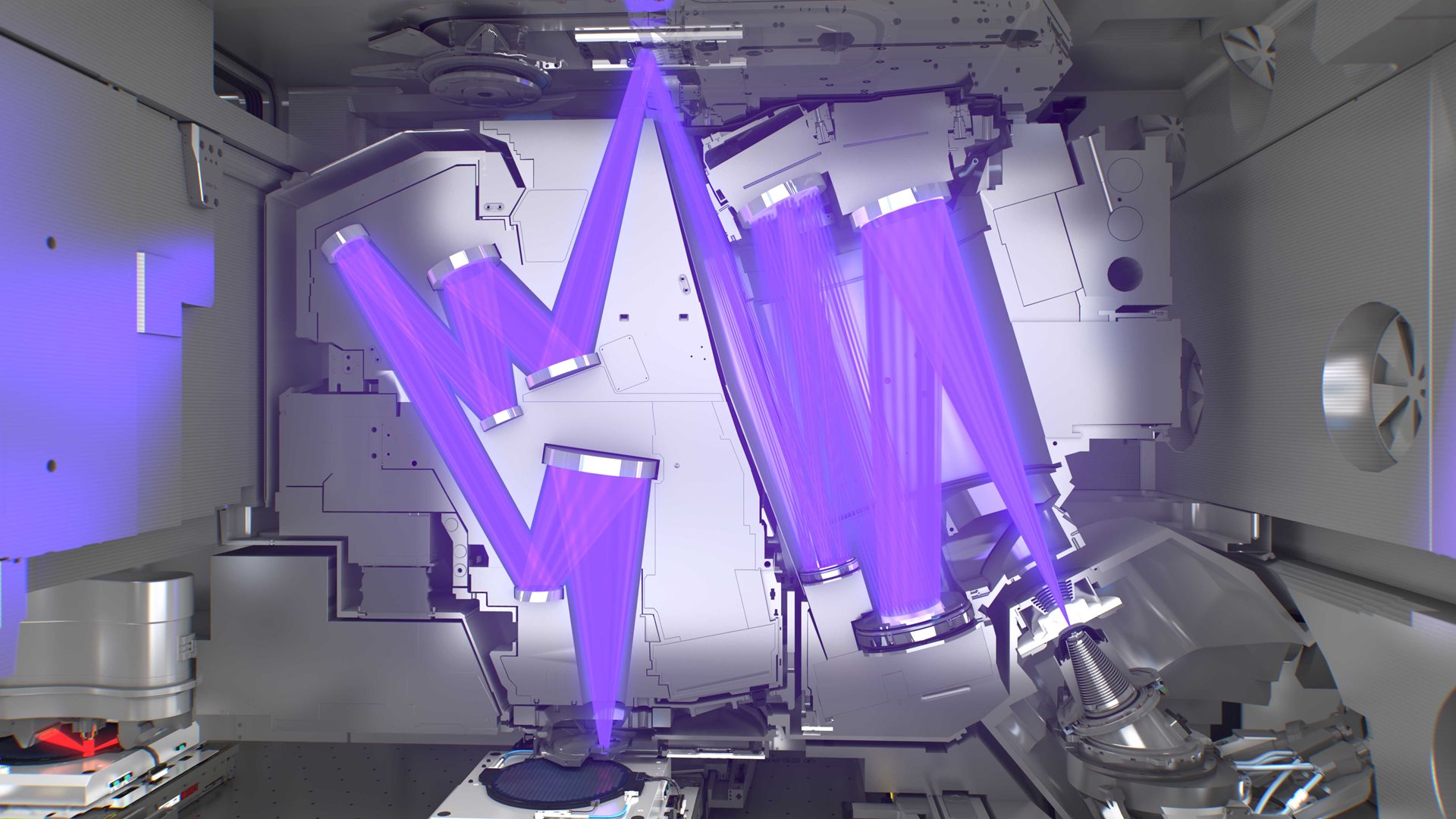
    That light source is extreme ultraviolet (EUV), with a wavelength of just 13.5nm. Getting there took ASML and its partners over 30 years. The Veritasium documentary The Machine That Saved Moore’s Law captures the absurdity of the engineering involved: you fire a high-powered laser at tiny droplets of molten tin, 50,000 times per second, each droplet hit twice: once to flatten it, once to vaporise it into a plasma that emits EUV light. That light is then bounced off a series of mirrors so perfectly smooth that if you scaled one up to the size of Germany, the largest bump would be a millimetre tall.

    Each EUV machine weighs about 180 tonnes, requires three Boeing 747s to ship, and costs upwards of €350 million. ASML recognised revenue on 48 EUV systems in 2025. Nobody else can build these machines. Intel tried to develop its own EUV capability decades ago and abandoned the effort. Nikon, once a competitor in DUV, never made the leap. ASML’s monopoly on EUV isn’t a moat. It’s an ocean.

    But ASML isn’t only EUV. The company also dominates DUV lithography (used for less advanced but still critical chip nodes), and it sells metrology and inspection systems through its Computational Lithography division. In FY2025, EUV accounted for 48% of systems revenue (€11.6 billion, up 39% year-on-year) with DUV and other products making up the rest. The installed base of lithography systems worldwide also generates recurring service and upgrade revenue. Installed base management contributed €8.2 billion in FY2025, about 25% of total sales.

    Financial Performance

    ASML’s financials over the past five years tell a story of accelerating demand for advanced chipmaking equipment, punctuated by the usual semiconductor-cycle swings.

    Metric FY2021 FY2022 FY2023 FY2024 FY2025
    Revenue (€B) 18.6 21.2 27.6 28.3 32.7
    Net income (€B) 5.9 5.6 7.8 7.6 9.6
    Net margin 31.7% 26.4% 28.3% 26.9% 29.4%
    Gross margin 52.7% 50.5% 51.3% 51.3% 52.8%
    EPS (€, basic) 14.36 14.14 19.91 19.25 24.73
    Bookings (€B) 26.2 30.7 20.0 18.9 28.0
    ASML High-NA EUV lithography system, the next generation of semiconductor manufacturing technology
    ASML’s High-NA EUV technology. Source: ASML

    A few things stand out. Revenue nearly doubled from 2021 to 2025, driven by surging demand for EUV machines. But bookings tell the more interesting story: they peaked at €30.7 billion in 2022, then fell to €20.0 billion in 2023 and €18.9 billion in 2024 as customers digested post-pandemic inventory. In October 2024, ASML accidentally leaked Q3 results showing weaker-than-expected orders. The stock dropped 16% in a single session. And then the cycle turned. Q4 2025 alone brought in €13.2 billion in new bookings, nearly double analyst expectations, and full-year 2025 bookings hit €28.0 billion. Semiconductor cycles haven’t been repealed, but AI demand is providing a powerful upswing.

    Margins are striking. ASML consistently earns gross margins above 50% and net margins near 30%. For a hardware company shipping physical machines, those are software-like numbers. That’s monopoly pricing at work: when your customers have no alternative supplier, you set the terms.

    The backlog at the end of Q4 2025 stood at €38.8 billion, providing strong visibility for the next 12 to 18 months. Management guided FY2026 revenue at €34 to €39 billion, implying continued growth at the midpoint.

    Valuation

    ASML’s valuation is the question that keeps potential investors up at night. Let’s look at the numbers without flinching.

    Metric ASML Applied Materials KLA Corp Lam Research
    P/E (trailing) ~49x ~38x ~40x ~48x
    P/E (forward) ~34x ~26x ~32x ~28x
    EV/EBITDA (fwd) ~35x ~20x ~32x ~24x

    The entire semiconductor equipment sector trades at elevated multiples right now, inflated by AI capex expectations. ASML is the most expensive of the group, but the gap is smaller than you might expect. Lam Research trades at nearly the same trailing P/E (~48x), and KLA isn’t far behind (~40x). Applied Materials is the relative bargain at ~38x trailing.

    So the question isn’t “why is ASML expensive?” but rather “does ASML deserve a premium even within an already expensive sector?” The argument for yes: ASML has a monopoly. The others don’t. Applied Materials, KLA, and Lam Research all compete with each other in etch, deposition, and inspection. ASML competes with nobody in EUV. That structural advantage, plus the recurring installed base revenue, earns it a higher multiple.

    The argument for caution: at ~49x trailing earnings, the market is pricing in years of strong growth before ASML “grows into” this valuation. Historically, ASML’s P/E has ranged from the low 20s during down-cycles to the high 50s during peak euphoria. At current levels, it sits in the upper half of that range.

    One way to think about it: if ASML hits the midpoint of its 2026 guidance (~€36.5 billion revenue) and maintains a 29% net margin, that’s roughly €10.6 billion in net income, or about €27 per share. At €1,200, that’s around 44x forward earnings. For a monopoly growing at mid-teens with decades of runway, some investors can stomach that. Others will wait for a pullback. Both positions are reasonable.

    The Bull Case

    AI capex is still accelerating

    Every major AI model (GPT-5, Gemini, Llama) needs more compute, which means more advanced chips, which means more EUV machines. ASML’s own projections estimate the semiconductor market growing from around $600 billion in 2024 to over $1 trillion by 2030. The share of advanced nodes (where EUV is indispensable) keeps rising. SK Hynix confirmed this trajectory by placing a $8 billion order on 24 March 2026, the largest in ASML’s history, specifically for high-bandwidth memory (HBM) production, the chips that go into AI accelerators.

    High-NA EUV is the next growth driver

    ASML’s next generation machine, the Twinscan EXE:5000 (High-NA EUV), is now entering production at Intel and Samsung. These machines have a higher numerical aperture, enabling even finer chip patterns. They cost around $380 million (~€350 million) each, compared to roughly $200 million for the current generation. As leading chipmakers transition to 2nm and below, High-NA adoption should drive higher average selling prices and revenue growth well into the 2030s.

    Installed base generates recurring revenue

    With over 5,500 lithography systems in operation worldwide, ASML’s service and upgrade business generates predictable revenue that smooths out cyclical swings. In FY2025, installed base management contributed €8.2 billion in revenue (up 26% year-on-year). As the EUV installed base grows, this segment should compound. Customers can’t service these machines with third-party providers because the technology is too specialised.

    Geopolitical reshoring benefits ASML

    The global push to build domestic chip capacity (the CHIPS Act in the US, the European Chips Act, Japan’s semiconductor strategy) means more fabs being built in more places. Each new fab needs lithography equipment. The European Chips Act alone targets doubling EU chip production by 2030. More fabs, more ASML machines.

    The Bear Case

    China restrictions are a real revenue headwind

    China was ASML’s second-largest market in FY2024, accounting for roughly 30% of systems revenue. US-led export controls, tightened in late 2024 and early 2025, now bar ASML from selling any EUV machines and some advanced DUV systems to Chinese customers. ASML has acknowledged that Chinese revenue will decline materially in 2026. The company managed the transition better than feared by reallocating capacity to other customers, but losing a third of your addressable market is not trivial.

    Customer concentration is extreme

    ASML’s three largest customers (TSMC, Samsung, and Intel) collectively account for the vast majority of EUV orders. If one of them delays capital expenditure (as Intel did in 2023), it ripples through ASML’s bookings. This concentration also gives these customers meaningful negotiating power. When TSMC asks for better terms, ASML has limited ability to say no.

    Semiconductor cycles haven’t been abolished

    The AI boom has made people forget that semiconductors are cyclical. The booking slump of 2023 and 2024 happened less than two years ago. If AI capex slows, whether because of a macro downturn, overbuilding, or slower-than-expected AI revenue for hyperscalers, ASML’s orders will feel it. The backlog provides a cushion, but it doesn’t make the company immune to cycles.

    Valuation leaves little room for disappointment

    At ~49x trailing earnings, the market is pricing in continued strong execution and growth. Any miss on guidance, margin compression from High-NA ramp costs, or geopolitical shock could trigger a meaningful de-rating. We saw this in October 2024 when ASML accidentally leaked Q3 results showing weaker bookings. The stock dropped 16% in a single day.

    Dividend Profile

    ASML is not a dividend stock, but it does return capital. The company proposed €7.50 per share in dividends for FY2025 (a 17% increase over FY2024’s €6.40), yielding roughly 0.6% at current prices. The payout ratio sits around 30% of net income, which is conservative and leaves room for growth.

    More significant than the dividend is the buyback programme. ASML announced a new €12 billion share repurchase programme running through December 2028. Between dividends and buybacks, the company returns a substantial portion of its free cash flow. If you’re buying ASML for income, you’re buying the wrong stock. The thesis here is growth and capital appreciation, with the dividend as a modest bonus.

    How to Buy ASML in Europe

    ASML is one of the easiest European stocks to buy. It’s listed on Euronext Amsterdam under ticker ASML and on the NASDAQ under the same ticker. As a European investor, buying on Euronext avoids currency conversion fees entirely if you hold euros.

    Broker ASML available? Exchange Approx. fee per trade (€5,000)
    Interactive Brokers Yes Euronext AMS + NASDAQ €1.25 to €3.00
    Degiro Yes Euronext AMS + NASDAQ €2.00 (Euronext core selection)
    Trade Republic Yes LSX (Lang & Schwarz) €1.00
    Scalable Capital Yes gettex / Xetra €0.99 to €3.99

    If you plan to buy and hold, I’d lean towards Interactive Brokers or Degiro for direct Euronext access. Trade Republic and Scalable Capital route through alternative exchanges (LSX, gettex), which works fine for most retail orders but may have wider spreads during volatile sessions. For a full breakdown of costs and features, see our best brokers for European investors comparison. [AFFILIATE:IBKR] [AFFILIATE:DEGIRO]

    My Take

    I have a personal affinity for companies that build the foundational technology others depend on. In every gold rush, the most reliable profits go to whoever sells the shovels. ASML doesn’t just sell shovels for the AI gold rush. It is the only company that can make them.

    What drew me to ASML wasn’t a financial ratio. It was understanding what EUV lithography involves: firing lasers at tin droplets in a vacuum, bouncing light off mirrors accurate to the width of an atom, all 50,000 times per second. The fact that this works at all, and that one company in the Netherlands figured out how to make it work reliably enough to ship dozens of machines a year, is one of the most remarkable engineering achievements in human history. When I find a company where the technology itself creates an unassailable competitive advantage, that catches my attention.

    The risk is the price. At current multiples, you’re paying for excellence, and any stumble will hurt. I initiated a position in March 2026 because I believe the AI infrastructure buildout has years left to run and ASML sits at the very centre of it. But I’m not naive about cyclicality. I sized this position knowing that a 25 to 30% drawdown in a semiconductor downturn would not surprise me.

    Disclosure: I hold a long position in ASML, initiated March 2026.

    FAQ

    Is ASML a good stock to buy in 2026?

    ASML has strong fundamentals: monopoly position in EUV, growing backlog, and exposure to the AI capex cycle. However, the stock trades at a premium valuation that prices in continued growth. Whether it’s “good” depends on your time horizon and risk tolerance. This is not investment advice. Do your own research or consult a financial advisor.

    Why is ASML the only company that makes EUV machines?

    EUV lithography required over 30 years and billions in R&D to develop, involving breakthroughs in optics, laser technology, and precision engineering. ASML built this capability through deep partnerships with Carl Zeiss (optics) and Trumpf (laser source). The technical barriers are so high that no competitor, including Nikon, has been able to replicate the technology. Starting from scratch today would take decades and tens of billions of euros.

    How do China export restrictions affect ASML?

    US-led export controls prevent ASML from selling EUV systems and some advanced DUV systems to Chinese customers. China was roughly 30% of systems revenue in FY2024, so the impact is material. ASML has been reallocating capacity to customers in other regions, but the lost China revenue is a headwind for growth.

    Can I buy ASML on Euronext in euros?

    Yes. ASML’s primary listing is on Euronext Amsterdam (ticker: ASML). Most European brokers, including Interactive Brokers, Degiro, Trade Republic, and Scalable Capital, offer access. Buying on Euronext means you trade in euros and avoid currency conversion fees.

    Does ASML pay a dividend?

    Yes. ASML proposed €7.50 per share for FY2025, yielding approximately 0.6% at current prices. The dividend has grown consistently over the past decade, though the yield remains modest. ASML also returns capital through share buybacks.

    Methodology

    This stock review is based on ASML’s publicly filed annual reports and quarterly earnings releases, regulatory filings, third-party financial data from Yahoo Finance and Morningstar, and industry analysis from SEMI. The EUV technology explanation draws on the Veritasium documentary linked above. Valuation peer comparisons use trailing and forward estimates from consensus analyst data as of March 2026. All financial figures are in euros unless otherwise stated. I last verified these numbers on 25 March 2026.

    Disclaimer: This article is for informational and educational purposes only. It is not investment advice. I may hold positions in the securities discussed, and in the case of ASML, I do hold a long position initiated in March 2026. Past performance does not guarantee future results. Investing involves risk, including the possible loss of principal. Always do your own research or consult a qualified financial advisor before making investment decisions.

    Affiliate disclosure: Some links in this article are affiliate links. If you open an account through these links, The Bourse Report may receive a commission at no additional cost to you. This does not influence our editorial opinions. We recommend only brokers we’ve personally used and tested. See our editorial policy for details.

    Keep Reading